
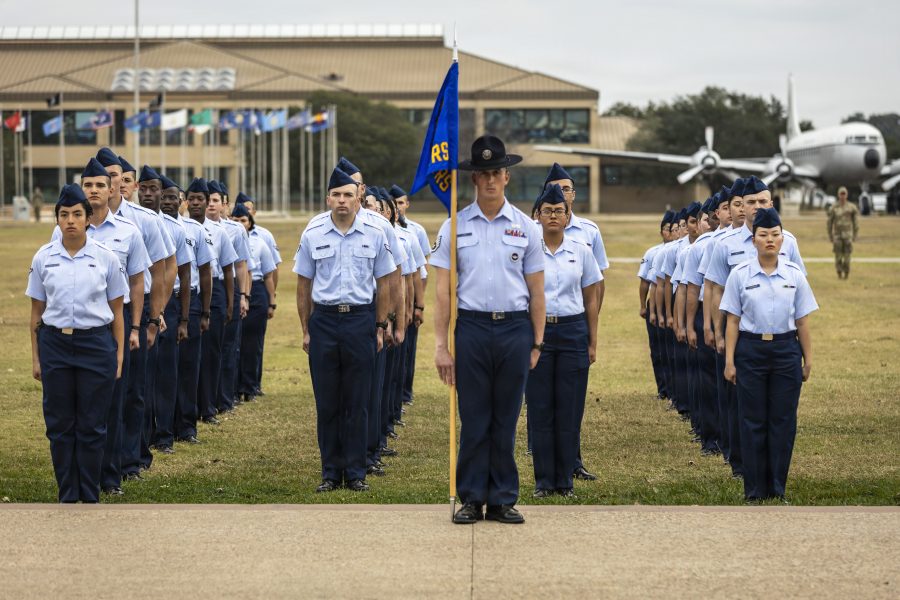
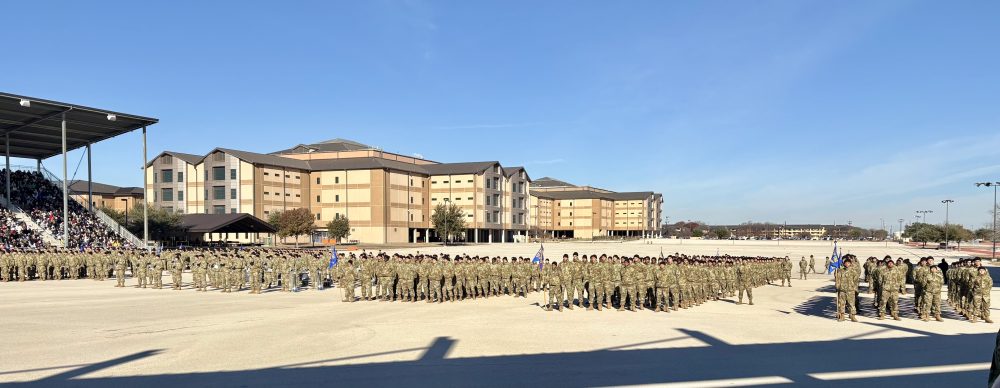
JOINT BASE SAN ANTONIO-LACKLAND, Texas—Hundreds of Air Force trainees marched between the grandstands of the Pfingston Reception Center on Jan. 28, sporting gloves and beanies to ward off an unusual Texas chill, before officially earning the tile of “Airman” and the challenge coin that goes with it.
Like tens of thousands before them, they recited the Airman’s Creed, then stood at attention, waiting for spouses, friends, even babies to “tap them out”—the touch that releases them from formation. Then they walked back to the dorms in groups of two or more to change into the uniform of the day and prepare for their impending graduation with a strict curfew still in place.
The coin ceremony remains, but these newly minted Airmen arrived at that moment from a journey unlike Airmen of the past—one designed to instill what leaders here call “airmindedness.”
“It is the Airmen trying to connect to what it means to be an Airman,” explains Chief Master Sergeant Whitfield Jack, senior enlisted leader of BMT. “The Marines know what they are: They’re riflemen. Sailors know that they’re firemen—when they’re on a ship, everyone knows how to be that fireman. But the Air Force, we’ve always struggled with it, since 1947.”
Gen. Henry “Hap” Arnold, the five-star chief of the Army Air Forces in World War II, coined the term “airmindedness” at least 80 years ago. Yet today Air Force doctrine offers no official definition. Col. Bill Ackman, commander of the 737th Training Group, which oversees BMT, says the aim is to create a mindset among Airmen that they should always aim to understand the broad context in which they operate and to apply airpower to that creatively.
The new “BMT 2.0,” which rolled out in October, seeks to imbue Airman with a greater sense of airmindedness at every step. Changes include more physical fitness training, smaller teams of trainees, a new orienteering course, and hands-on preparation for PACER FORGE, the new final field exercise designed to simulate operations at a makeshift airbase, an early introduction to the concept of Agile Combat Employment.
Yet the breakneck pace of the BMT enterprise—classes run nonstop, with new classes starting 50 weeks per year—means the rollover from one curriculum to the next comes gradually, not with the flip of a switch, Ackman told Air & Space Forces Magazine on Jan. 28.
Indeed, only within the past few weeks have officials “locked down” the final versions of the Progressive Training Events that prepare recruits for PACER FORGE.
“Up to that point, the concept was iterate quickly, refine it, and push out a new change,” he said. “And once we feel like we’ve gotten as close you can get to a 100 percent solution for how the event should be held, then we lock it down. So right now, our curriculum is good to go.”
At least for now: the next set of changes, “BMT 3.0,” launch in the spring.
Ackman and Jack continue monitoring how the changes are progressing—Ackman even has a monitor in his office showing live feeds from around the training complex—but they report positive early returns.
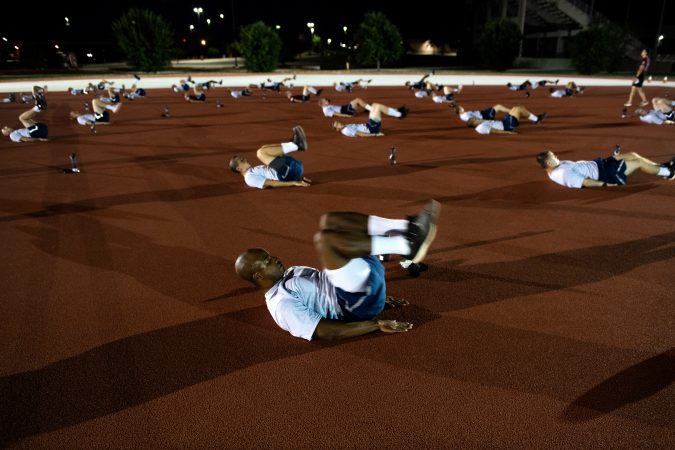
Graduates embrace the new 90-minute PT sessions, and the number who report that BMT should be more physically demanding is declining.
“Before we did BMT 2.0, we were in like the mid-, upper-70 [percent range],” Ackman said. “Every graduate said, ‘I wish it was more physical. I wish we had more PT, I wish we were outside more.’ … Now that number has come down a little bit, but it’s still in the 60s. So we’re looking for ways to make it more physical, to give them more opportunities.”
More PT is translating into fewer musculoskeletal injuries, which Ackman credits to a new hourlong “Readiness Recovery Routine” trainees perform nightly, easing muscles with foam rollers and stretching and reducing stress with “tactical breathing.”
Military Training Instructors, whose tough love defines much of BMT, are on board with the recovery routine, which raised some eyebrows when it was introduced.
“This is something that they haven’t seen coming through basic,” Ackman said. “You’ve got to make sure you explain the why to them.” Instructors pushing back with comments like “I didn’t need recovery” are frequent. But leaders press them to be open minded, and that’s working. “As the MTIs are getting more familiar with executing these new tasks,” Ackman said, “I think they’re understanding the benefit behind it. “
Trainees like the “airmindedness” programming. “Being exposed to airpower in any way is greatly appreciated,” Ackman said.
Plans call for constructing a mock airfield for trainees, complete with an F-16 fighter and two C-130 cargo aircraft, to expose them to airfield operations. But for now, trainees take a class under the wings of a C-130 at Lackland’s Inter-American Air Forces Academy, where they learn the basics of the aircraft and its subsystems.
“And then we make the analogy that, ‘Hey, this is just like the Air Force,’” Ackman said. Some “are going to be finance and you’re going to be weather and you’re going to be a loadmaster, [but regardless,] you are all interdependent in order to get airpower generated and executed.’”
Ackman said having an airplane is “huge,” noting “And so to be honest, just the proximity of aircraft is huge. I had no exposure to aircraft when I came through.”
A second training event includes a march to the parade field at Lackland and 42 aircraft that encircle it.
“Up until a few months ago, there was no interaction with that, aside from when they graduate,” Ackman said. It was just a backdrop and new graduates knew nothing about the planes.
After graduation, “parents are naturally kind of drawn to [it] … and they’ll walk over with their new Airman, and ask, ‘What plane is this?’ And the Airmen would be like, ‘I have no idea.'”
Now, however, Airmen visit the airpark, where they are sent off as small teams to collect information about the aircraft within a limited timeframe. Afterward, they debrief with their Military Training Instructor.
“It’s a zero investment cost to utilize resources that already exist here,” Ackman said.
Exposing them to aircraft makes them think, he said: “OK, what was the mission of a B-17? What’s the mission of a C-123?”
The exercise gets trainees out of the dorms, encourages them to work in small teams, and exposes them to the missions of different aircraft types. Of course, some Airmen are destined for career fields where they will have minimal exposure to aircraft, but even then the initial experience is important.
“You may go and work in a finance office for the rest of your career, but you have that touch point where you’re like, ‘I kind of understand … we all help generate airpower.”
That’s motivating.
“If I was to make broad generalizations about the generation of trainees that we get here, I think their desire to understand the why, it nests perfectly with what we’re trying to deliver,” he said. “As Airmen, you deserve to understand the why for a number of different reasons. One, you have an affinity now for the mission, but two, you can help us get to a solution in a better way.” In fact, he adds, “Maybe the generational changes are bringing folks more in line with what we were hoping to forge while they’re here at BMT.”