
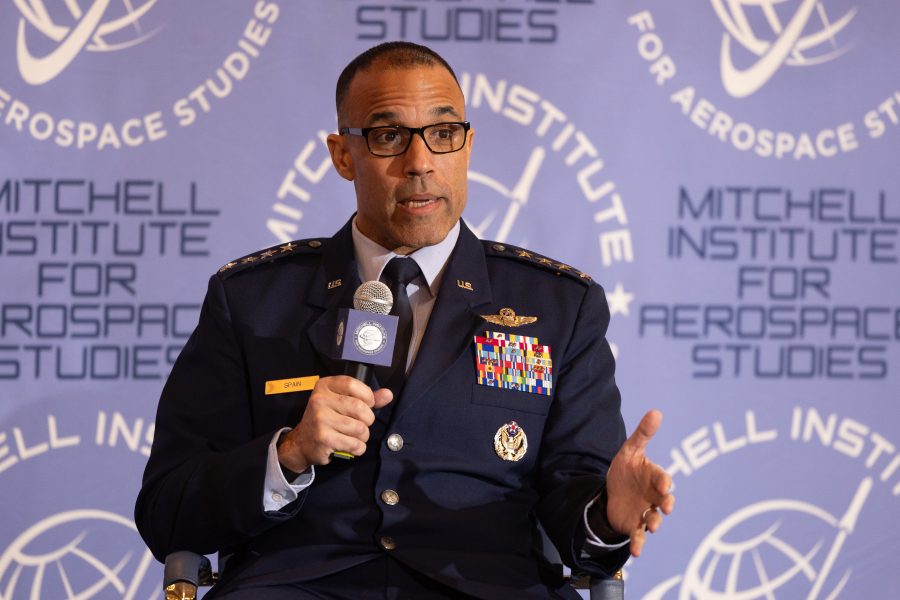
Readiness and sustainment are the clear priorities for Air Combat Command boss Gen. Adrian “Elmo” Spain, but the career fighter pilot has three other focuses too: Adapting to the strategic environment, modernizing for the future, and empowering leaders at the operational level.
“If we [have to] go fight, it’s with what we have today, and that force has to be ready,” Spain said at the Airpower Forum, a Mitchell Institute for Aerospace Studies event in Arlington, Va. “I’m unwilling to take more risk on that force. In fact, we need to grow it back.”
Spain said the results of decisions made over the past decade mortgaged future readiness to pay for near-term and modernization bills. The increased risk to the force must now be paid down, he said, to ensure today’s force is ready to fight tomorrow.
“You don’t get to bring back the readiness levels that you had [in the past] immediately,” he said. “It takes time, and it takes resources. … There’s no quick fix.”
The Air Force has steadily come down in size and modernized more slowly than envisioned, “which means that the older airplanes that we had are going to get worn out more and more often. … And even when we did modernize, we kind of took some risks in the modernization,” Spain said. “So all that is coming to a head, and there’s no shortage of awareness of the problem. There’s no shortage of energy.”
There is even a clear willingness to apply resources against the problem, he added. But that still leaves one critical ingredient: time.
“We know how to deal with the situation that we’re in, and we know the answers to get ourselves out of it,” he said. “We just have to be disciplined about sticking to that path and continue to grow our way back into a better readiness state. And I think we’ll be successful at that.”
Operations like Midnight Hammer, to destroy Iranian nuclear installations, and Absolute Resolve, to capture Venezuela’s former president Nicolás Maduro, demonstrate the Air Force’s frontline operators remain highly capable and effective. The challenge is ensuring the parts, maintainers, pilots, planes, and munitions are on hand to conduct sustained combat operations against a sophisticated foe.
“It’s our job to buy down the risk as much as possible so that we can win quickly and decisively, get out of the current fight, and deter anybody else who’s watching from starting another fight,” Spain said. “Every time we execute, every time the Air Force and the joint force gets into a scrape or a scrap or an operation, we have to be decisive and we have to be overwhelming in our efficiency and effectiveness, so that we can message to other people—[those] who may be thinking now might be a good time to [challenge the U.S.]—to change their mind about that … and to reinforce the deterrent posture that keeps us out of the fight in the first place.”
Spain said he personally watches a range of readiness metrics, from mission capability rates to aircraft availability and experience levels in squadrons. The No. 1 shortfall is spare parts, he said, but the problem is that most of those parts aren’t sitting on a shelf waiting to be paid for. They have to be ordered, manufactured, and delivered, and in some cases, the supply chain backups are complex enough that it will take years to solve.
In the meantime, however, squadron and wing commanders need to take matters into their own hands. Looking back to what Gen. William Creech accomplished as head of Tactical Air Command, which later morphed into ACC, Spain said, “we’ve actually gone back in history … to learn from his readiness rebound in the late ’70s and early ’80s.”
Creech led TAC from 1978 to 1984, a nearly unprecedented six-year stretch, driven by a commitment to reverse the mistakes in training and preparedness that he and others blamed on the failures of the Vietnam era. For Creech, the goal was to fly, review, and drill to ensure only the best tactics were employed and that pilots going into harm’s way could respond, correctly and automatically, to any challenge.
“So a lot of what we’re focusing on is really just back to basics,” Spain said. “Some of those don’t involve money. They involve behavior. They involve attention. They involve skill sets. They involve partnering. And what are we focused on inside of our wings to enable an operation to be as efficient, as effective as possible. And then, if resources come on top of that, I can take the most advantage of the resources.”
Air Force Chief of Staff Gen. Kenneth Wilsbach, who preceded Spain at ACC, witnessed those challenges and frustrations during his own tenure, and charged Airmen upon taking office as Chief “to fly and fix so we’re ready to fight and win.”
That’s where the parts shortage comes in: Years of just-in-time delivery proved efficient in peacetime but disincentivized contractors and suppliers from keeping spares on their shelves.
“We have to refill the stock of spare parts and support equipment,” Spain said. “And then we have to get more effective at getting things through depot repair lines and depot modification.”
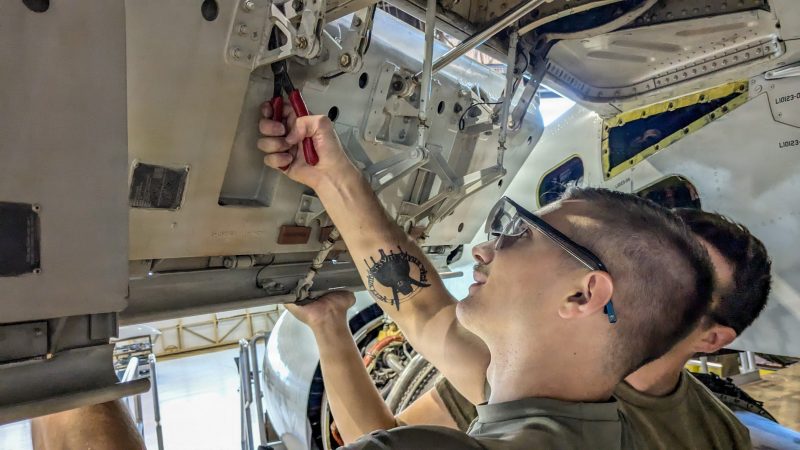
Beyond readiness, Spain said he is focusing ACC on three areas:
- Adapt to the strategic environment. Air Force operators cannot expect to operate with impunity from bases that rarely come under attack. “We have to defend them, and I have to be able to move and maneuver within contact, whether that’s from a rocket force or from a long-range fires force of some other type,” Spain said. Deployed units must also be able to execute Agile Combat Employment, a concept for dispersing to smaller, remote operating locations. “You still have to generate airpower … while things are blowing up and while people are dying all around you. You have to put the weapon on the airplane that just landed. You have to do it in three minutes, and that plane has to get back off the ground,” Spain said.
- Bring the future forward. When new capabilities are provided to Air Combat Command, Spain said, “I have to be able to catch it normally, get an operational capability very quickly. … Are the people prepared to receive it? Is the infrastructure in place to support [it] at the base?”
- Empowered leadership. “I want to push down authority to the lowest possible accountable level of expertise,” Spain said. “I don’t just want to push down authority. I want to push down authority to the right person who needs it at the right time and who can own the risk of using it. And that’s different than where we’ve been for the last 30 years. We’ve pulled a lot of that stuff up. We have to have leaders that are comfortable taking risks without looking over their shoulder. And if we want them to do that, they have to exercise that and … they’re going to make mistakes. They can’t be fired every time somebody makes a mistake.”
In each case, the objective is to make a little progress each day, Spain said.
“I would love to have two to four years of sanctuary to make all that stuff happen,” Spain said. But the reality is that change must come slowly while a host of ongoing missions continue unabated.
“We have to execute while we’re trying to get better,” he said. Resources may come sooner or they may take longer. In the meantime, it’s best to work on what you can fix in front of you. “You’re operating without a net and without a road, and we have to get better anyway,” he said. “So I’ve got 24 hours today to get a little bit better so I can be more ready tomorrow. What are you doing with your 24 hours? And if I stack those day after day after day, week after week, month after month, a year from now, we’re going to be better, resources or not.”