
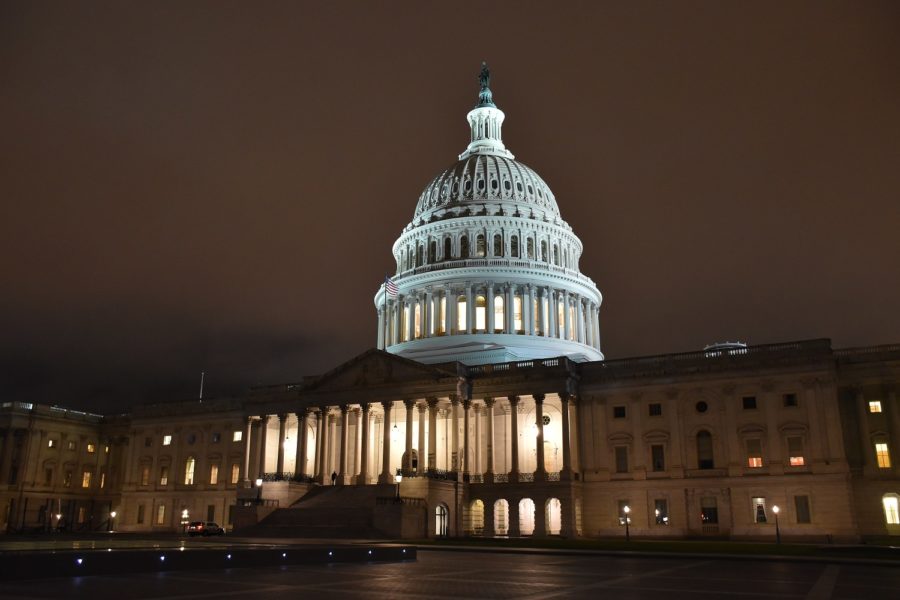
President Donald Trump signed the 2026 National Defense Authorization Act on Dec. 18, a day after Congress passed the annual defense policy bill for the 65th consecutive year.
The NDAA does not appropriate money, but its reach is wide, authorizing programs, setting policy, and directing reports, studies, research, and more, as Congress’ central means of exercising its oversight responsibilities over the Pentagon.
For the Air Force, this year’s law carries far-reaching implications. Here are some of the biggest:
Topline
While the NDAA is not a spending bill, its authorization tables define lawmakers’ priorities and set the stage for defense appropriations bill, assuming Congress passes one before the current continuing resolution ends in January.
The 2026 NDAA boosts Air Force procurement spending, authorizing $28.1 billion, an $800 million increase that authorizes a C-40 for executive airlift, a new LC-130 “Skibird” cargo aircraft, F-35A spare parts, and more Joint Strike Missiles and Joint Air-to-Surface Standoff Missiles.
Research and development spending is authorized to rise to just shy of $54 billion, with the biggest increase adding $1.2 billion to the Sentinel intercontinental ballistic missile; $647 million to keep the E-7 Wedgetail airborne early warning and control aircraft funded is also authorized, while the measure cuts future F-35 development by $214 million.
The Space Force got a major R&D boost, going from $3.9 billion to $4.4 billion. That increase comes mainly from restored funding for the Proliferated Warfighter Space Architecture’s Tranche 3 Transport Layer and the Next-Generation Overhead Persistent Infrared program’s polar segment.
Air Force operations and maintenance programs gain $290 million in spending authority for “campaigning and exercises,” with much of that focused on the Pacific. Those accounts also lost $1 billion, taken out for “unobligated balances,” the legislation says.
E-7
One of the biggest programmatic changes Congress made in the NDAA was to save the E-7, which the Pentagon had sought to cancel in its 2026 budget proposal.
Air Force plans to buy up to 26 E-7s to replace its aging E-3 AWACS aircraft were to be shelved, with the airborne battle management and targeting mission instead to be accomplished with a combination of space-based systems and a few extra Navy E-2D Hawkeyes.
The Air & Space Forces Association rallied former Air Force leaders to save the Wedgetail, arguing that space-based moving target technology is not ready and arguing the much smaller, less capable E-2D lacked the coverage and range the Air Force needs.
Lawmakers agreed, authorizing extra funds to continue Wedgetail development and including provisions barring the Air Force from terminating the E-7A prototyping contract or preparing to terminate any associated production lines.
Aircraft Retirements
Air Force aircraft divestment plans did not resonate with lawmakers, who ordered the Air Force to refrain from retiring 102 A-10 close air support jets and 21 F-15E fighters. The NDAA also extends prohibitions on retiring RQ-4 drones, B-1 bombers, and Air National Guard C-130 transports.
Still to be determined: How the Air Force pays to maintain and operate those aircraft. That funding would come in the defense appropriations bill or, if no additional funds are forthcoming, the Air Force would have to find that funding elsewhere.
Acquisition Reforms
The NDAA encompasses major changes to the Pentagon’s acquisition enterprise and the defense industrial base are that supplies it. The legislation includes elements of both the FORGED Act, championed by the Senate Armed Services Committee, and the SPEED Act, from the House Armed Services Committee.
“We’ve worked together to deliver the most significant acquisition reforms in a generation—cutting red tape, accelerating decision-making, and improving our ability to get modern capabilities into the hands of our troops on time and on budget,” the committees’ leaders said when they unveiled the final version of the NDAA on Dec. 8.
Among the changes, the bill allows the Pentagon to award larger sums for Advanced Technology Achievements, gives more authorities to the Director of Operational Test and Evaluation and the Office of Strategic Capital, permits cost-sharing with other federal agencies to foster innovation in the industrial base, and repeals previous limitations on acquisition authorities.
Personnel
The NDAA authorizes a 3.8 percent pay raise for all troops and addresses a range of benefits:
- Subsistence allowance: A new calculation for the Basic Allowance for Subsistence, resulting in slight increases;
- Family Separation Allowance: A slight increase;
- Directions to develop a “clear, accessible document” that explains how the Basic Allowance for Housing is calculated, and to study alternative ways to calculate BAH;
- Parental Leave: the NDAA eases rules governing such leave, allowing members to take it over a two-year period if operational requirements or professional military education disrupts members’ ability to take that leave.
Additional directives cover child care, including a provision to enable financial assistance when families provide in-home child care, and a second provision for increasing payments for child care in high-cost areas.