
When Chairman of the Joint Chiefs Air Force Gen. Dan Caine described the 150 aircraft used in Operation Absolute Resolve, the mission to capture Venezuelan President Nicolás Maduro, he referenced many by name, including the F-35 and F-22 fighters and B-1 bomber.
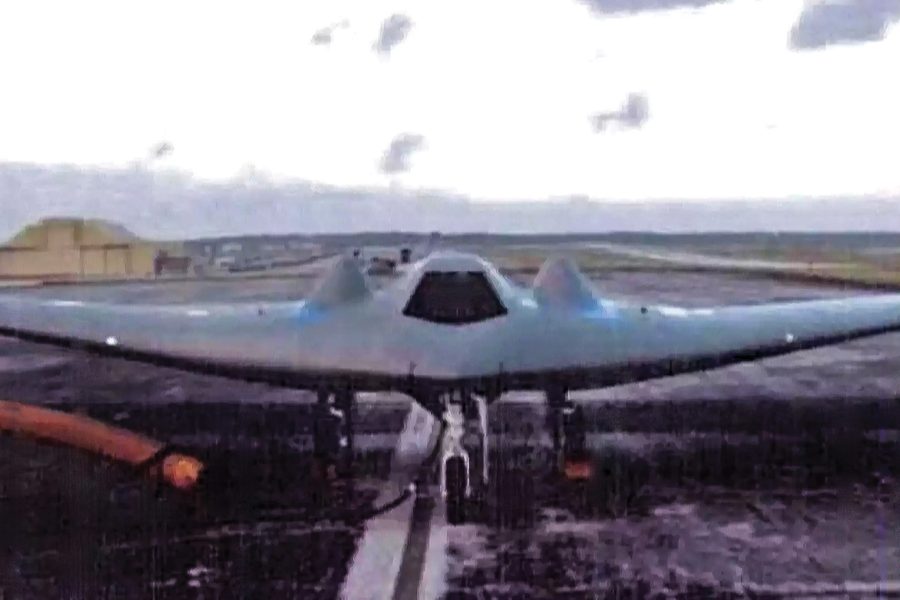
Not specified, however, were “remotely piloted drones,” among them a secretive aircraft spotted and photographed returning to Puerto Rico after the mission: the RQ-170 Sentinel, which lit up the Internet with curiosity after a local aviation enthusiast posted video of the aircraft in the early morning sky on Jan. 3.
Neither the Air Force nor U.S. Southern Command would comment on operational movements and activities, so the RQ-170’s participation in Operation Absolute Resolve remains officially unconfirmed. But experts interviewed by Air & Space Forces Magazine expressed no surprise that the unmanned aircraft had popped up near the Venezuela operation because it is well suited for a key component to the mission: stealthy intelligence, surveillance, and reconnaissance.
In Caine’s debrief, he described the “months” of intelligence work that went into preparing for the operation, using a range of assets to monitor Maduro and “understand how he moved, where he lived, where he traveled, what he ate, what he wore, what were his pets.”
Airborne intelligence in well-defended downtown Caracas required a delicate touch. The Air Force’s best-known ISR asset, the MQ-9 Reaper, lacks the stealth needed to evade Venezuela’s relatively advanced air defenses, which include Russian S300 integrated air defense systems.
“You cannot park an MQ-9 over the capital of Venezuela and expect that thing to survive,” said retired Brig. Gen. Houston Cantwell, a senior fellow at AFA’s Mitchell Institute for Aerospace Studies, who commanded the 732nd Operations Group and its RQ-170s for two years in the mid-2010s. “But an RQ-170 has a much better potential to be able to surveil when there is an integrated air defense system that is also over the same piece of sky.”
Besides simply surviving, the RQ-170’s stealth makes it harder for those being surveilled to be aware of what’s happening, noted veteran aviation reporter and aerospace analyst Bill Sweetman. “You might want to remain covert so people don’t take precautions against being observed,” he noted.
Airborne ISR complements space-based satellite ISR, Cantwell said. “You’ll see the adversary change their patterns of life, because you can’t change the revisit rate of a satellite. … and so they’ll either hide capabilities or stop doing certain kinds of activities, knowing that space is going to be there,” Cantwell said. “But when you throw in something like a 170, now there’s an uncertainty. Now you can fill in some of the gaps that exist with space and allow a capability to revisit a target in an unpredictable manner.”
Flying closer to the Earth’s surface, air-based assets also provide different angles and can collect different kinds of signals, Cantwell added, making them useful for “battle damage assessment, as well as that battlefield preparation in advance.”
In one of the few public disclosures about the RQ-170, the Air Force described an exercise at Nellis Air Force Base, Nev., in 2020 during which a Sentinel drone flew alongside many of the same platforms that would be used five years later to strike Venezuela, such as F-22s, F-35s, and Navy E/A-18 electronic warfare jets. The main objective was to test whether the F-35 could suppress enemy air defenses so platforms like the RQ-170 could penetrate contested airspace.
Shrouded in Secrecy
First spotted by reporters at Kandahar Airfield in Afghanistan in the mid-to-late 2000s, the RQ-170 has always been shrouded in mystery, with the Air Force releasing precious few details about its capabilities and movements. Sweetman, one of the journalists who first reported on the RQ-170’s existence, dubbed it the “Beast of Kandahar,” a nickname that stuck, particularly after Iran captured one in 2011.
Years later, he and others have been able to surmise a few things about the drone. “From the size of it, it looks as if you’d carry perhaps one, or at most two payloads on it,” Sweetman said. “The one that’s been seen most has been electro-optical, but I wouldn’t be surprised if you could swap that out for a radar. It’s not very big. It doesn’t have a lot of payload volume. So it’s not the sort of thing that would be a multi-sensor payload, I think. It’s certainly not new … and probably quite modest in range and altitude.”
Over the past two decades or so, RQ-170s have reportedly been spotted flying near North Korea and Iran, but Cantwell said the aircraft are far more active than most people realize.
“The RQ-170 has been used constantly in multiple combatant commands since its inception,” he said. “You just never hear about it because it is such a highly classified capability.”
The secrecy is likely less about not exposing exquisite reconnaissance technology and more about preserving its stealthiness, Cantwell said.
“Its entire existence is predicated on, ‘Hey, we have to be able to penetrate these [integrated air defense systems],” Cantwell said. “And the more information that we put out there about the capabilities of the 170, the more we jeopardize its ability to do exactly what we need it to do. So, for very good reasons, we are very hush hush about where it operates, when it operates, what are its capabilities, what are the communications systems.”
Sweetman suggested the drone’s actual ISR capabilities are similar to the MQ-9’s, though that is unconfirmed.
“I think it’s something that’s sustained and held in reserve, and that you use when you want to do a sort of Reaper reconnaissance-type thing, but you want to do it into a somewhat more contested area,” he said.
Stealthy ISR
While much remains unconfirmed or unknown about the RQ-170, it is not entirely an enigma. The Air Force has acknowledged its existence and published at least one photo of it, and in 2011 Iran was able to seize control of one flying over the Middle East, putting it on display for the world to see.
Indeed, Sweetman noted that the service has capabilities that are even more secret and high-tech. In 2014, he reported on the existence of an RQ-180 drone—something the Air Force later briefly confirmed but has since said nothing about.
In that context, he said, the RQ-170 is not so much the pinnacle of stealthy ISR but rather a gap-filler. “It fills a niche between a Reaper, which is completely non-stealth and Reapers have been shot down, and the sort of high-end capabilities, like the RQ-180,” he said.
Whether the Air Force used RQ-180s or other unacknowledged drones to support Operation Absolute Resolve may never be known, but Sweetman said he doubts it.
“You’d probably look at Venezuela and say, probably, ‘pearls too precious to wear’ in that environment, because you’re operating out of a lot of different airfields, and as we saw with that video, you do have a chance of compromise,” he said. “And I think you really wouldn’t want that. I mean, the RQ-180 is for China.”
Regardless, the Venezuela mission and the intelligence Caine referenced shows what specialized ISR can bring to the fight, Cantwell said.
“The value of stealthy ISR is so important, and it’s been demonstrated time and time again,” he said. “Whenever you have a high-value operation going on, the more intelligence you can have, both in advance and during the actual operation, the better chance you have of success. So these stealthy, penetrating ISR platforms really prove their worth during these real-world operations. It really shows that in the future, we have to continue to invest in this kind of penetrating ISR if we want to maintain that advantage in the future.”