
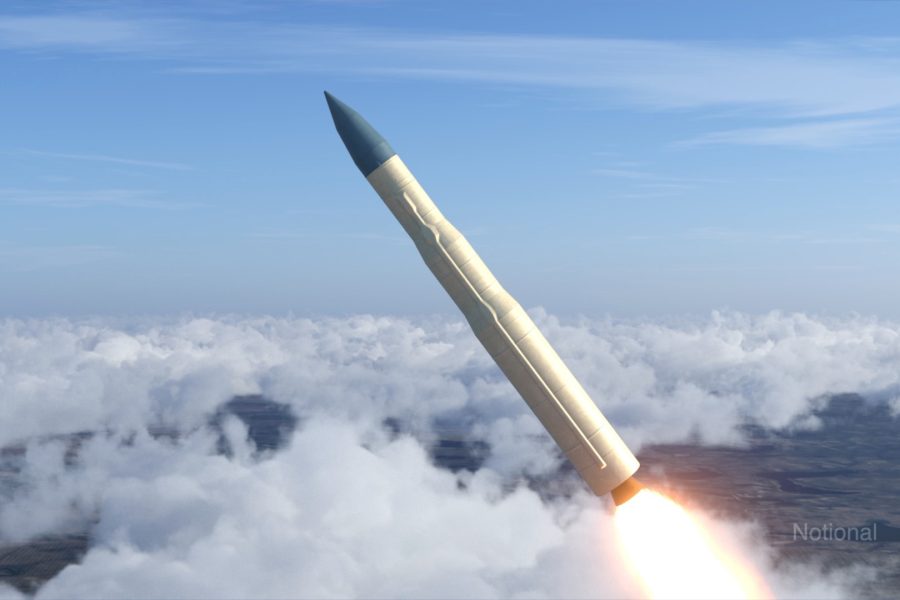
The LGM-35A Sentinel is a developmental three-stage, solid-propellant, silo-based ICBM designed to replace the Minuteman III land-based element of the nuclear deterrent “triad.” Nuclear modernization is the Defense Department’s top priority and USAF exhaustively studied further extending the 50-year-old Minuteman III before determining full replacement would be the most cost-effective investment. USAF awarded Boeing and Northrop Grumman technology maturation and risk-reduction contracts for a future Ground-Based Strategic Deterrent (GBSD) in 2017. Boeing declined to bid on full development in 2019, leaving Northrop Grumman to develop GBSD, officially designated LGM-35A Sentinel in 2022. AFGSC plans to modernize and/ or replace existing Minuteman III launch control, alert, and C2 facilities at Malmstrom, Minot, and F.E. Warren to accommodate Sentinel, targeted for IOC with nine alert missiles by 2029. Sentinel will replace 400 deployed Minuteman IIIs and 450 silos on a one-for-one basis, with the addition of 242 missiles to support developmental testing as well as reliability validation over the life of the program. The ICBM will incorporate modular design and open system architecture to ease both maintenance and future modernization. The service plans to initially deploy it with a single thermonuclear warhead aligning it to New START limits, though the ICBM’s increased performance could permit a multiple-warhead configuration. Sentinel will utilize both the Mk21 reentry vehicle and ICBM fuse already undergoing modernization for Minuteman III. AFGSC projects the LGM-35A will reach full operational capability by 2036, providing land-based strategic deterrence capability through at least 2075. Northrop Grumman completed a full-scale qualification static fire test of the LGM-35A’s first stage solid rocket motor at its static-test facility at Promontory, Utah, on March 6, 2025 , following a test of the second stage in a vacuum chamber at Arnold Engineering Development Complex, Tenn., in 2024. Required design changes to the command and launch infrastructure drove an 81 percent cost increase, triggering a DOD program review in early 2024. USAF rescinded its approval of the preliminary design and is undertaking an approximately twoyear restructuring of the program. The service also paused work on ground infrastructure and is reviewing revised options, including mobile or hybrid fixed-mobile facilities. Planned IOC will be delayed by at least two years to 2031 or beyond, though development of the LGM-35A itself is continuing. The first test launch was likewise postponed at least two years due to delays sourcing guidance components and is now targeted for 2026.
LGM-35A Sentinel Technical Data
Contractors: Northrop Grumman (prime contractor); Aerojet Rocketdyne (third-stage solid fuel rocket); Bechtel, Clark Construction (launch infrastructure); CAE (training system); Collins Aerospace (training system/C2); General Dynamics (C2, digital engineering, aerospace equipment); Honeywell (guidance and control); Textron (reentry system); Lockheed Martin (payload support); Kratos, HDT Global (transport systems).
First Flight: 2027 (planned).
Delivered: N/A.
IOC: Early 2030s (planned).
Production: 642 (planned).
Inventory: Zero.
Operator: AFGSC (planned).
Unit Location: Planned: F. E. Warren AFB, Wyo.; Malmstrom AFB, Mont.; Minot AFB, N.D.; Vandenberg SFB, Calif. (test location)
Variant: LGM-35A. Developmental Minuteman III replacement
Dimensions: Unknown