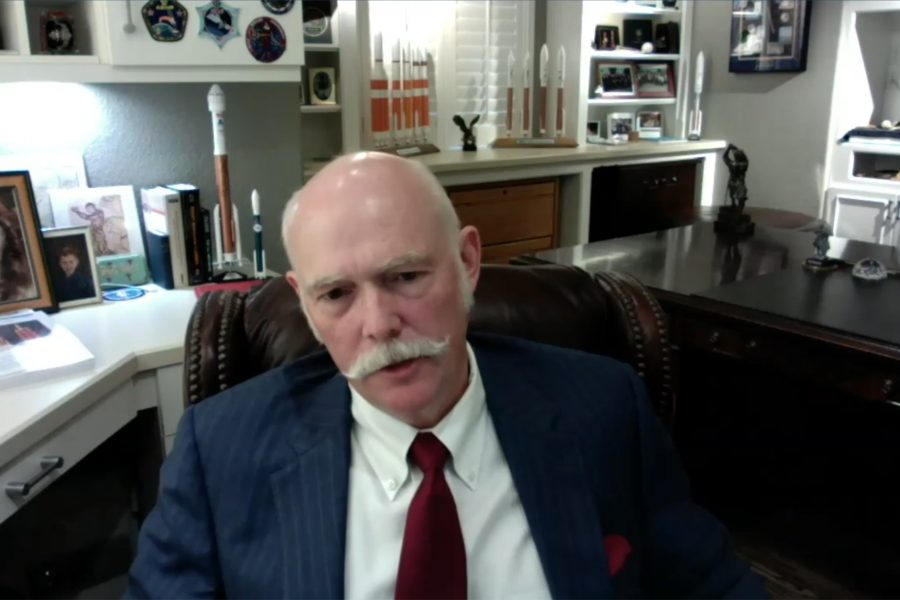
United Launch Alliance CEO Tory Bruno takes part in a virtual fireside chat with Space Force Vice Commander Lt. Gen. David Thompson during the Air Force Association's virtual Air, Space & Cyber Conference on Sept. 15, 2020. AFA video screenshot.
Watch: ULA’s Tory Bruno, Space Force’s “DT” Thompson at AFA’s vASC
Oct. 1, 2020
Share Article
Audio of this article is brought to you by the Air & Space Forces Association, honoring and supporting our Airmen, Guardians, and their families. Find out more at afa.org
Audio of this article is brought to you by the Air & Space Forces Association, honoring and supporting our Airmen, Guardians, and their families. Find out more at afa.org
The Air Force Research Laboratory is undergoing a major reorganization, consolidating 11 of its organizations into seven as part of a broader Pentagon effort to get more technology from the lab to users in the field.
Anticipating significant demand in the coming years for reconnaissance and surveillance satellites, the Space Force is increasing the ceiling value of its recently awarded Andromeda contract from $1.8 billion to more than $6.2 billion.
The Space Force plans to stand up a Mission Operations Center to manage the backbone of its hybrid commercial-government data transport constellation, the Space Data Network.
Lt. Gen. Douglas A. Schiess has been nominated by President Donald Trump to become the next Chief of Space Operations, the top uniformed leader in the U.S. Space Force.
The Space Force plans to expand the scope of its data transport constellation in the next few years, kick-starting a competition to bring on new commercial capabilities and procuring nine launches in fiscal 2027 to support the hybrid satellite communications network.
The Space Force is proposing to cancel a $3.4 billion program intended to provide missile warning and tracking coverage of the northern polar region as part of its 2027 budget request.
The Space Force’s fiscal 2027 budget request includes about $2.5 billion for commercial services like satellite communications and off-the-shelf capabilities, but officials say commercial components and technology are embedded throughout programs, making the true allocation much higher.
The Space Force has awarded 20 contracts worth up to $3.2 billion to 12 companies since last year to develop space-based interceptor capabilities, Space Systems Command announced April 24, providing new details on the firms involved and the scope of their work.
The new Space Force budget request omits funding for future tranches of the Space Development Agency’s data transport layer, teeing up a potential debate in Congress about the future of the organization and the service’s plan for managing both tactical and enterprise communication needs.
✓
Thank You!
Check your inbox to verify your email address and finish setting up your AFA account.
★
Welcome Back!
An account with this email already exists. Please log in to continue.
Subscribe to the Air & Space Forces Daily Report
The latest news from Air & Space Forces Magazine, as well as news from other leading publications, delivered right to your inbox every morning!
We’re sorry, there has been an error. Please review your input or try again later.