

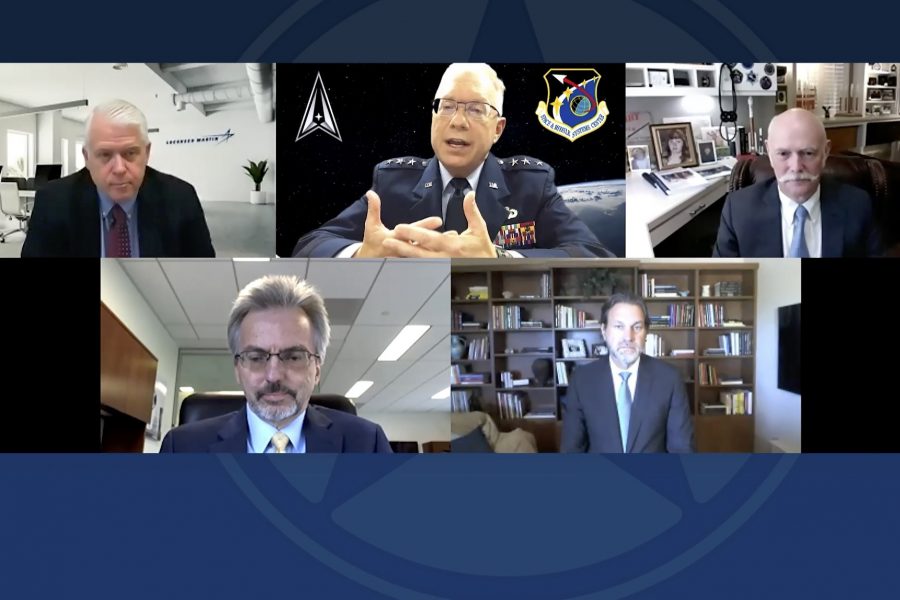
Clockwise from left, Rick Ambrose, Lt. Gen. John F. Thompson, Tory Bruno, Bruce Chesley, and Blake Larson take part in a panel about industry collaboration with the Space Force during the Air Force Association's virtual Air, Space & Cyber Conference. AFA video screenshot.
Watch: Industry Views on USSF Requirements, from AFA’s vASC 2020
Sept. 30, 2020
Share Article
Audio of this article is brought to you by the Air & Space Forces Association, honoring and supporting our Airmen, Guardians, and their families. Find out more at afa.org
Video: Air Force Association on YouTube
The “Industry Perspectives: How to Align Private Sector with Requirements of the USSF” panel held as part of the Air Force Association’s virtual Air, Space & Cyber Conference featured a discussion with Tory Bruno, Bruce Chesley, Blake Larson, and Rick Ambrose.
Audio of this article is brought to you by the Air & Space Forces Association, honoring and supporting our Airmen, Guardians, and their families. Find out more at afa.org
The Space Force is planning improvements at its launch ranges to better accommodate the logistics and infrastructure demands that come with the launch industry’s shift toward reusable rockets, according to the commanders of the service’s two launch deltas.
The Space Force’s strategy to replace its fleet of neighborhood watch satellites in geosynchronous orbit includes plans to field multiple satellite constellations, one focused on reconnaissance and one focused on surveillance that will autonomously track objects in GEO, the service said in a Nov. 26 notice.
For the last few years, through a little-known program called Kronos, the Space Force has been consolidating and modernizing its suite of legacy systems that provide operators with intelligence tools and command-and-control capabilities in an increasingly contested space environment. Now, USSF is reaching out to commercial firms to prototype and…
The Space Force has awarded initial prototype contracts to multiple firms to develop space-based interceptors designed to take down missile threats within minutes after launch.
The Space Force needs to invest more resources in cutting-edge technologies—including launch and simulation capabilities—to maintain the upper hand over China in space, according to a congressional commission tasked with tracking threats from Beijing.
U.S. Space Command has established an internal planning team, dubbed Tasked Force Voyager, to spearhead logistics for the combatant command's relocation from Colorado to Alabama.
Space Force leaders say that while they’re eager to implement the Pentagon’s newly announced acquisition transformation strategy, civilian personnel cuts and a prolonged government shutdown have depleted the acquisition and contracting workforce, adding to pressures on the cadre that could make it difficult to hit the ground running on reform.
The Space Force is moving ahead with plans to create a fourth field command focused on wringing out future capabilities, although details around timing—and the new organization's name—are still in flux.
The Pentagon recently issued new rules on cybersecurity measures that commercial satellite operators must employ if their products or services are used by U.S. intelligence agencies or military services.
Subscribe to the Air & Space Forces Daily Report
The latest news from Air & Space Forces Magazine, as well as news from other leading publications, delivered right to your inbox every morning!
We’re sorry, there has been an error. Please review your input or try again later.
