
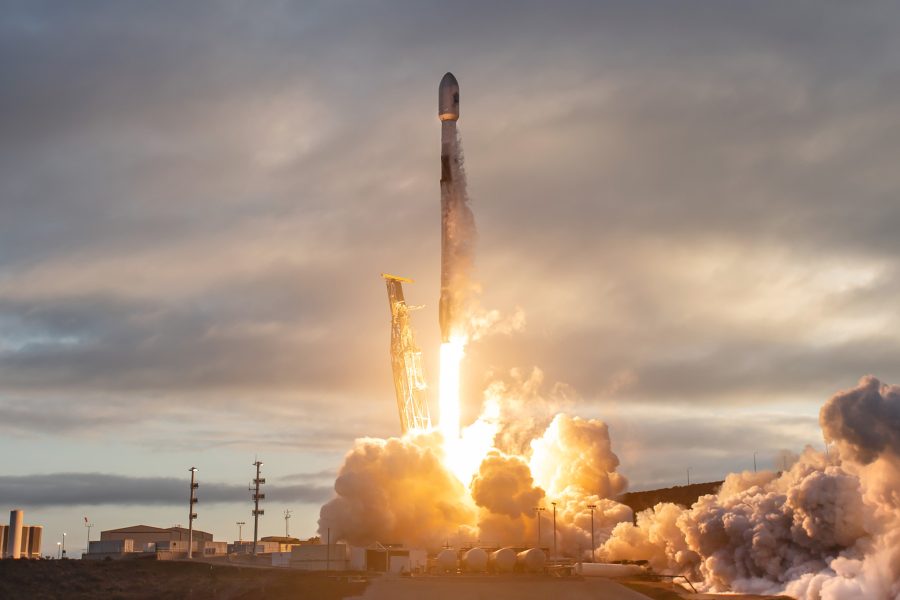
The Space Force is eyeing upgrades to launch more and bigger rockets from its western range at Vandenberg Space Force Base, Calif., in the coming years.
The range at Vandenberg has long been less busy compared to its eastern counterpart at Cape Canaveral Space Force Station, Fla., due in part to the different orbits for which each site is best suited. Both, however, have seen a surge in activity in the past few years as the space industry has grown. Vandenberg in particular supported 66 launch missions in 2025, a spokesperson told Air & Space Forces Magazine, up from 51 the prior year.
More growth is likely coming: in October, the Space Force approved a plan proposed by SpaceX to construct a new hangar at the western range that the company expects could double its launch cadence there from 50 flights per year to 100 by 2027.
Space Launch Delta 30 Commander Col. James Horne, who oversees range operations at the base, said that while the service welcomes the surge in launch activity, it has some work to do to ensure it can continue to meet that demand.
“This is exactly what we aspired to in the early 2000s when we built this commercial launch strategy that we’re seeing play out,” Horne told reporters in December at the Spacepower Conference in Orlando, Fla. “So, we created our own problem, and now we’re moving really fast to solve it from a capacity perspective.”
Vandenberg is well positioned to support projected demand over the next five or so years, Horne said, but as it looks ahead to the mid-2030s and beyond, there’s a need for more capacity. One option is to upgrade and expand the number of launch pads available to lift providers.
The Space Force has also issued contracts to expand payload processing facilities at its ranges. Last April, it awarded Astrotech Space Operations a $77 million contract to upgrade its facility at Vandenberg. In October it announced a $78 million contract to Blue Origin for a similar project at Cape Canaveral. Payload processing encompasses integration, testing, and fueling necessary to prepare a satellite for launch. High launch demand has created a bottleneck at existing facilities, service officials say.
Horne said SLD 30 is also making plans to leverage undeveloped land in the southern area of the range to build more launch facilities. He estimated the range has room for four to seven additional launch complexes, depending on the size of the rockets that utilize them.
At least one of those sites could host large rockets like SpaceX’s behemoth Starship, according to a Dec. 30 notice to industry. According to the notice, Vandenberg is considering leasing land for a new launch complex, dubbed Space Launch Complex 14, that could support heavy and super heavy rockets. Heavy-class rockets can carry between 20,000 to 50,000 kilograms to low Earth orbit, while super heavy vehicles can lift more than 50,000 kilograms.
To develop the land, the range is tapping a $1.3 billion fund provided by Congress to support a slew of launch infrastructure projects from fiscal 2024 to 2028. Horne said that funding is key, but the range will need more resources to continue its expansion efforts. The Space Force is in the midst of crafting a broader strategy, dubbed “Spaceport 2036,” that will spell out its launch infrastructure and resiliency needs over the next 10 years.
“We’re building the infrastructure to continue to unleash that capacity and then help us accommodate some of the strain we’re seeing,” he said. “We’re paying a large technical debt that we accumulated over several decades. We really haven’t significantly overhauled the launch infrastructure since the ‘60s.”