


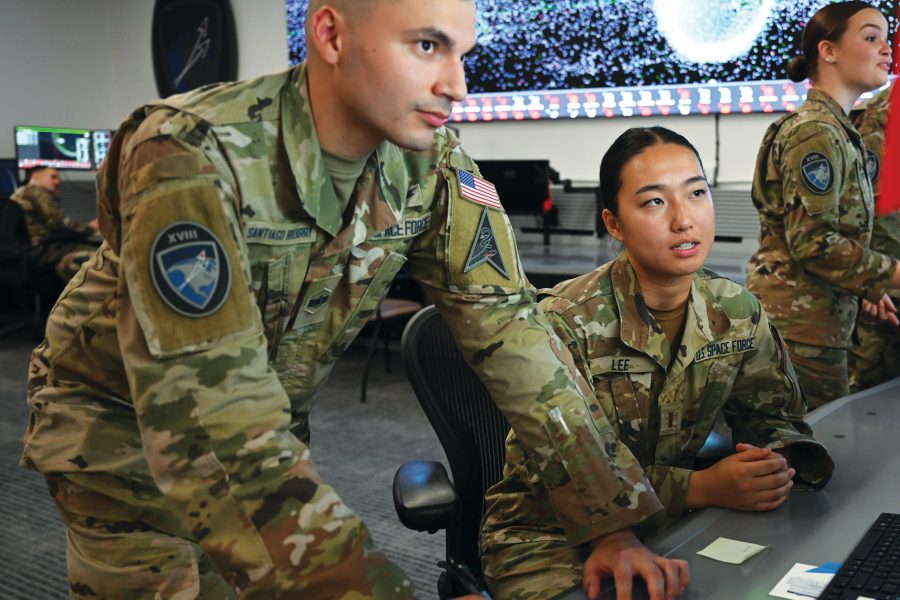
U.S. space and cyber forces were the “first movers” in this weekend’s strikes on Iran, Pentagon leaders say, helping create a path for the joint force to strike more than 1,000 targets in the campaign’s first 24 hours.
“The first movers were U.S. SPACECOM and U.S. CYBERCOM, layering nonkinetic effects, disrupting and degrading Iran’s ability to see, communicate, and respond,” Chairman of the Joint Chiefs of Staff Air Force Gen. Dan Caine told reporters in a March 2 briefing at the Pentagon. Caine later added that space and cyber effects were successful in disrupting Iran’s sensor and communications networks.
The Defense Department commenced its strike campaign against the Iranian regime, Operation Epic Fury, on Feb. 28. The attack targeted key government and military hubs, including command and control facilities, ballistic missile sites, and, most notably, a compound where Ayatollah Ali Khamenei was meeting with top advisors. U.S. and Iran officials have since confirmed Khamenei’s death.
While many of the aircraft, ships, and weapons used in major military operations have a degree of visibility, space operations and capabilities are often described as invisible—an unseen force disrupting or enabling communication, guidance and navigation, and target identification and engagement.
In a recent briefing at AFA’s Warfare Symposium before the Iranian strikes, the head of the Space Force’s Combat Forces Command, Lt. Gen. Gregory Gagnon, said space effects are as critical to any modern day military operation as flour is to baking.
“We’re baked in everything,” he said Feb. 25 in Aurora, Colo.. “If you love cookies and you love brownies, we’re actually the flour. You don’t see us, but you need us.”
The Pentagon has acknowledged space capabilities have played a critical role in recent operations, including last year’s strikes on Iran’s nuclear weapons facilities and a January mission to capture Venezuelan President Nicolas Maduro. While officials have declined to identify specific systems used, Gagnon identified three capability sets as essential to recent operations:
- the global sensor grid, comprised of ground-based telescopes and radars, which have a presence on every continent besides Antarctica
- intelligence forces
- electronic warfare assets, some based in the U.S., and others deployed around the world
Space capabilities likely played a key role in setting the stage for the operation, according to Charles Galbreath, senior resident fellow for space studies at the Mitchell Institute for Aerospace Studies. U.S. Space Forces Central, the service’s component to U.S. Central Command, probably contributed to planning efforts to make sure space effects were well integrated into the operation.
In the lead-up to Epic Fury, space operators may have worked to ensure that GPS and communication signals were strong enough to withstand jamming attempts and, conversely, attempted to deny or scramble Iran’s navigation and satellite communication systems.
“If Iran was using satellite communications, which I suspect they would, we want to be able to deny those, to confuse their command and control,” Galbreath told Air & Space Forces Magazine.
During Operation Midnight Hammer last June, when B-2s dropped bunker-busting bombs on Iranian nuclear facilities, Space Force electromagnetic warfare units helped ensure the bombers could safely engage their targets. Mission Delta 3, the operational unit responsible for EW capabilities, has several known systems at its disposal, including the Remote Modular Terminal, a small, deployable jammer developed by the Space Rapid Capabilities Office.
SPACECOM likely leaned heavily on missile warning and defense capabilities to defend against Iran’s retaliatory strikes, Galbreath said, and any targeting information yielded by those sensors would typically be integrated with key intelligence data from the National Reconnaissance Office.
“What comes to mind first is missile warning capabilities that can cue either intercept aircraft or ground-based missile defense systems or ship-based missile defense systems to support the shoot-down of those incoming attacks,” he said. “And then, if they have cyber capabilities as well, we want to make sure that we can defend our networks against their attacks.”
Galbreath described Iran’s own counterspace capabilities as “nascent,” noting that the country may have some jamming and spoofing systems.
“It’s not terribly hard to understand the frequencies that we’re operating at and develop a noise generator at those frequencies to be a brute force jammer,” he said. “Anything more sophisticated than that, I would have to question if it’s an Iranian capability or if it’s something that’s been handed to them by another country.”
Since the U.S. launched its first attacks this weekend, there have been multiple reports of GPS and Automatic Identification System interference affecting ships in the Strait of Hormuz, a vital oil trade route in the Middle East.
