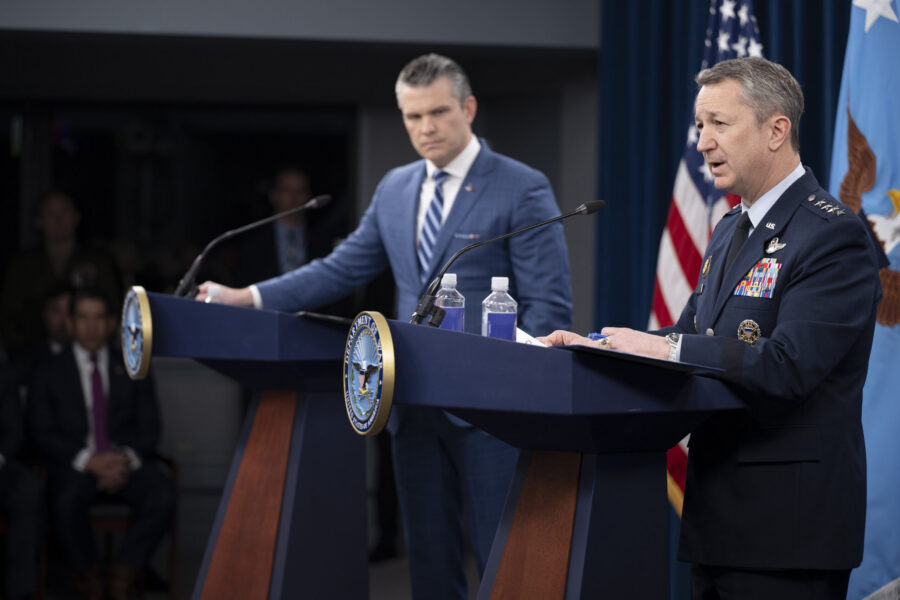
Secretary of Defense Pete Hegseth claimed “a historic military victory” after the U.S. and Iran agreed to a two-week ceasefire late April 7, even as he and Chairman of the Joint Chiefs Gen. Dan Caine said American forces will remain “ready” to resume operations should the ceasefire expire without a longer peace deal.
“Let us be clear, a ceasefire is a pause, and the joint force remains ready, if ordered or called upon, to resume combat operations with the same speed and precision as we’ve demonstrated” during Operation Epic Fury, Caine told reporters during a Pentagon briefing.
To that end, Hegseth seemed to confirm that the U.S. won’t immediately be withdrawing the massive numbers of troops, aircraft, and other assets it has positioned in Europe and the Middle East to support the conflict—the biggest collection of airpower in the region since the 2003 invasion of Iraq.
“We’re not going anywhere,” Hegseth said. “We’re going to make sure Iran complies with the ceasefire and then ultimately comes to the table and makes a deal. So, we’ll stay put, stay ready, stay vigilant. As the chairman laid out, our troops are prepared to defend, prepared to go on offense, prepared to restart at a moment’s notice with whatever target package would be needed in order to ensure that Iran complies.”
Yet much of Hegseth and Caine’s April 8 briefing had a tone of triumphant finality; Hegseth called Epic Fury “a capital V military victory”
He also said that the agreement that led to the ceasefire “means that [Iran] will never, ever possess a nuclear weapon,” and Caine said the U.S. military achieved its objectives of destroying Iran’s ballistic missile and drone capabilities, sinking its navy, and degrading its defense industrial base.
Pentagon officials have cited these objectives since the start of the campaign, and Caine reeled off a list of statistics meant to illustrate that they have been met:
- More than 13,000 targets struck
- 80 percent of Iran’s air defense systems destroyed, including 1,500 air defense targets
- More than 450 ballistic missile and 800 one-way attack drones storage facilities hit
- More than 2,000 command and control nodes hit
- More than 90 percent of the regular Iranian navy sunk
- More than 95 percent of Iranian naval mines destroyed
- Approximately 90 percent of Iran’s weapons factories attacked
- Nearly 80 percent of Iran’s nuclear industrial base hit
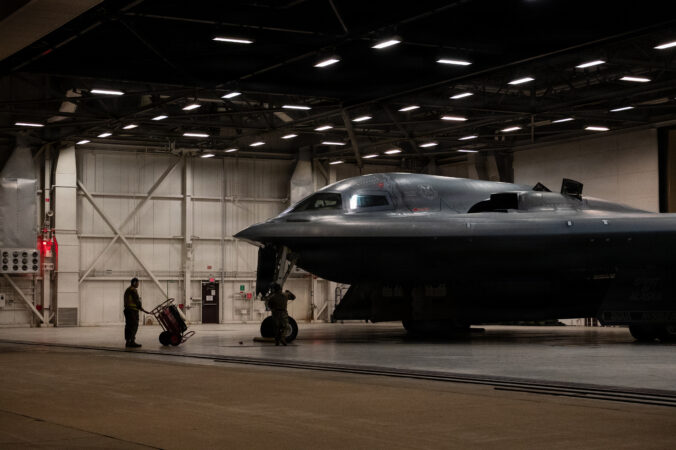
Caine also noted that the U.S. Air Force conducted 62 bomber missions as part of the operation, including 18 flown roundtrip from the continental U.S. Many of those long duration, 30-hour-plus flights involved B-2 stealth bombers taking off from Whiteman Air Force Base in Missouri.
“No other military in the world can do that. And it’s a testament to the logistical force that quietly serves behind them. I cannot thank TRANSCOM and the Air Force tanker and mobility force more,” Caine said.
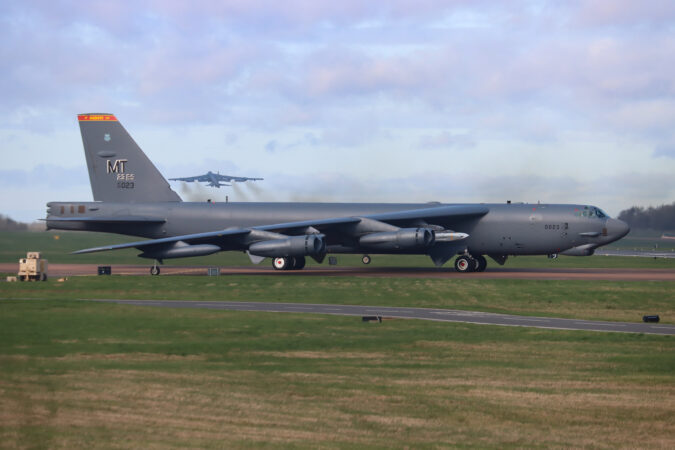
Meanwhile, nearly two dozen B-1 and B-52 bombers massed at RAF Fairford in the United Kingdom for more frequent missions that still lasted many hours.
U.S. Central Command has not detailed how many aircraft have deployed to support the operation or how many munitions have been expended. However, Air & Space Forces Magazine previously estimated—based on open-source flight tracking data, posts from local aircraft spotters and satellite imagery—that close to 300 Air Force, Navy and Marine Corps fighters took part in operations.
At different points, CENTCOM did detail the many different kinds of platforms used in support of or during the conflict, including every type of operational fighter, bomber, and aerial tanker in the inventory. The U.S. Air Force also sent C-130 and C-17 cargo planes, RC-135 and U-2 reconnaissance aircraft, MQ-9 drones, HH-60W helicopters, E-11A communications nodes, E-3 Sentry airborne battle management platforms, and even the new EA-37B electronic attack jets.
Hegseth said during the April 7 briefing that Epic Fury used “less than 10 percent of America’s total combat power.” But for the Air Force in particular, the operation was a major lift given that the service’s fleet is growing smaller and older with readiness challenges.
The role of the Space Force in the conflict has been less well-defined, but Caine has previously said space forces were among the “first movers” in the operation, and Chief of Space Operations Gen. B. Chance Saltzman said last week that Guardians and their capabilities are deployed “inside the threat zone” and deeply integrated into joint operations. In an April 7 social media post, President Donald Trump also indicated the Space Force has used satellites to continue surveilling Iran’s nuclear facilities that B-2s hit in June 2025 during the earlier Operation Midnight Hammer.
Those nuclear facilities will likely play a key role in the ceasefire. Trump and Hegseth have said one of the key objectives of Epic Fury was to dismantle Iran’s nuclear program, and they both said—Trump on social media, Hegseth during the press briefing—that Iran will give up the nuclear material in the facilities hit during Midnight Hammer as part of the ceasefire agreement.
“The United States will, working with Iran, dig up and remove all of the deeply buried (B-2 Bombers) Nuclear ‘Dust,’” Trump wrote.
Hegseth left open the possibility that should Iran not hand over the nuclear material voluntarily, the Pentagon may “have to do something else ourselves, like we did Midnight Hammer or something like that.”
Left unclear is how long the Trump administration would give Iran before it conducts an operation to extract the nuclear material, or how long it will take to fully implement the ceasefire agreement. Hegseth acknowledged that Iranian strikes continued late April 7 after the deal was announced, but argued that was a sign of how Iran’s command and control capabilities have been degraded.
“Iran would be wise to find a way to get the carrier pigeon to their troops out in remote locations to know not to shoot any longer one-way attacks or missiles, because … it takes time sometimes for ceasefires to take hold. We’re watching it. We’re prepared if necessary, but we hope and believe that it’ll hold,” he said.