
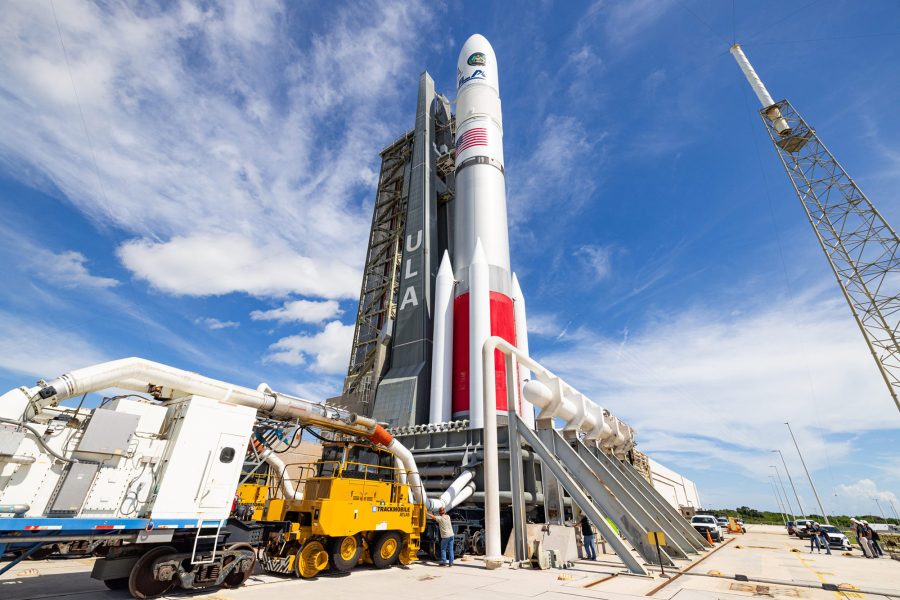
United Launch Alliance’s new Vulcan Centaur rocket is slated to fly its second national security mission in February—nearly six months after its first operational launch and almost a year after it was certified to launch military payloads for the Space Force.
The company announced Jan. 7 that the mission, dubbed USSF-87, will lift off Feb. 2 from Cape Canaveral Space Force Base, Fla. Flying onboard Vulcan will be two Geosynchronous Space Situational Awareness Program satellites, the seventh and eighth in the constellation, which observe and track objects and activity in orbit. The spacecraft were expected to launch last year, but the mission was postponed due to earlier Vulcan development and certification delays.
Vulcan’s long-awaited second military mission, its first of 2026, follows a 2025 that fell short of ULA’s projections. It also comes amid the high-profile departure of CEO Tory Bruno, who announced in December he would leave the company to lead national security programs at Blue Origin, a direct competitor to ULA.
“It has been a great privilege to lead ULA through its transformation and to bring Vulcan into service,” Bruno said in a post on X. “My work here is now complete and I will be cheering ULA on.”
It’s not clear yet what Bruno’s departure will mean for the company, a Lockheed Martin-Boeing joint venture and, until recently, the government’s longtime launch provider of choice. For its part, ULA says it will continue to be “a steadfast partner of the Space Force.” Lockheed and Boeing have appointed ULA Chief Operating Officer John Elbon to serve as interim CEO as they search for a permanent replacement.
In recent years, SpaceX, with its mastery of reusable rocketry, has unseated the firm from its dominant position in the national security market. And competition from companies like Blue Origin, a new entrant to national security launch, could pose further threats, experts say.
Todd Harrison, a senior defense fellow at the American Enterprise Institute, said ULA’s decision not to make Vulcan reusable from the start put the company at risk, making it difficult for the rocket to compete. Of note, ULA does have a plan to eventually recover Vulcan’s engine through a system called Sensible Modular Autonomous Return Technology, which it expects to start flight testing next year.
“ULA’s fate has been in jeopardy since it decided to make Vulcan an expendable launch vehicle years ago, and now I think Bruno’s departure will only accelerate its decline,” Harrison told Air & Space Forces Magazine. “Sadly, I would not be surprised if ULA ceases to exist by the end of this decade.”
In 2023, multiple news outlets reported that ULA was up for sale, naming Blue Origin among the interested buyers, though a deal never materialized. Harrison speculated the reported failed transaction and Bruno’s subsequent move could indicate that Blue Origin saw promise in at least one part of the company—its leadership.
“I think Blue Origin may be extracting the value it wants by bringing over Bruno without the cost of ULA’s legacy workforce, somewhat redundant vehicle, and aging infrastructure,” he said.
Caleb Henry, director of research at analytics firm Quilty Space, said Bruno’s success in shepherding ULA through a rapidly changing launch market is laudable. While Bruno’s decision to leave ULA “certainly turned some heads,” Henry told Air & Space Forces Magazine, it’s not unprecedented for a CEO to transition after seeing a major project—like the development of a next-generation rocket—through to completion. And for Blue Origin, it makes sense to bring on a leader with national security experience as the company looks to break into the military space market.
Still, Henry noted, ULA and Vulcan have a long road ahead.
One challenge, he said, is scaling the rocket’s production and increasing its launch cadence so that it can meet demand from customers. Last year, Vulcan was targeted to launch 10 missions, but flew only once following a malfunction during its second certification flight in October 2024.
“Vulcan needs to scale up, and I can’t think of a launch company that hasn’t described the scale-up process as just as difficult, if not more difficult, than getting to the launch pad that first time,” Henry said.
ULA isn’t the only company on-ramping a new rocket, which presents another challenge: competition. Rocket Lab, Stoke Space, Firefly, and Relativity are all slated to debut their new rockets this year, and Blue Origin’s reusable New Glenn, which flew twice in 2025, is two launches away from potential certification for Space Force missions. The company successfully recovered the rocket’s first stage after its second launch in November.
Of course, ULA also faces competition from SpaceX, the now-dominant launch firm that holds the majority of contracts for future Space Force missions. Last April, for the first time, SpaceX won the majority share of the Space Force’s National Security Space Launch missions slated to fly between fiscal years 2027 and 2032. Under the deal, SpaceX is projected to fly 28 missions while ULA is tapped for 19.
Despite these challenges, Henry said ULA is still very much in the race to join SpaceX as the next “mainstay” heavy launch vehicle provider—especially with a new, proven vehicle rolling off the line.
“I think the jury is still out there,” he said. “And I actually think that 2026 and 2027 will be pivotal years to determine who secures that spot.”