
President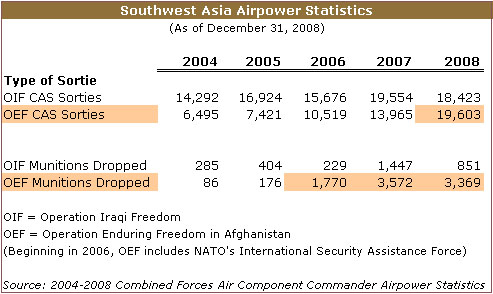 Obama wants a “comprehensive assessment” of the situation in Afghanistan, Defense Secretary Robert Gates told reporters last week. Gates acknowledged that the “goals we did have for Afghanistan are too broad and too far into the future” and should give way to “more concrete goals that can be achieved realistically within three to five years.” There will be additional troops allocated to Afghan operations—Joint Chiefs Chairman Adm. Michael Mullen noted that the combatant commander has asked for 30,000—but neither Mullen or Gates would posit a definite number. Meanwhile, to battle the resurgence of Taliban and al Qaeda insurgents, US coalition and International Security Assistance Force commanders have turned increasingly since 2006 to the use of airpower. Close air support strikes in Afghanistan surpassed those in the Iraqi theater in 2006 and have continued well above Iraq numbers. Last year, US, coalition, and NATO airmen for the first time flew more close air support sorties in Afghanistan than in Iraq and dropped nearly eight times the number of weapons.
The Air Force’s Experimental Operations Unit hosted a change of command ceremony recently, another sign of how the CCA concept is maturing and becoming entrenched in the Air Force’s structure, to the point where exercises have generated multiple sorties in a single day to simulate high-tempo combat operations.