
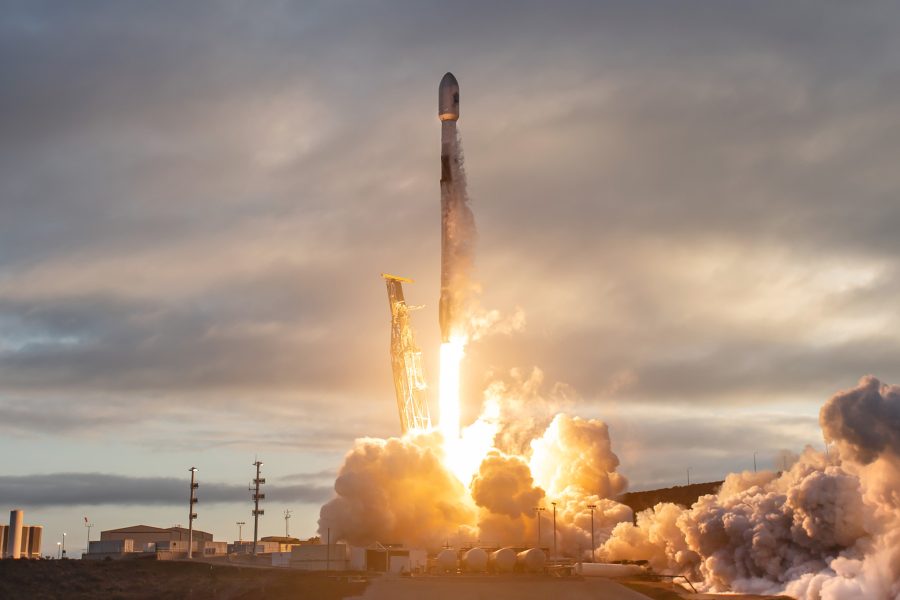
The Space Force recently awarded SpaceX $739 million to launch nine missions for the Space Development Agency and National Reconnaissance Office over the next three years.
The task order, announced Jan. 9 by Space Systems Command, continues a string of national security launch contract wins for SpaceX, which has become the dominant player in the market.
Five of the awarded launches will be to build out SDA’s constellation of missile warning and tracking satellites in low-Earth orbit:
- Two this summer or fall carrying a combined 18 satellites built by L3Harris
- One this summer or fall carrying eight Millennium Space Systems-built fire control satellites meant to demonstrate the ability to help a weapon system track, target, and disable a range of missile threats.
- Two around mid-2027 carrying a combined 18 satellites built by Lockheed Martin
The Space Force didn’t disclose how many satellites will fly on the four missions for NRO, whose spacecraft are largely classified. The launches, scheduled for 2026 and 2028, may be in support of the intelligence agency’s proliferated, multi-mission satellite constellation, which today includes nearly 200 satellites.
This is the third batch of task orders the Space Force has awarded in the latest phase of its National Security Space Launch program, which includes two lanes for companies to compete for military launch services: Lane 1 is for commercial-like missions and is open for competition from a wider swath of providers; Lane 2 is for firms whose rockets are designed to meet more challenging security and performance requirements.
“The task orders awarded in support of our mission partners, SDA and NRO, demonstrate the importance we have placed on being time efficient and cost conscious in our Phase 3 Lane 1 approach to reliably deliver space capability to the warfighter quicker and at the best value to the American taxpayer,” SSC’s System Program Director for Launch Acquisition Col. Matt Flahive said in the statement.
While there is more competition for around 30 Lane 1 missions, there are no guaranteed number of missions for any one firm and SpaceX has swept all the task orders awarded thus far—including this most recent batch. Back in October 2024, the Space Force announced it selected SpaceX for seven SDA launches and an undisclosed number of NRO missions at a value of $734 million.
There are more clearly defined ratios planned for the 54 missions in Lane 2; SpaceX has been tapped for 28 missions, United Launch Alliance for 19, and Blue Origin for seven. Yet even within that framework, SpaceX got the lion’s share of seven Lane 2 launches announced in October 2025: five compared to just two for ULA.
Both SpaceX and ULA have rockets that have been certified to fly Lane 2 missions, but the former’s Falcon 9 rocket has hundreds of launches under its belt while the latter is working to ramp up operations for its Vulcan Centaur vehicle.
Blue Origin, meanwhile, is still on the path to certification for its New Glenn rocket, with two successful flights complete and two more still to go.
All three companies are qualified for Lane 1, whose only requirement is that a rocket fly successfully at least once in order to receive a contract. NSSL newcomers Rocket Lab and Stoke Space are on deck for Lane 1 competition pending successful flights of their rockets, which both companies say will debut this year.