
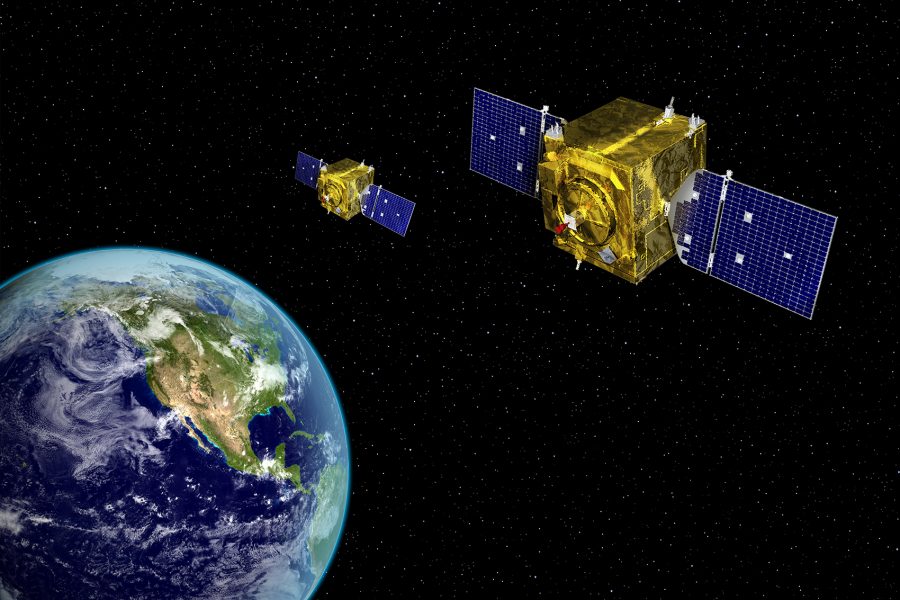
The Space Force’s strategy to replace its fleet of neighborhood watch satellites in geosynchronous orbit includes plans to field multiple satellite constellations, one focused on reconnaissance and one focused on surveillance that will autonomously track objects in GEO, the service said in a Nov. 26 notice.
Officials had previously described plans for the reconnaissance fleet, dubbed RG-XX, with spacecraft that will be able to refuel and maneuver to get a better look at particular objects or threats in GEO.
The surveillance fleet, in contrast, will be “capable of wide-area volume search and tasked collections on priority objects,” according to a request for information from Space Systems Command, focused specifically on wide-field-of-view electro-optical sensors. It will be complementary to RG-XX, the request added.
“The primary objective of this proliferated constellation will be to autonomously search for, detect, and revisit Resident Space Objects in and around the Geosynchronous Equatorial Orbit-belt,” the RFI states.
Space domain awareness is a top priority for the Space Force and U.S. Space Command. Officials want the ability to better track threats and more insight into potential adversaries’ on-orbit operations. Along with space-based sensors, the service has a network of ground radars that track activity in orbit as well as launches.
Surveillance is focused on more general, prolonged monitoring—which wide-field-of-view sensors can provide—while reconnaissance is focused on specific objects and targets on tighter timelines—something for which maneuverable satellites would be particularly useful.
The Space Force fielded its first two Geosynchronous Space Situational Awareness Program satellites in 2014 and has since launched four more. It deactivated one of those satellites in 2023, leaving five active spacecraft in the constellation. The service had planned to send two more spacecraft to orbit this year, but that mission, USSF-87, has been pushed to the first quarter of 2026.
Officials have been publicly discussing a replacement for GSSAP since early 2024 and released a draft solicitation for RG-XX in October. The service is exploring off-the-shelf solutions and wants RG-XX satellites to have refueling ports so that their fuel can be topped off in orbit, extending their range and service life.
The new notice to industry on the surveillance constellation doesn’t provide as much detail, including any timing of a development effort, though it notes that the service is eyeing some “near-term” acquisition decisions and is interested in low-cost options that could go into production in less than two years.
Also unclear is how many surveillance satellites USSF intends to buy, though the notice states it’s considering a “proliferated constellation.” The service hasn’t projected quantities for RG-XX either. Maj. Gen. Stephen Purdy, the Space Force’s acting acquisition executive, told reporters in September that numbers will depend on how much funding the service gets for the effort.
“My intent, bluntly, is to buy as many as possible,” he said. “This is clearly a mission need where we need a lot as rapidly as possible.”
Editor’s Note: This story was updated Dec. 15 to clarify that the Geosynchronous Space Situational Awareness Program is focused solely on reconnaissance and does not have a surveillance mission.