
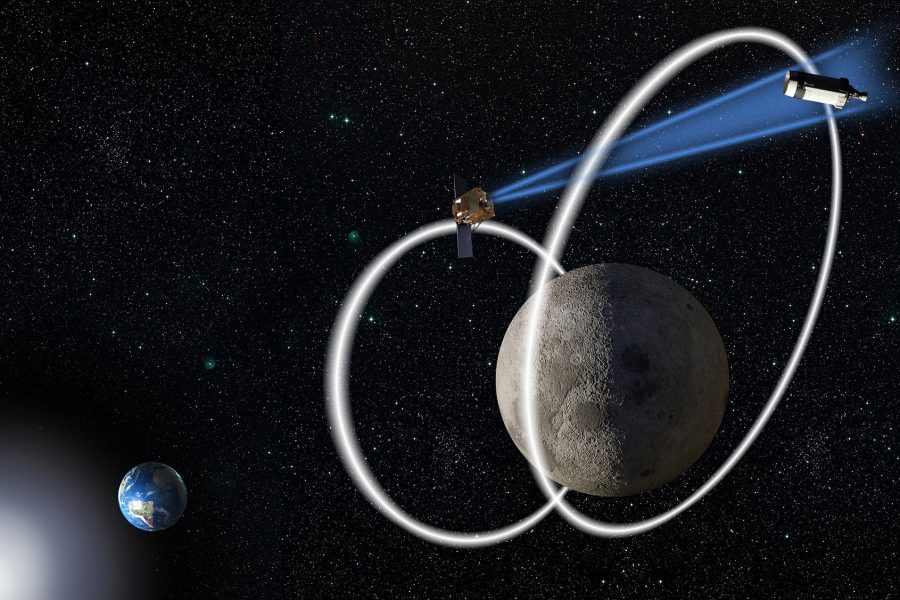
As NASA prepares for a slew of lunar missions over the next few years, the Space Force is contemplating its role in future operations around the moon.
The service is developing a plan to increase focus on cislunar operations, according to Thomas Ainsworth, who is performing the duties of Assistant Secretary of the Air Force for Space Acquisition and Integration.
Cislunar space is the region beyond geosynchronous orbit extending to the moon and even farther to cover areas influenced by Earth and the moon’s gravity—hundreds of thousands of kilometers in distance and 1,728 times the volume of space contained within geosynchronous orbit, according to an Air Force Research Laboratory primer.
“We do need to begin integrating cislunar capability into the Space Force,” Ainsworth said March 17 at McAleese Defense Programs Conference. “We are serious about that. We are going to be standing up leadership positions and integration points where we can start bringing those technologies in and actually have a plan to execute them going forward.”
The goal, he noted, is to be a “good partner” to NASA and to leverage the cislunar capability development that’s happening in pockets throughout the Pentagon’s innovation ecosystem.
To date, much of the U.S. government’s lunar ambitions have centered on NASA and its plan to return astronauts to the moon through the Artemis program. The Defense Department has pursued research programs aimed at better understanding the vast expanse of cislunar space—including the Air Force Research Lab’s Oracle program, which plans to launch several cislunar space domain awareness satellites in the coming years. But the Space Force hasn’t dedicated much planning, funding, or personnel to those efforts.
That’s changing, Ainsworth said, and the momentum is linked in part to a White House executive order, released in January, that described the U.S. military’s space responsibilities as extending from very low-Earth orbit to cislunar and called for more investment in deep-space navigation capabilities.
Speaking with reporters last month at AFA’s Warfare Symposium in Aurora, Colo., Chief of Space Operations Gen. Chance Saltzman said the executive order’s mention of cislunar operations is significant.
“Just having that discussion at that level is tremendous for us,” Saltzman told reporters Feb. 24. “It helps with resources. . . . As U.S. interests go further and further into space, there’s going to be a need to protect and defend those interests.”
Saltzman noted that while NASA’s Artemis is currently driving a lot of the discussions around cislunar operations, the Space Force will have a role to play in the future. In fact, the service’s highly anticipated roadmap for what systems, infrastructure, and personnel it will need over the next 15 years, dubbed the “objective force,” factors in the need for cislunar capabilities.
“I don’t want to get caught flat-footed when we start to have to protect U.S. interests out there,” Saltzman said. “So we’re along for the ride, if you will, and we’re collaborating closely.”
New PAEs
The Space Force’s work to establish programs and personnel focused on cislunar capabilities is an example of its expanding mission set and is part of its broader acquisition reform initiatives, Ainsworth said. In response to Defense Secretary Pete Hegseth’s acquisition transformation strategy, announced last November, the Space Force in January established two portfolio acquisition executives—one for space-based sensing and targeting and a second for assured access to space, which includes launch and mobility programs.
Ainsworth announced four additional PAEs during his speech:
- Infrastructure, which includes data management as well as training, testing, and personnel
- Battle Management Command, Control, Communications and Intelligence, or BMC3I
- Satellite communications and PNT, or positioning, navigation, and timing
- Missile warning and tracking
The service plans to announce at least three more PAEs, including one focused on integrating technology from offices like DARPA, the Space Rapid Capabilities Office, and the Defense Innovation Unit.
“We’ve recognized over the number of years, coming out of the innovation ecosystem, there are a lot of tech pushes,” he said. “These sometimes lead to brand new missions, which has happened multiple times with the Space Force, but they also sometimes fundamentally change the way we go after capabilities. … As we stand up the integration PAE, we’re looking for a tech push path that would allow us to bring in new technology as we develop it.”