
The Space Force is moving ahead with plans to build a physical test and training range that will feature a mix of ground and space-based systems, releasing a formal solicitation for a multi-vendor contract worth $981 million to design, develop, integrate, and sustain those capabilities.
Space Systems Command issued its request for proposals for the National Space Test and Training Complex Innovative Technology and Engineering-Space Test and Range, or NITE-STAR, on March 18 and plans to award initial contracts this summer. According to SSC’s program executive officer for operational test and training infrastructure, Col. Corey Klopstein, the intent is to identify a pool of companies to compete to build elements of that physical environment on the ground or to provide live, on-orbit range capabilities—like satellites or instrumentation—either for dedicated use or as a service.
“There are commercial capabilities out there that we want to be able to leverage in a different way for test and training … and we’ve leveraged range-as-a-service type of capabilities through commercial vendors,” he said during a March 25 event hosted by Defense One. “We want to see more of that going forward. In parallel, we are also developing purpose-built capabilities that we’re going to have on orbit.”
NITE-STAR is part of the Space Force’s broader effort to build the ranges and simulators needed to train Guardians and validate the capabilities they’ll operate. Klopstein said the service is focusing its OTTI efforts on three primary areas: physical ranges, digital test and training environments, and the underlying infrastructure, or backbone, to manage data.
For the last few years, the service has been working closely with commercial companies to field quick solutions to meet its near-term test and training needs, awarding “tens of millions of dollars” through commercial solutions openings and other rapid acquisition contract mechanisms, Klopstein said. Those contracts have helped mature capabilities like the Space Warfighter Operational Readiness Domain, or SWORD, a digital training capability. The tool, which provides simulated space effects and scenarios, was initially developed by the 392nd Combat Training Squadron at Schriever Space Force Base, Colo., in partnership with the SSC. The service has since awarded several contracts to expand it.
Klopstein’s team has also used a long-standing “other transaction authority” to put in place a “range-as-a-service” contract to conduct training exercises using commercial satellites. In partnership with Mission Delta 2, the service’s space domain awareness delta in Combat Forces Command, they were recently able to coordinate the movement of a commercial satellite so that Guardians could observe it from the ground and use it for a training event.
While that ad-hoc approach has served the service well so far, it’s not sustainable, Klopstein said. Novel acquisition tools and commercially available solutions will still play a role moving forward, he said, but contracts like NITE-STAR are meant to lay the longer-term foundation for more high-fidelity live and virtual training capabilities.
Prior to releasing the NITE-STAR solicitation, the Space Force last year awarded an indefinite-delivery, indefinite-quantity contract for the data backbone piece. Klopstein and his OTTI team also plan to release an RFP for the digital environment work and award a contract before the end of this year.
“That’s the contractual foundation that we’re putting in place,” he said. “We want to have those key … contracts for digital, physical infrastructure. And then we want to use things like our [commercial services openings] or [other transaction authorites] to be able to feed those to deliver capabilities quickly.”
Backyard Ranges
In describing the Space Force’s vision for a digital or simulated training environment, Klopstein said the goal is to create the space domain equivalent of a “backyard range,” where Guardians can get “reps and sets” at their home stations.
“A fighter squadron or bomber squadron that is at a base … they’re able to fly within airspace that is close in proximity to where their home station is,” he said. “That’s kind of the backyard range that they use. And then when they need to do a large force exercise, they’ll go to a place like the Nevada Test and Training Range or the Utah Test and Training Range or Eglin [Air Force Base] to be able to work across mission areas—fighters, bombers, air refuelers. Well, we’re trying to do the same thing for the Space Force.”
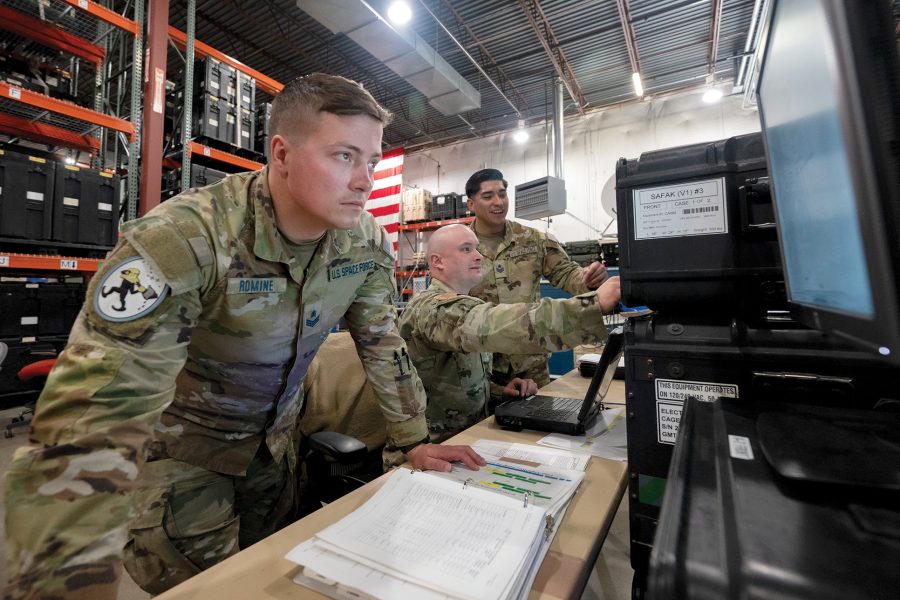
For Guardians, the service wants to provide that close proximity training environment via a mission simulator. Today, the service uses replications of operational systems for Guardians to train on. Its vision is for the contractors who develop a given system to provide a “training mode” that allows training to occur on the operations floor. SWORD, the digital training environment tool, would be integrated with the operator’s console to simulate the environment with space effects and scenarios.
“They’re able to conduct their training in whatever scenarios they need to conduct them, but we’re providing the blue models that are replicating potentially other systems, the red models that are replicating threats, and we’re doing that in the back end of that simulation environment,” Klopstein said. “We want to be able to bring that to the ops floor.”
SWORD currently supports large-scale training exercises like Space Flag, and SSC plans to transition it to a cloud environment in the coming years, which will allow it to support home station training as well as real-time distributed training across multiple installations. The service plans to launch a pathfinder in 2027 to demonstrate an initial cloud-based SWORD deployment and then mature and scale the tool over the next five years.
For high-fidelity testing, the service has joined the Joint Simulation Environment user group and plans to create a JSE to test space systems. JSE is a physics based synthetic environment that was originally designed for sensitive F-35 testing, but is being expanded for use by other programs and for pilot training.
While that digital testing and training architecture will surely take time to evolve, Klopstein said the key for the OTTI team right now is defining its needs, establishing standards, and creating pathways for industry to develop those capabilities.
“The important thing for us is making sure that we define those environments, define the standards that can integrate capabilities into those environments, and then get that out to industry and other program executive officers and other program offices, so that when they’re building assets, they’re building replications of satellites, they’re making their new developments, or they’re building their training strings for their ground systems that they understand the standards to build to,” he said.