
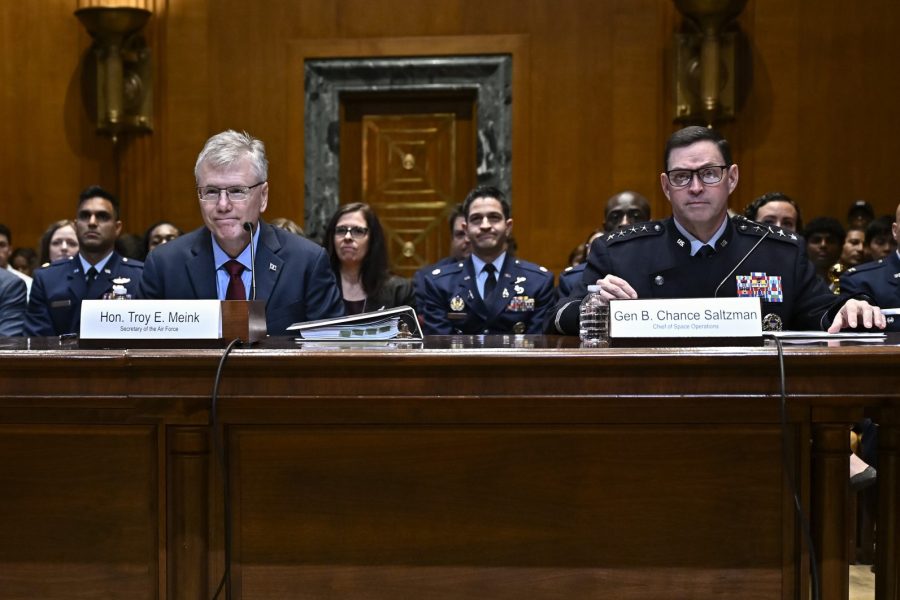
ORLANDO, Fla.—Weeks after senior Air Force leaders revealed the service would shed a number of the re-optimization initiatives pursued by their predecessors, Chief of Space Operations Gen. B. Chance Saltzman confirmed the Space Force is retaining all of the elements of the strategy specific to his service.
Speaking with reporters Dec. 11 at the Spacepower Conference, Saltzman and Air Force Secretary Troy Meink said that while the Air Force reforms included significant reorganization that Meink feared would be too disruptive, the Space Force changes aligned closely with the new service’s natural growth trajectory.
“We’re keeping all of it,” Saltzman said. “Because it’s all just a natural part of the Space Force evolution since our inception.”
The Department of the Air Force, then under the leadership of former Secretary Frank Kendall and Chief of Staff Gen. David Allvin, rolled out the re-optimization strategy in February 2024, detailing 24 sweeping changes to training, deployment, and acquisition. The goal was to position the Air Force and Space Force to better prepare compete with China.
In early December, Meink and Chief of Staff Gen. Kenneth Wilsbach revealed that the Air Force has abandoned many of those new organizations and approaches, including the standup of new organizations like Integrated Capabilities Command and Airman Development Command. Only eight of 19 Air Force-specific initiatives will continue.
“I’ve always said, don’t reorganize unless something’s really broke, because it takes a long time to recover from reorganization,” Meink said in the briefing. “So, we really looked hard at where we were making changes, and what was the necessity for those changes. So, I think we finished all that.”
The Space Force, meanwhile, will continue to pursue its re-optimization priorities, which include:
- redesigning career paths for high-tech operations
- implementing new readiness standards and expanding exercises
- formalizing the creation of Combat Units of Action and implementing a new Space Force Generation model
- Creating a fourth field command, Space Futures Command, to validate concepts, lead mission area force design, and conduct experimentation and wargames.
USSF has implemented all of those priorities, Saltzman said, except for what is arguably the most significant organizational lift—establishing Space Futures Command. As originally envisioned, the field command will leverage the existing Space Warfighting Analysis Center, which was established in 2021 to flesh out the service’s force structure needs, and combine it with two new centers, a Wargaming Center and a Concepts and Technology Center.
The new command will not adopt the “futures” moniker, but Saltzman hasn’t described in detail how it would differ from the service’s original vision. With input from Meink, he said, USSF has “reframed” the command’s mission and will focus more heavily on expanding SWAC’s role.
Speaking at a Center for Strategic and International Studies event in November, Saltzman said the new field command will play a key role in crafting future versions of the objective force—a detailed vision for what platforms, support, and structure USSF will need over the next 15 years—as well as other documents meant to provide a “clearly articulated demand signal” to industry and other stakeholders.
The service is now making decisions about staffing, headquarters location, and workflows, and Saltzman expects to stand up the new command in 2026.