
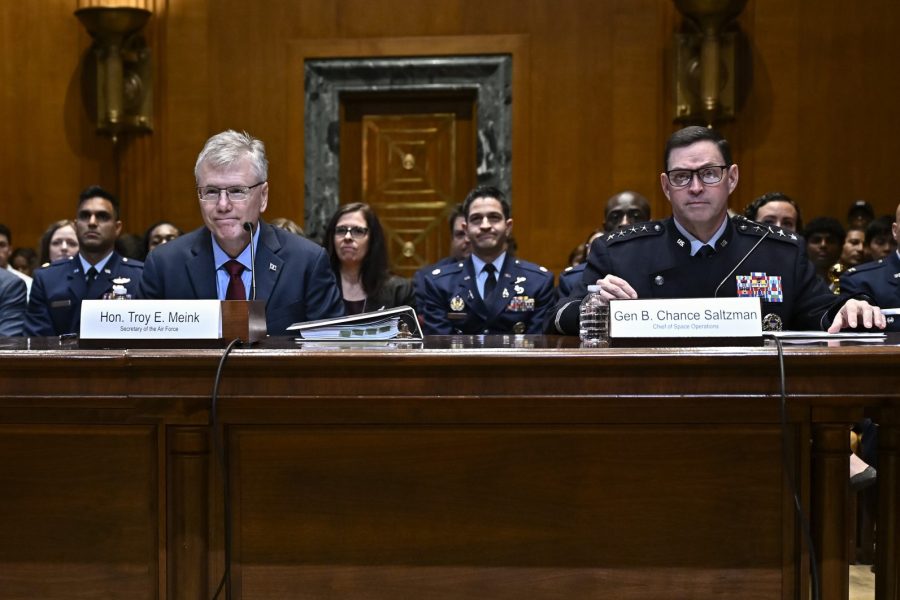
AURORA, Colo.—Space Force leaders for years have been making a case for more funding and personnel to manage its growing slate of missions and responsibilities—from tracking and engaging more advanced missile threats to supporting an ever-expanding demand for launch services—and to operate in an increasingly dangerous threat environment.
After years of describing to lawmakers and Pentagon leaders the nature of that threat and the key role spacepower plays in deterring conflict in the domain and enabling the rest of the joint force, Chief of Space Operations Gen. Chance Saltzman told reporters during AFA’s Warfare Symposium here that the message appears to finally be taking hold.
“I’m no longer having to defend to any of the key stakeholders that the threat should be taken seriously—we’re over that,” he said Feb. 24. “They recognize that the Space Force has to control the domain if we’re going to be successful in all the other domains for the joint force. And so, we’ve been pretty successful in advocating for an increase in those resources.”
The Space Force won a nearly $14 billion boost to its budget in fiscal 2026, which it will use to advance existing capabilities, like space-based sensing and domain awareness, as well as new missions, like space-based moving target indication. Its total fiscal ’26 budget is around $40 billion—more than double its first budget as an independent service, when the White House requested $15 billion for fiscal ’21.
If current plans hold, senior leaders say, the fiscal 2027 request will be substantial. President Donald Trump has floated a total 2027 defense budget of $1.5 trillion, although it’s not clear if that would be in a single bill, or come in pieces, as last year when Congress first passed a reconciliation bill known as the One Big Beautiful Bill Act. Many observers question whether the Pentagon can digest a spending increase of about 50 percent in a single year.
Space Force leaders aren’t focused on the macro level, however, and instead on their specific needs. And they appear confident they will get more funding.
“We’ve had a lot of increases, and we’re going to continue to have increases,” said Lt. Gen. Douglas A. Schiess, deputy chief of space operations for operations.
Kit, Infrastructure, and People
While Schiess and others didn’t offer much detail, they did say they expect more funding for new space systems, new infrastructure, and personnel to support priorities like missile defense, space domain awareness, and targeting.
Air Force Secretary Troy Meink, in a tone-setting speech to kick off the conference Feb. 23, said “there’s a lot of push” within the Defense Department to add space capabilities. Based on that demand, he added, “there’s no question the Space Force is going to grow quite a bit.”
Asked which missions the department must prioritize, Meink didn’t hesitate: “All of them.”
“It’s a priority for the Air Force, the Department of War, to bring on more space capability,” he said. “Just like air dominance, we need space dominance and all the different sets of programs that are required to allow us to do that.”
Saltzman said the Space Force is looking to add capability in areas like testing and training infrastructure and space weapon systems in fiscal ’27. Lt. Gen. Philip Garrant, commander of Space Systems Command, highlighted space-based sensing and MTI, along with strategic investment in production capacity, as critical challenges.
Right now, Garrant said, industry lacks the capacity the Space Force wants. “Getting the people who are building these things to invest so that we can buy more” is what he and others want to see.
“Production and ramped-up production, and getting our industry partners to invest in facilitation so that we can then turn around and invest in production is a significant priority for us,” Garrant told reporters.
The joint commander responsible for fighting in the space domain, Gen. Stephen Whiting of U.S. Space Command, highlighted one area where he’d like to see Space Force investment: new capabilities to deliver on-orbit logistics and refueling. About the pending budget plan, he said he’s “heartened by what we’re hearing about the dollar figures that are in play for this budget.”
People are another major priority. The Space Force plans to increase recruiting and retention efforts, Saltzman said, and he and Chief Master Sergeant of the Space Force John Bentivegna say the service must ultimately double in size to manage the joint force’s demand for space capabilities.
That means increasing both military and civilian personnel. Schiess said that while the service was designed to be “lean and agile,” it is now time to grow.
“We’re bringing new capability into those legacy systems, we’re bringing on technology—AI and things like that—to make the crewed force smaller,” he said. “We have incredible enlisted Guardians that are taking on more responsibilities. But it’s still a people problem.”
The service lost about 14 percent of its civilian workforce when the federal government implemented mandatory cuts and deferred resignation and retirement programs a year ago—initiatives that disproportionately hurt USSF’s acquisition enterprise. Garrant, whose Space Systems Command is comprised of mostly civilian experts, said Feb. 25 he now has additional hiring authorities to tackle the challenge. His team is implementing a workforce capitalization strategy to add more acquisition and contracting experts.
Kelly Hammett, director of the Space Rapid Capabilities Office, indicated he expects his team—and the service more broadly—may be allowed to expand its acquisition cadre. He described the Space Force’s fiscal ‘27 request as “large” and “pretty positive.”
“That’s much needed for me,” he said. “I’ve been touting that for the whole entire time I’ve been here. We’ve asked every year and all the additional manpower authorizations for the last four years have gone to ops. … But I think I’m going to get more people, which is good, because they keep giving me more programs.”
Additional funding in 2027 would also help the Space RCO transition more emerging technologies developed through the Air Force and Space Force’s AFWERX and SpaceWERX innovation arms into new and ongoing programs, he said.
Funding Execution
Adding so much funding quickly—including the nearly $14 billion in last year’s reconciliation bill—brings challenges. It takes people and talent to manage new programs and operate new systems.
Decisions become more complicated if it’s not clear whether funding levels will be sustained in future years or if the funding is a one-time injection. This was a key issue with funding received through the One Big Beautiful Bill Act last year. According to multiple reports, the department plans to spend the entirety of that funding in fiscal 2026, a change from earlier plans which called for holding back $38 billion for 2027.
Meink said that while having a steady, predictable budget is ideal, so is having more money now to increase production and get after other priorities.
“We’ll make whatever we get work,” he told reporters.
Garrant said executing reconciliation funding has been “a tremendous opportunity.” Managing that increase has tightened SSC’s relationship with the Air Force and the department’s financial management offices as well as other stakeholders in the Office of Management and Budget and Congress to ensure money is spent efficiently.
“The expectation to submit spend plans and demonstrate our ability to effectively and responsively execute those dollars, that’s been a really high demand signal from the administration and Congress,” he said. “It’s really caused us to sharpen our pencils and really have a really good approach.”
As the service anticipates even more funding in 2027, Garrant and SSC’s Deputy Commander Col. Andrew Menschner, said it will draw from those lessons and will continue to focus on developing its workforce to be able to manage that growth.
“We really do have to focus on the development of our Guardians, both military and civilian, to be able to execute the level of programs that are headed to Space Systems Command,” Menschner said. “I think there’s some real opportunity there to incorporate not only the lessons learned that we’ve had, but some of the new AI tools that we’re bringing online.”