
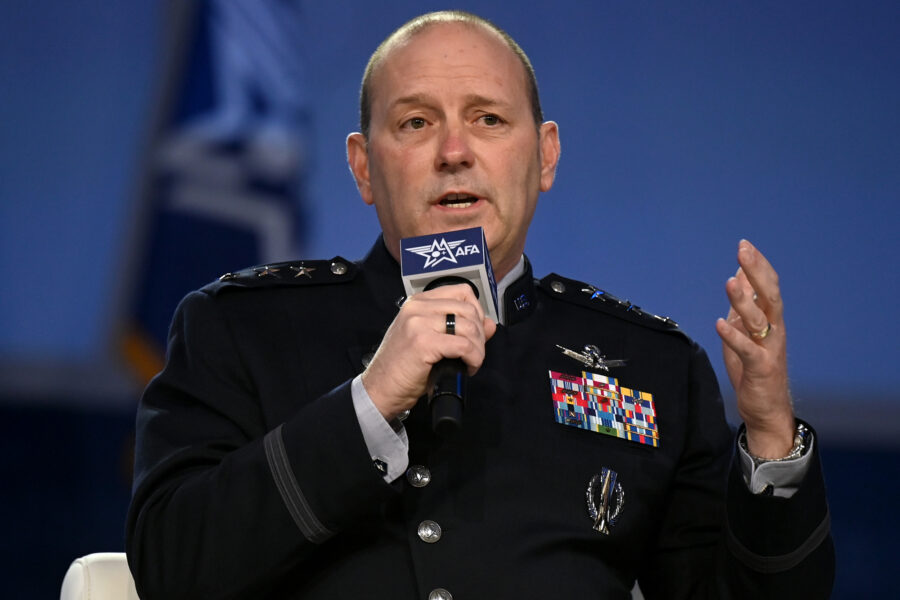
New approaches to testing Space Force equipment are speeding up delivery to operators, but the service needs more testers and perhaps its own space-focused test center, officials said April 1.
Those are key pieces of the fledgling force’s testing methods and future moves that will keep new technology flowing into operations, said Lt. Gen. Douglas Schiess, deputy chief of space operations.
Schiess said the service has put acquirers, testers, and operators into “test integration teams” at the beginning stages of new programs, while speaking at the Mitchell Institute’s Spacepower Security Forum in Arlington, Va.
That’s in contrast to the traditional method, which involved extensive developmental testing before bringing in system operators, who would often have other testing needs.
By bringing the various entities together early in the process, Schiess said the team can evaluate whether it has an early “minimum viable product” that may not pass all tests perfectly but brings a new capability to the force.
“Maybe have the operators, the integrators, and the contractors actually together to see what is it we’re actually going to test, when it’s time to test, to be able to say, ‘Hey, this is something that we can present to a combatant commander,’” Schiess said.
His comments echoed those shared by his boss, Chief of Space Operations Gen. B. Chance Saltzman, at AFA’s Warfare Symposium in February.
“We’re toppling the silos that used to exist between acquisitions, test, and operations. Testing is a means to an end,” Saltzman said during a keynote speech. “It demonstrates through data and sound analysis that systems will work when called upon, but no amount of testing can eliminate every risk or prevent every failure.”
The more integrated method seeks to collect early test data, assess risks, deliver a usable product to the field, and continually improve the technology in operations, Saltzman said.
“We will no longer have the luxury of pursuing perfection when a system that is good enough provides combat capability on a more operationally relevant timeline,” Saltzman said.
The Space Force is also evaluating testing needs to further streamline the process, Schiess said. Service officials are working with Secretary of the Air Force Troy Meink to determine what testing is needed.
Schiess said test plans will need to be tailored for individual systems based on how much risk the service determines it can take for a particular mission. For example, he said, not all systems require the same degree of rigor as a nuclear command and control asset.
“I think we are taking risk in those areas, but it’s risk we have to do, because if we don’t do anything then we’re taking a lot of risk because we’re not delivering anything to the warfighter,” Schiess said.
At least one industry partner, speaking on a later panel, agreed, calling both government acquisition and the space industry as a whole risk-averse.
“It’s really easy to be conservative, real easy. Let’s do another test, slow down, let’s take some time, take a month to go make a test, six months for us to run a test, then we’ll talk about it, then we’ll make a decision, we’ll be sure it runs perfectly,” said Jeff Hanke, president of space systems for L3Harris. “That’s not speed.”
Hanke said industry leaders especially need to balance risk and understand that some risk is necessary.
But to take this approach, the service needs more testers, which means more people, Schiess said.
“One of the problems is, and you’ll see when our budget comes out … that we need more manpower to be able to do that,” he said. “Because those same operators are operating the current systems that we have or we’re now going to a new system, and we’ve got to take operators that maybe have not done that before get them ready to be with the acquirers and contractors to be able to do that.”
Chief Master Sergeant of the Space Force John Bentivegna told Congress in a Feb. 11 hearing that the 10,000-member military branch needs to double in size to meet its evolving mission requirements and counter growing threats.
Additionally, the service is looking at whether it needs its own testing apparatus, separate from the Air Force. Currently, the Air Force’s Director of Test and Evaluation and the Air Force Test Center oversee Space Force testing.
“We’re working through what does that look like in the future, is that a separate Space Force test entity?” Schiess said.
The Space Force established System Delta 81 in September 2025 to help Space Operations Command and Space Training and Readiness Command, or STARCOM, obtain test and training infrastructure.
STARCOM oversees the service’s network of ranges for realistic, threat-informed test and training environments, known as the National Space Test and Training Complex, or NSTTC, according to the service’s 2022 NSTTC Vision Statement.
Schiess declined to specify particular programs using the testing integration team model due to their classified status.
But at the Warfare Symposium, Saltzman provided one example—electronic warfare. He didn’t highlight a particular system, but he may have been referring to the Meadowlands satellite communications jammer, built by L3Harris. The company gave two developmental systems to the Space Force in April 2025. The first production unit of the compact ground-based satellite signal jammer arrived in December.
L3Harris repurposed legacy hardware in the preceding Counter Communications System that Meadowlands is replacing. The upgrade reduced the number of boxes required to transport the system from 23 to seven, replacing the CCS electronics.
The Space Force’s electromagnetic warfare-focused Mission Delta 3 unit was involved throughout the development, design, and testing of Meadowlands, unit members told reporters in December.