
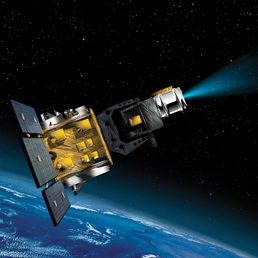
ORLANDO, Fla.—The Space Force wants to emphasize small, low-cost systems and commercial capabilities in the next generation of Silent Barker surveillance satellites, drawing lessons from its work to replace the Geosynchronous Space Situational Awareness program.
The service issued a notice to industry in late November seeking input on its plans to field a fleet of small, wide-field-of-view surveillance satellites in geosynchronous orbit, and Col. Brendan Hochstein, commander of Space Systems Command’s Delta 89, told reporters Dec. 12 that those surveillance satellites will form the follow-on to today’s Silent Barker program.
Silent Barker’s surveillance capabilities, which became operational earlier this year, complement the Geosynchronous Space Situational Awareness Program’s reconnaissance mission. The satellites coordinate target tracking and data sharing amongst themselves using complementary sensors. Both programs have, thus far, been developed and fielded largely in secret.
The Space Force has been publicly discussing a replacement for GSSAP since early 2024, and released a draft solicitation for the effort, RG-XX, in October, seeking commercial sensor technology that can be integrated onto small satellites—a departure from GSSAP, which featured larger spacecraft with more exquisite sensors. Its Nov. 26 notice requesting industry input on the Silent Barker follow-on effort indicates the service plans to take a similar approach to that program, and Hochstein confirmed those efforts in a briefing with reporters at the Spacepower Conference here.
“RG-XX will be the first, but we’ll leverage what we’re doing there: more commercial vehicles, a broader base to bring on some of the newer technologies,” he said. “For the surveillance mission—think wide-field-of-view, scanning the environment—the advancements there, what we’re seeing in industry, should enable many more entrants on that acquisition.”
The capability difference between Silent Barker and its follow-on satellites likely won’t be significant, Hochstein said. Instead, the major change will be in the acquisition approach and force design.
“I wouldn’t necessarily say it’s a jump in capability, but it’s using the capability differently,” he said. “[We’re] opening it up to industry to say, ‘Hey, how can we do this differently? Can we use a multitude of sensors, hopefully lower cost, that could satisfy the same requirements, the same mission for the combatant command? We really want to invite industry feedback on that.”
The Space Force is also interested in industry proposals to make future Silent Barker and GSSAP-like satellites refuelable. Acting Space Force acquisition executive Maj. Gen. Stephen Purdy said in September that the service is asking industry to propose refueling port designs in their GSSAP responses. Hochstein said the capability is less pertinent for the Silent Barker follow-on than it is for RG-XX and its reconnaissance mission, which could be enhanced if satellites can freely maneuver without fear of using too much fuel.
For both programs, the service is seriously considering whether asking companies to design satellites for that sort of life extension is worth the cost—and if simply replacing spacecraft as they reach end of life or run out of fuel is a more economical approach.
“There’s a trade space between having refueling versus having less expensive vehicles,” Hochstein said. “That’s where we are leveraging industry to give us proposals that cover that spectrum, to give them that trade space. Because if you overspecify, say, refueling, that may eliminate certain vendors.”
Beyond the move to a more distributed constellation, another key difference in the acquisition approach for the follow-on effort is that the Space Force will take the lead on development, rather than partner with the National Reconnaissance Office as it did for Silent Barker.
“The partnership with the NRO is great and strong,” Hochstein said. “We’re working to fully transition that to the Space Force for the future acquisition.”