
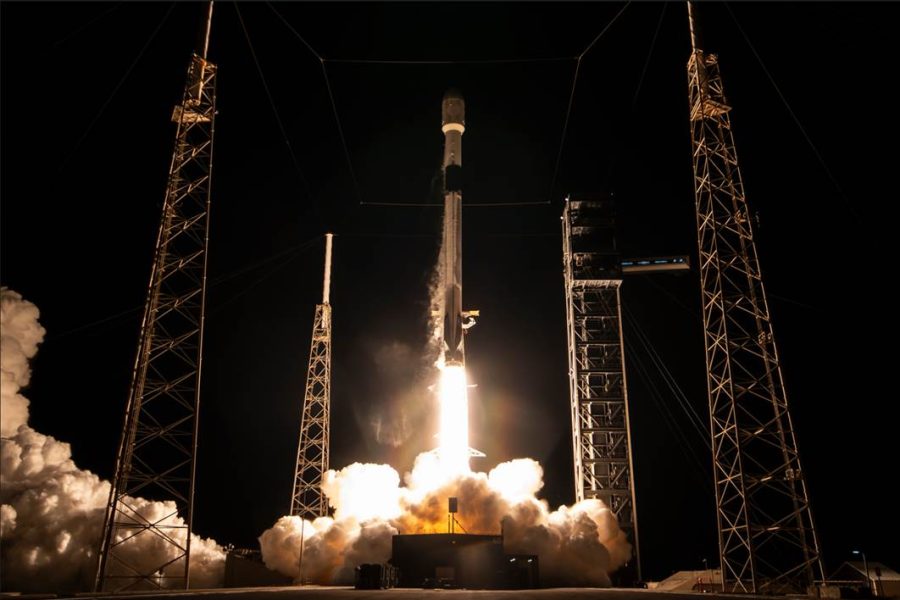
A SpaceX Falcon 9 rocket launched a GPS III spacecraft on Jan. 27, adding capacity, accuracy and anti-jam capabilities to the now 32-satellite constellation. But even as the new technology comes together, lawmakers continue to push for more resilient positioning, navigation, and timing capabilities.
Built by Lockheed Martin and launched from Cape Canaveral Space Force Station, Fla., the latest GPS III satellite is the ninth of 10 spacecraft; the final satellite in the class is slated to launch in March. After that, the Space Force will begin fielding a more capable follow-on, GPS IIIF. Also built by Lockheed and slated for initial delivery next year, there are 22 GPS-IIIF satellites in the works.
Today’s GPS constellation is a mix of new and legacy spacecraft, the oldest of which are nearly 30 years old. Industries from farming to travel to banking rely on GPS for timing and positinging, and consumers are increasingly dependent for even their daily commutes. But GPS remains an essential military capability, especially for navigating difficult terrain in remote areas.
U.S. leaders have sounded the alarm about GPS’s vulnerabilities, especially the signal jamming that has become ubiquitous in Ukraine, where Russia has put enormous energy into disrupting GPS. For the U.S. military, dependent on space for precision targeting and communications, signal disruption poses a growing threat.
That’s what has Congress pressing for solutions. In a Jan. 20 report accompanying the proposed fiscal 2026 defense spending bill, lawmakers criticized the Defense Department for moving too slowly on alternative PNT solutions. A classified 2024 Defense Science Board report recommended the Pentagon develop jam-resistant user equipment and strengthen the ground control segment, and the spending measure asserts the department “has not taken any significant steps to address the findings and recommendations.”
The bill has not yet cleared the Senate. It would invest an additional $15 million to increase resiliency in the GPS constellation and $30 million to develop alternative PNT capabilities. It also calls on Defense Secretary Pete Hegseth to outline a plan for PNT modernization.
Strength in Numbers
Launching more GPS satellites, like the spacecraft lofted this week, is one solution. Adding more, newer GPS III satellites on orbit adds capability. The new satellites are three times more accurate and emit signals eight times stronger than their predecessors. That means operators have more reliable signals.
In a Jan. 26 interview, Lockheed’s Vice President for Navigation Systems Malik Musawwir said those combined capabilities also make it harder to jam GPS signals.
“When you’re boosting that signal, it ultimately decreases the area that jammers have an effect on a military user in the field,” he told Air & Space Forces Magazine. “If somebody were to jam that signal, they have to be significantly closer to the person or capability they’re trying to jam when you have a boosted signal, like what GPS IIIs are providing.”
The GPS IIIF generation will build on that improved performance, Musawwir said. Once again, stronger signals and increased accuracy will be part of the package, along with what he called regional military protection—essentially a spot beam, 1,200 kilometers in diameter, delivering signals 60 times stronger than before. The satellites will also have a search and rescue payload.
The Space Force is discussing ways to add more resiliency features to those spacecraft with Lockheed. The tenth GPS III satellite will include an optical crosslink designed to allow spacecraft to communicate more efficiently and securely with their ground station or with other satellites. The GPS III crosslink will demonstrate space-to-ground optical communications, a jam-resistant technology that will inform future decisions about how to outfit GPS IIIF satellites.
“It’s an enabler for capability, whether it’s in comms or it’s rapid tasking, so that you’re resilient and don’t necessarily have to have line of sight with a ground station,” Musawwir said. “We’re going through the next phase of the demonstration—flights, design maturity process—right now on the IIIF contract, and looking forward to exercising those kinds of opportunities on the IIIF vehicles.”
Beyond GPS
Aside from its GPS modernization efforts, the Space Force has yet to lay out a holistic PNT resiliency plan, though it has in recent years pursued several experiments to shape its broader strategy.
In 2024, the service kicked off a program called Resilient GPS, choosing three companies to design a fleet of smaller, low-cost satellites to augment the larger constellation. However, the Space Force’s fiscal 2026 budget request defunded the effort, and Space News reported in January that it had opted to cancel the program at the end of its design phase.
During a presentation Jan. 23 at Space Systems Command’s annual Industry Days conference, Col. Neil Barnas, commander of Systems Delta 831, said the Space Force gleaned lessons from R-GPS that it will feed into other programs, but didn’t expand on the reason for its cancellation. A spokesperson for Space Systems Command did not respond to a request for more details by press time.
The Space Development Agency has discussed incorporating PNT in future tranches of its Proliferated Warfighter Space Architecture, but the Space Force paused Tranche 3 of SDA’s Transport Layer earlier this year, throwing that program into doubt. While other SDA satellites will have jam-proof PNT capabilities, the Tranche 3 spacecraft were to transmit those signals to users on the ground.
Disaggregating PNT capabilities by using orbits besides MEO, where GPS satellites currently reside, is one way to potentially secure the capability. Last summer, the Space Force launched an experimental PNT spacecraft, dubbed Navigation Technologies Satellite-3, into geosynchronous orbit, where it will demonstrate whether a multi-orbit capability can boost resiliency. SDA’s satellites, meanwhile, are in LEO.
DARPA and the Defense Innovation Unit, meanwhile, have also pursued development of GPS-like capabilities without depending on space. These focus on maturing quantum sensing technologies like inertial navigation. The most recent X-37B mission, launched in August, carried a quantum inertial sensor.
Barnas said the Space Force’s Space Warfighting Analysis Center is crafting a roadmap for developing additional PNT capabilities between now and 2040, and expects that study to be completed in September. The strategy will also consider how the service might integrate commercial systems into a hybrid PNT architecture.
“We need to be thinking about the types of architectures, the layered architectures,” he said. “We need to be thinking about multi-orbit, multi-frequency, commercial, international—it’s a very broad scope within that study.”