
ORLANDO, Fla.—The Space Force’s Combat Forces Command is expanding its footprint with the creation of two new operations hubs for electronic warfare and satellite communications.
Former CFC commander Lt. Gen. David Miller announced in September at AFA’s Air, Space, and Cyber Conference that Mission Delta 3 had established its first Space Electronic Warfare Tactical Operations Center, or SEWTOC, to “synchronize” both surveillance of EW threats as well as the way Guardians provide their own EW effects.
“We’re able to geolocate that capability in the future on seconds-to-minutes timelines, whereas we had to deploy capability to augment to do it in the past, and we’ll be able to remotely synchronize in a fallback posture across multiple areas of responsibility,” Miller said at the time.
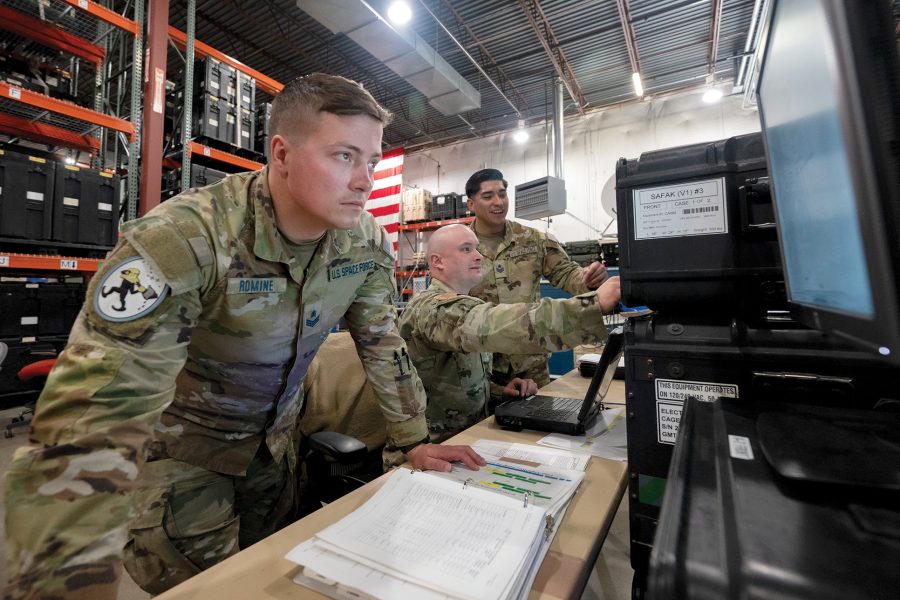
Mission Delta 3, which is responsible for training and presenting electromagnetic warfare operators, is running the first SEWTOC location in Colorado Springs, Colo., where it’s integrating two key space EW systems: Bounty Hunter and a signal jamming system called the Remote Modular Terminal.
Delta commander Col. Angelo Fernandez told reporters Dec. 11 at the Spacepower Conference in Florida that the new operations center construct supports CFC’s move toward a more hybrid approach to deploying EW systems both at home and in theaters around the world. He noted that the mission delta is increasingly focused on providing long-range EW fires that can be delivered at scale and with the same level of precision that an advanced aircraft would provide.
“We could have weapon systems forward in the theater, operators in the rear, and vice versa,” Fernandez said on the sidelines of the conference. “What it does is it brings this resiliency layer to our current posture to be able to conduct and meet the global demands levied on our teams and then have them tactically aligned with the appropriate combatant commander.”
Mission Delta 3 has a plan to stand up more SEWTOCs and integrate additional systems into the hub, including the Meadowlands jammer, an upgrade to the Counter Communications System that is slated to enter operations next year. Fernandez declined to discuss specific timelines and possible locations but did say the expansion would be swift.
“We’re rapidly trying to accelerate on every front, whether it’s modernizing our weapon systems or ensuring our tactical operation centers are established,” he said.
The creation of the SEWTOC is part of a broader shift in the way the command presents forces to either detect threats or counter them with space effects.
“There are efforts in motion today across multiple mission deltas to create locational redundancies for operational capabilities,” a spokesperson for the command said.
SATCOM Hub
Combat Forces Command has also established a second new operations center in recent months, this one focused on satellite communications, according to Lt. Gen Gregory Gagnon, who took the helm at Combat Forces Command in November. Gagnon said Dec. 12 during the Spacepower Conference that the new SATCOM Operations Center, or SOC, is focused on better integrating satellite communications capabilities.
The SOC was formally established in September, according to the command spokesperson, and its creation is distinct from CFC’s push to replicate its capability hubs across multiple locations. Instead, the center consolidates narrowband, wideband, and protected SATCOM operations, led by Mission Delta 8, on a single operations floor. The SOC plans to incorporate commercial SATCOM capabilities by the end of this year, the spokesperson told Air & Space Forces Magazine. The command does not yet have a plan to integrate international partners into the SOC.
Those center will also bring together “real-time intelligence teams,” and cyber defense systems that allow operators to quickly respond to enemy jamming attempts or other space-enabled electromagnetic interference, the spokesperson said.
“When we give our Guardians more advanced tools and capabilities, they impress us by taking us to the next level,” CFC’s Senior Enlisted Leader Chief Master Sgt. Michael Rozneck said in an emailed statement. “Our Guardians, with their expertise and collaboration, are now better postured to maintain connectivity of the joint and combined force while fighting through jamming.”