
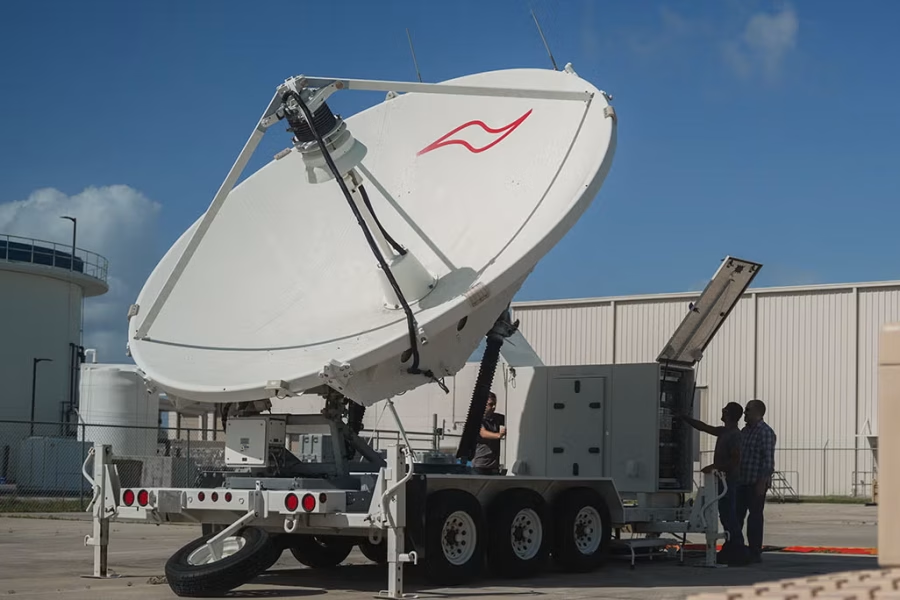
The Space Force has accepted the first production unit of its Meadowlands satellite communications jammer from prime contractor L3Harris and is poised to start using the system in operations next year.
The compact ground-based satellite signal jammer is designed to be easier for military units to assemble and operate than its predecessor, the Counter Communications System. L3Harris handed over the first two Meadowlands development systems in April, and the company announced Dec. 11 it has since delivered its first production unit. Jeff Hanke, president of L3Harris Space Systems, told Air & Space Forces Magazine the firm has now completed multiple production units, and is on track to hit a delivery cadence of one system per month.
L3Harris also produced the baseline CCS. The Space Force awarded the company an initial $120 million contract in 2021 to upgrade and simplify the system to make it more mobile and user-friendly. There are currently 16 CCS systems in the field, according to an L3Harris fact sheet.
L3Harris declined to provide Meadowland’s unit cost, but Hanke said the company is repurposing the original CCS hardware. The upgrade work, which is being done at L3Harris’ Palm Bay, Fla. facility, involves replacing the CCS electronics, reducing from 23 to seven the number of boxes required to transport the system, and updating the trailers used to move it in the field.
“It’s kind of a win-win for them,” he said in a Dec. 11 interview. “They get a great system that’s new, more mobile, more compact, easier to use, more updatable and more capable as far as mission goes. The part about it being mobile also makes it very survivable.”
Meadowlands is one of just a few space weapons USSF officials have acknowledged publicly. As the service grows more wary of threats from adversaries targeting U.S. space systems, it’s looking to increase its electromagnetic warfare capabilities like Meadowlands to jam enemy satellites.
Col. Angelo Fernandez, commander of the Space Force’s EW-focused Mission Delta 3, told a small group of reporters Dec. 11 that Meadowlands is particularly well suited to disrupt “long haul” communications that might be used in austere environments like the desert. Fernandez and Chief Master Sgt. Kevin Pfister, MD-3’s senior enlisted leader, said their teams have been involved throughout the Meadowlands design, development, and testing process, have had positive feedback on the system, so far.
“It requires less lift, it requires less space, it requires less external demands on any location that you would put that system to employ it,” Pfister said on the sidelines of the Spacepower Conference in Orlando, Fla. “It also allows you to backhaul and operate from anywhere worldwide that we have an operation center set up.”
Fernandez said mobility is key for his force, which is evolving to include both forward-deployed and U.S.-based operations centers. From a system performance perspective, Fernandez said, Meadowlands allows operators to target multiple signals at a faster rate than the previous CCS variant.
“The Meadowlands system has far exceeded anything we expected,” he said. “When you look at what we’re driving forward to the joint force in terms of combat credible capability, it’s meeting that and then some.”
As Meadowlands progresses toward a steady production cadence, the system has caught the eye of U.S. allies, Hanke said, and the Space Force is working to make it available to foreign military sales customers. The company recently cleared a key FMS milestone for the system, completing an international initial baseline review.
“It will be a very exciting time in the next, I’ll say, three to five years, how much you’ll see Meadowlands grow to other countries,” Hanke said.
The system will be among the first Space Force programs with an FMS component, according to Maj. Gen. Stephen Purdy, the Space Force’s acting acquisition executive. In a Dec. 12 media briefing, Purdy said Meadowlands provides a unique learning opportunity for the service in terms of foreign sales.
“It helps us exercise the process of FMS at a higher level than what we’ve been doing,” Purdy said. “Exercising the process and getting us all familiar with who’s got what roles in a larger system like that is very helpful.”
Requests from foreign militaries to buy U.S. space capabilities has doubled since 2023—from around 40 to nearly 80 this year. That includes both FMS cases as well as other Defense Department programs, like Building Partner Capacity and Foreign Military Financing, which are also designed to support and facilitate international access to U.S. military technology. The service expects the dollar value of such cases to grow to between $10 and $12 billion over the next three to five years.
Purdy said the Space Force needs more resources and personnel to manage the growth it’s projecting, and Meadowlands could help it prove that it’s ready to take on a heavier case load.
“Meadowlands is hugely helpful to showcase, ‘Hey, we’re learning how to do this process. We can execute it successfully,'” Purdy said.