
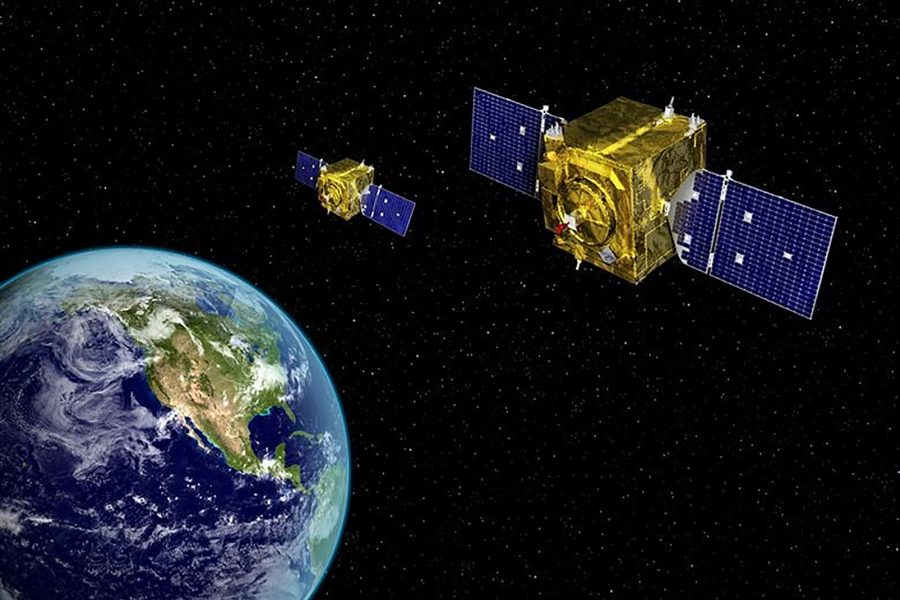
The Space Force chose an initial pool of 14 contractors to compete to build a constellation of maneuverable satellites designed to observe and track activity in geosynchronous orbit.
The service awarded a total of $1.4 million in initial funding, it announced April 8, under an indefinite delivery, indefinite quantity contract that could be worth as much as $1.8 billion. The program, known both as Andromeda and RG-XX, will field a fleet of small satellites to augment, and possibly replace, the Geosynchronous Space Situational Awareness program constellation with lower-cost spacecraft the service could replace or refresh as threats evolve.
The award comes less than three months after the service released a request for proposals in January. The service selected a mix of firms—from larger primes like Lockheed Martin and Northrop Grumman, to smaller companies like Redwire Space Missions and True Anomaly.
The Space Force hasn’t said how many satellites it needs to populate the Andromeda constellation, though former acting acquisition executive Maj. Gen. Stephen J. Purdy Jr. has said the service wants “as many as possible”—and quickly. Officials have said the satellites could come online as soon as 2030. Col. Bryon McClain, program executive officer for space combat power, said the initial cadre of firms will help inform its long-term plan for the program, including how many satellites it will need and whether they’ll need to be refuelable.
“We intend on using this very first period with our IDIQ to really help us refine the requirement with industry as a partner in this, instead of us just doing an architecture and a design saying, go build this,” McClain told reporters in January. “We’re trying to lay the groundwork for bigger service decisions that haven’t been made yet.”
The Space Force sees Andromeda as a means to fill a growing need from U.S. Space Command for more maneuverable reconnaissance satellites that can quickly change orbits, a concept the command calls dynamic space operations. It’s among the first programs to consider including a requirement that spacecraft have a gas tank that can be refueled in orbit, a feature that could help enable the mobility SPACECOM needs to respond to threats from adversaries like China and Russia.
After this initial phase, the service is planning “on-ramps” to add new companies to the contract and use it as a mechanism to upgrade Andromeda’s technology on a regular basis. McClain said he hopes the partnership with industry provides a strong demand signal for the kinds of technology and capabilities the service wants firms to invest in—an approach that’s in line with the push from Pentagon leadership to adopt acquisition approaches that make it easier for non-traditional and commercial firms to compete for defense work.
“The IDIQ allows us to narrow down the vendor pool, which allows vendors to focus their internal investments on our mission needs,” he said. “I want competition, I want short buys, but I also want to have a lane, a future, that industry sees that they can leverage for their investments.”
The fiscal 2027 budget doesn’t include a dedicated line item for Andromeda, and the Space Force’s detailed budget books have yet to surface. Higher-level Pentagon documents released April 3 propose $1.3 billion for “space situational awareness programs”—a $528 million increase over fiscal ’26—but it’s not clear if Andromeda is included in that total.
The 14 firms selected for Andromeda:
- Anduril Industries
- Astranis Space Technologies
- BAE Systems, Space Mission Systems
- General Atomics Electromagnetic Systems
- Intuitive Machines
- L3Harris Technologies
- Lockheed Martin
- Millennium Space Systems
- Northrop Grumman
- Quantum Space
- Redwire Space Missions
- Sierra Space
- True Anomaly
- Turion Space
