
Space Force acquisition leaders say they’re worried the lapse in funding for the Small Business Innovative Research program could impede the service’s efforts to leverage commercial technology and innovation.
The Air Force and Space Force are among the biggest users of SBIR and Small Business Technology Transfer Research contracting mechanisms, which provide seed funding to small firms whose capabilities could benefit government agencies. For the Defense Department, the program has helped create a needed bridge between innovative companies and the military’s complex acquisition bureaucracy.
The Space Force, through the Air Force Research Laboratory and its SpaceWERX innovation hub, is using SBIR contracts to experiment with on-orbit refueling technology, mature concepts for more resilient position, navigation, and timing capabilities, and explore dynamic space operations concepts like maneuverable spacecraft buses.
Funding for the SBIR program lapsed in late September as Congress failed to resolve a longstanding debate around how to implement guardrails that prevent companies from abusing the program. Officials had hoped the Fiscal 2026 National Defense Authorization Act would include a provision to fund the program for another year while that debate continues, but the compromise version of the legislation released in early December omitted such language.
Space Force acquisition leaders said during the annual Spacepower Conference in Orlando, Fla., that while concerns around how to manage the program may be legitimate, the abrupt pause in funding is disruptive to a number of ongoing efforts and could make it harder to work with smaller, innovative firms over the long term.
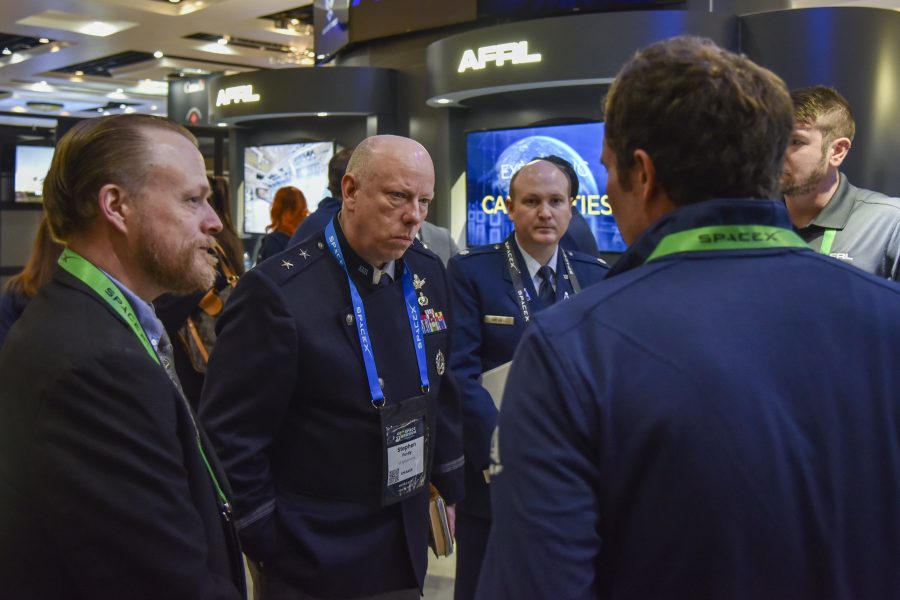
“I’m actually very concerned,” Maj. Gen Stephen Purdy, acting Space Force acquisition executive, told reporters Dec. 12.
Space Rapid Capabilities Office Director Kelly Hammett voiced similar sentiments to reporters in a Dec. 11 briefing. The Space RCO, which is focused on responding quickly to some of the Space Force’s urgent capabilities needs, relies heavily on AFRL and SpaceWERX to foster disruptive technology companies through programs like SBIR. Hammett said there are a few efforts that could be in limbo if Congress doesn’t reauthorize the program.
One of those efforts involves dynamic space operations, a high priority for U.S. Space Command leaders who say operators need the ability to more rapidly maneuver in orbit. The Space RCO has been reaching out to smaller firms through AFRL and SpaceWERX to help build out a concept for developing a product line dedicated to building satellite buses, payloads, and other capabilities that could enable that freedom of maneuver. Its plan to release a request for proposals by the end of this year is on hold due to the SBIR funding lapse.
“We’re at a little bit of an impasse right now,” Hammett said.
He noted that he’s sympathetic to some of the concerns about the effectiveness of the SBIR and STTR programs, whose low-dollar awards—between $100,000 and $300,000 for proof-of-concept work and up to $2 million for research and development projects—tend to result in more studies than products. Hammett and his team have pushed to raise the value of those contracts and to focus on more mature capabilities that are more useful to the Space RCO.
While SBIR and STTR contracts may be on the smaller side, Purdy said their worth extends beyond their dollar value. In the private sector startup community, they serve as a show of government interest in a company’s technology—an often vital validation that firms use to generate additional funding from venture capital investors. That private investment in emerging space technology is critical for the Space Force, Purdy said, and it has helped fund companies that went on to compete for USSF programs like RG-XX, Resilient GPS, and Protected Tactical SATCOM-Global.
“I can’t lose that vital feeder,” he said. “There’s a valley of death that we’ve been able to bridge in our little ecosystem.”