
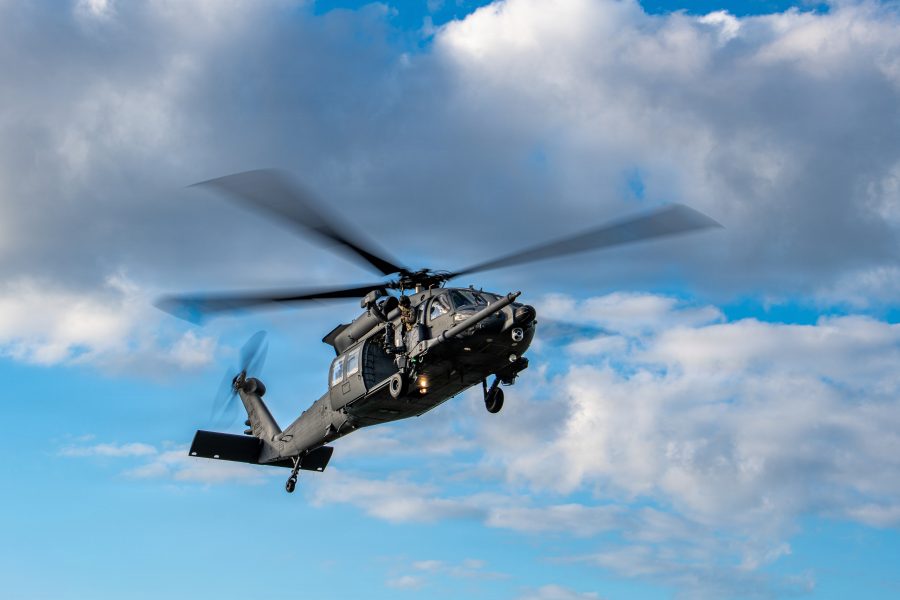
Poor event planning and staffing contributed to a fatal mishap last April at Kadena Air Base, Japan, when rotor wash from an HH-60W helicopter knocked over a Japanese teacher from a Department of Defense Education Activity school attending a public aerial demonstration, according to an Air Force investigation.
The victim, a 60-year-old woman, was standing just 95 feet away from the helicopter’s landing zone when the sudden, powerful wind from the rotor wash knocked her down on a concrete walkway, causing severe head injuries that led to her death several days later. In an Accident Investigation Board report released Jan. 21, investigators cited the civilian’s age and an umbrella she was holding as contributing factors to the mishap, along with a false confidence in the demonstration’s safety on the part of the aircrew.
The April 22 aerial demonstration was taking place at Kadena Elementary School in recognition of the “Month of the Military Child.” Similar events took place at multiple schools on Kadena in 2023 and 2024, but the landing at Kadena Elementary was new in 2025. The HH-60W belonged to the 33rd Rescue Squadron.
Investigators found that planners for the 2023 and 2024 demonstrations developed a concept of operations that called for spectators to stay 600 feet away from the helicopters’ landing zones. That was 100 feet farther than the 500-foot minimum distance required in the Air Force instruction governing such events.
Yet when the project officer and the site survey lead for Kadena Elementary were establishing spectator zones for the 2025 event, they chose three areas all within 160 feet of the landing zone. The planners later told officials they based their site placements based on estimated distances from the previous years’ demonstrations and an Air Force manual governing helicopter landing zone operations—but that manual is intended for military operations, not civilian demonstrations.
What’s more, one of the three spectator zones was meant to be along the north side of a road, about 130-140 feet from the landing zone, but the planners never specifically wrote down any guidance and only communicated their plans verbally, leaving it up to school administrators to create their own seating charts. When they did, they included the south side of the road and a covered walkway in the spectator zones, less than 100 feet from the landing zone.
When the demonstration took place, the aircrew in the HH-60W didn’t initially see the spectators under the covered walkway. The copilot later told investigators he would have radioed the ground controller “to move spectators from the south side of the road to the north side of the road had they been visible,” per the report.
As the helicopter came down to land in a field, it created powerful winds with its rotor wash. Analysis from the HH-60W program office later determined that the victim likely experienced an average wind speed of 29 miles per hour, reaching gusts up to 40 miles per hour.
“There were 22 spectators in the immediate vicinity of the [victim] at the time she experienced the strong gust of rotor wash (19 children and three adults),” the board report states. “All 19 children were involuntarily displaced by the wind gust, and the three adults were either involuntarily displaced or voluntarily moved their body to protect against the rotor wash. Witnesses who stood near the [victim] on the covered walkway described the rotor wash as a severe or significant ‘blast.’ Other witnesses along the road described being pushed by the wind or needing to brace against it to avoid falling.”
The woman was carrying a closed umbrella that got caught in the rotor wash and was forced open, yanking her down onto the concrete walkway.
“Her head struck the concrete at an accelerated speed that caused head injuries much more severe than typically expected from a routine fall,” the report states.
Bystanders attended to the teacher and contacted emergency medical services. She was quickly transported, unconscious, to a hospital and diagnosed with a brain bleed. She died from her injuries April 27.
Investigators determined the primary cause of the mishap was insufficient distance between the HH-60W and the spectators—some were just 78 feet from the helicopter’s flight path. The insufficient distance was the result of “failures in mission planning and poorly staffed oversight processes.”
The lead project officer, for example, “had no prior experience planning an aerial demonstration and appeared to have no dedicated planning support in the form of assistants or training,” investigators wrote. The ground controller responsible for monitoring the landing zone was asked to fill in for a missing volunteer the day before the event and received minimal instructions.
Planners submitted two separate approval packages for the event, both of which “incorrectly provided assurances that all spectators would remain 600 feet from helicopter [landing zones].” The one that was eventually approved didn’t even list the Kadena Elementary School landing zones. Planners also weren’t familiar with the Air Force instruction governing aerial events and didn’t provide written or recorded instructions.
The accident investigation board found that the lackadaisical approach was caused in part by the fact that the 33rd Rescue Squadron approached the mission with a false sense of security. Because members of the unit are used to conducting dangerous and highly technical missions—including ones that require “the ability to land a helicopter within a foot of a military member on the ground”—they considered the civilian event routine and did not consider how civilians might react differently to rotor wash.
Yet studies on rotor wash have shown there is a significant difference, investigators noted, particularly if the civilian is holding an umbrella or is older. Given the victim’s circumstances, she was at a particularly heightened risk.
“Our investigation found that the aviators involved in the aerial demonstration . . . were confident they were not putting spectators at risk, attested to by the fact that many had family members watching the demonstration from the school’s spectator areas,” the report concludes. “The mishap at [Kadena Elementary School]—with the tragic loss of a longtime DoDEA teacher and deeply respected community member—regrettably makes clear that their well-meaning confidence was misplaced.”