
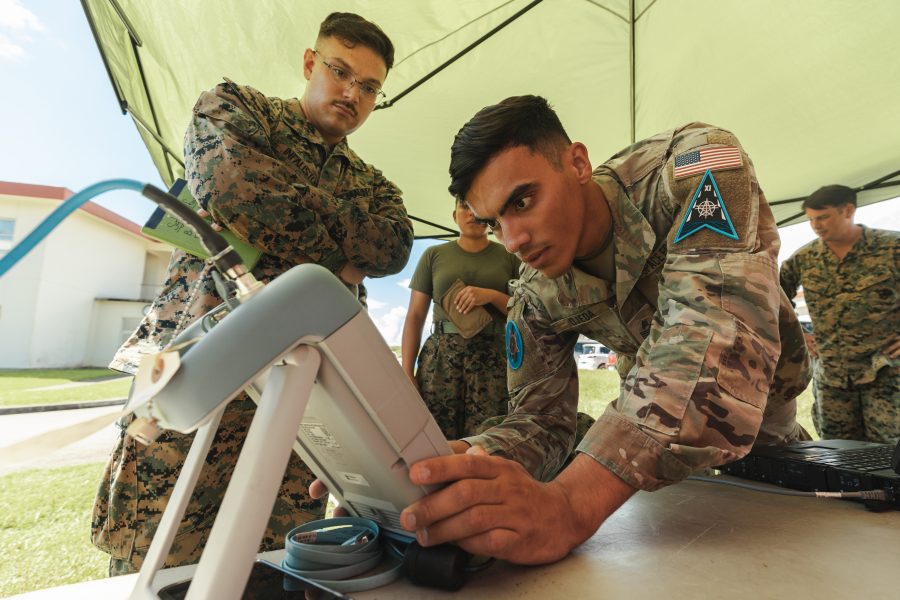
For decades, the Pentagon has viewed space as a “supporting” domain to enable operations in the land, sea, and air. But a new report from AFA’s Mitchell Institute for Aerospace Studies argues the time has come to consider how ops in those domains can now support space.
While the Space Force and U.S. Space Command still have the fundamental responsibility to gain and maintain superiority in orbit, they need support from across the entire U.S. military to achieve the level of control they need to operate freely in the domain, Jennifer Reeves, senior resident fellow for space studies, argues in the report.
Leaders from the other military branches and COCOMs are talking more and more about the importance of space capabilities and how those capabilities are coming under threat from U.S. adversaries. But across the Pentagon, there is still a belief that the responsibility for countering and defending against those threats falls largely on the Space Force and SPACECOM.
“The prevailing and historic mindset in the Department of Defense is that space is a supporting domain,” Reeves writes. “This must change to reflect the new reality—operations in all domains are needed to support space operations.”
Reeves recommends that the Pentagon needs to go back to the basics to make that change happen, starting with four lines of effort:
- Commission a comprehensive review of space roles and missions
- Increase investment in technologies that address key gaps and integrate cross-domain effects
- Improve basic knowledge of space capabilities and concepts across the joint force through “targeted professional military education reform”
- Integrate space superiority concepts and capabilities in major theater exercises
Speaking with reporters Dec. 4, Reeves said the goal of a roles and mission review is twofold: to ensure the department is focused on the right space missions and to identify potential duplication among the missions the missions it performs today.
“What we need to be looking for are the gaps and seams,” Reeves said. “We need to ensure that we’re fulfilling all the missions that should be fulfilled, and that talks to effectiveness. At the same time, we want to ensure that we’re not unintentionally duplicating missions, flying in the face of efficiency in times when it could be dangerous as well as fiscally constrained, and we are wasting money on duplicative systems and missions.”
Similar to the 2001 Rumsfeld Commission—which assessed U.S. national security space management and organization and recommended the creation of a separate “Space Corps” within the Air Force decades before the Space Force was established—the review would look across the military services, combatant commands, and the intelligence community, Reeves said. The newest service was in part created to bring clarity and leadership to the space enterprise, she noted, and it’s time to measure whether that has, in fact, occurred over the last six years.
“It is past time to review the entire national security space architecture to evaluate whether greater transformation and further deliberate reassigning of responsibilities is needed to achieve the intended streamlined and centralized space control establishment,” Reeves wrote in the report.
That sort of clarity is key for both operations and acquisition, she said, noting that programs like Golden Dome—the department’s effort to create an advanced, multi-domain homeland missile shield—will require it.
The capability gaps and overlap identified as part of that roles and missions review would inform Reeve’s recommendation that the department invest more strategically in new technologies as well as existing systems. That investment, the report states, should focus on capabilities from the other services that support space superiority, like sensors, communication links, and electronic warfare systems.
“For the United States to secure space superiority, it must possess satellite-, ground-, and link-segment counterspace systems that are responsive to an agile threat,” the report states. “Clearly, these systems operate in all the domains, not solely in space. All services must work to field systems to conduct these operations and make them available for joint, cross-domain space superiority operations.”
On military education, Reeves argues that personnel across the military services should be introduced to basic space concepts and core missions early in their careers. She also recommends the department incorporate space concepts into joint professional military education and establish an advanced PME track focused on space, similar to what each of the other services offer.
“The new advanced space PME will be an opportunity for joint education, thus advancing a deeper understanding of space superiority within all services,” the report states.
Finally, Reeves advocates for an expansion of space effects and superiority concepts in joint exercises. While many cross-domain training events already explore the implications of losing access to space capabilities, she noted that these exercises often don’t include an in-depth look at what’s causing that interference and how to bring systems back online.
“Commands must practice the cross-domain counterspace operations required in conflict,” Reeves wrote. “Budgets must also reflect these requirements—whether discussing people, technology, or training. Warfighters from different services and competencies must practice together to get it right before real resources, capabilities, and lives are at stake.”