
The Pentagon’s counter-drone task force announced it will conduct a high-energy laser test with the Federal Aviation Administration less than a month after the use of a military laser on the southwest border prompted the FAA to shut down the airspace over El Paso, Texas.
The FAA’s abrupt Feb. 11 decision came after U.S. military units operating on the U.S.-Mexico border allowed U.S. Customs and Border Protection agents to use the military laser system. The shutdown only lasted a few hours, but it caused confusion and panic among lawmakers and public officials. Experts quickly labeled the incident as a “case study” on the complex web of authorities needed to employ such weapons near civilian areas and the consequences of agencies failing to coordinate properly,
Now, the Joint Interagency Task Force 401 and the FAA will conduct a test March 7-8 at White Sands Missile Range, N.M. to “specifically address FAA safety concerns while gathering data about the laser’s material effects on aircraft surrogates, validating the functionality of automated safety shut-off systems, and informing analyses for aircrew eye safety,” according to a March 6 Pentagon announcement.
“This is a critical step in making sure our warfighters have the most advanced tools to defend the homeland,” Army Brig. Gen. Matt Ross, Director of JIATF-401, said in the announcement. “By working hand-in-hand with the FAA and our interagency partners, we are ensuring that these cutting-edge capabilities are safe, effective, and ready to protect Americans from emerging drone threats. Our measure of success is to quickly deliver state-of-the-art [counter-unmanned aerial system] capability to the warfighter, and this test furthers that mission.”
U.S. Northern Command, Joint Task Force Southern Border, and the Army’s Portfolio Acquisition Executive for Fires also helped to coordinate the test. Representatives from the Department of Energy, National Nuclear Security Administration, Department of Homeland Security, Customs and Border Protection, and the New Mexico National Guard are also expected to attend.
U.S. officials have remained tight-lipped about the Feb. 11 incident except to say it involved Mexican drug cartels flying drones at the border. NORTHCOM boss Air Force Gen. Gregory M. Guillot told lawmakers in March 2024 that roughly 1,000 incursions by unmanned aircraft systems occur daily along the U.S.-Mexico border.
The incident was the latest high-profile example of the threats drones—even small, cheap ones—present to the U.S. homeland. While this threat was at the border near the Army’s Fort Bliss, the Air Force has been dealing with the issue since December 2023, when unidentified drone swarms flew unchecked over Joint Base Langley-Eustis, Va., for several days. Other drone incursions followed over air bases in Ohio, Utah, and other locations, compelling the Air Force and its sister services to place a top priority on finding ways to detect, identify, track and, if necessary, bring down these small, inexpensive drones.
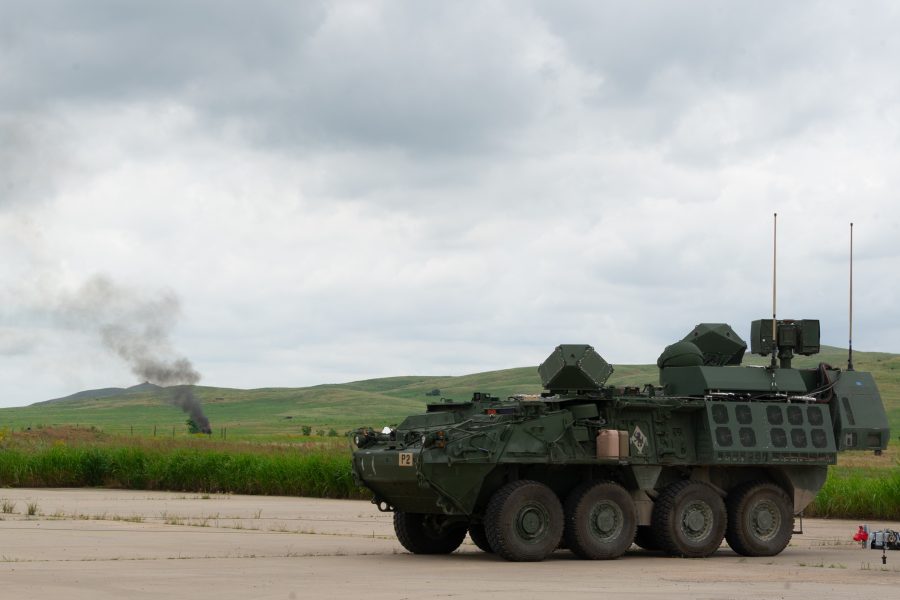
It’s unclear what laser technology was used in the El Paso drone incident. Reuters reported that the Army had deployed AeroVironment Inc’s LOCUST laser counter-drone weapon system near El Paso International Airport. AeroVironment delivered two Joint Light Tactical Vehicles equipped with 20 kilowatt laser systems to the Army in December as part of the second increment of the Army Multi-Purpose High Energy Laser prototyping effort. The Army has also conducted numerous tests of its Directed Energy Maneuver-Short Range Air Defense, or DE M-SHORAD, that’s equipped with a 50-kilowatt laser for counter-drone operations.