
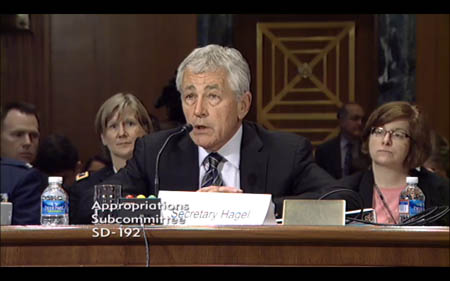
 A lot has changed since the Defense Department first announced the planned “pivot to the Pacific” last year. For example, North Korea has become more volatile, forcing the Defense Department to protect its assets in Guam, Hawaii, and South Korea, Defense Secretary Chuck Hagel told members of the Senate Appropriations Committee’s defense panel on June 11. Over the last few months, the department has “repositioned resources and capabilities” in the region, said Hagel. “A good deal of my time has been devoted to that part of the world.” But, such changes come at a cost and the US’ fiscal future also has changed with the implementation of sequestration. “There have been additional costs. There may be [more] additional costs,” said Hagel. Army Gen. Martin Dempsey, Joint Chiefs Chairman, told legislators during the same hearing that sequestration “absolutely” will affect DOD’s ability “to produce capability and capacity.” Dempsey said the Strategic Choices Management Review, which assessed the impact of further sequestration-related reductions on the department, will determine at what point the defense strategic guidance announced last year “will potentially be rendered unfeasible.” He added, “That work should become clear in the weeks ahead.” (Hagel prepared testimony) (Dempsey prepared testimony)
The Air Force has finished resurrecting a B-1B Lancer, completing a yearslong process to transform a bomber that had been stored for parts in the Arizona desert into the new flagship of the 7th Bomb Wing at Dyess Air Force Base, Texas.