
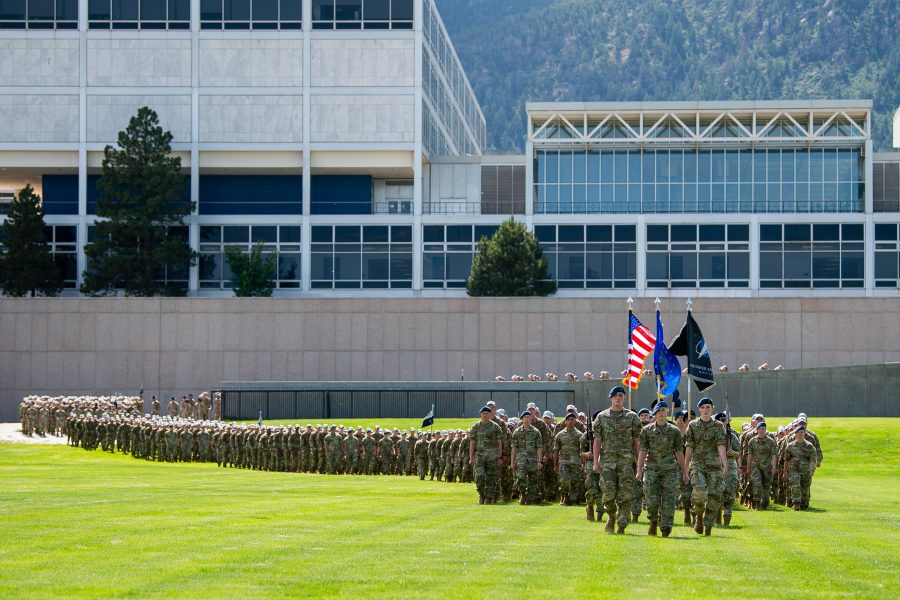
The U.S. Air Force Academy should grow its cadet corps by 10 percent and build a “home” for the U.S. Space Force on site, rather than create an entirely new service academy, a congressionally mandated oversight committee writes in a new report.
USAFA’s Board of Visitors—comprised both of members appointed by the President and multiple members of Congress—briefed its conclusions to Air Force Secretary Troy E. Meink on Feb. 5. Board Chair Rep. August Pfluger (R-Texas), a member of USAFA’s class of 2000, said the report calls for a “generational investment” in all the military service academies to modernize facilities and enhance programs.
The Air Force Academy’s ’s 1950s-era infrastructure is in dire need of upgrades and modernization, the report says, and includes in its recommendations a proposed “tri-complex” of buildings to house a new “Air, Space, and Cyber Education Center.”
The goal is to encourage Meink and Defense Secretary Pete Hegseth to begin implementing recommendations in the fiscal 2027 budget request, due to Congress this spring.
“I am immensely proud that the U.S. Air Force Academy Board of Visitors has completed a forward-focused, comprehensive report for Secretary Hegseth outlining concrete recommendations to strengthen the Academy’s institutional effectiveness,” said Pfluger, a former F-22 pilot, in a statement. “At a time when global operations continue to highlight the decisive role of airpower, these recommendations reflect our commitment to ensuring the Academy remains focused on and equipped to develop the warfighters and leaders needed for future complex, multi-domain conflict. I look forward to working with Secretary Hegseth and Secretary Meink to turn these recommendations into lasting improvements for the Academy and our Air Force and Space Force.”
The Academy’s cadet wing has hovered around 4,000 members in recent years, down from more than 4,300 a decade ago and consistently fewer than the 4,300-4,400-member corps at the U.S. Naval Academy and U.S. Military Academy.
The Board of Visitors blamed the shortfall on budget cuts dating back to sequestration, rather than lack of interest, and the implications of smaller graduating classes have grown greater as the school’s mission has expanded to serve two services, rather than one.
“Restoring the Air Force Academy cadet wing to its pre-sequestration level of 4,400 is a strategic necessity,” the board report stated. “This increase is critical to compensate for the graduates who now commission into the newly formed Space Force, ensuring the Air Force’s officer production numbers remain robust. Furthermore, this action would re-establish parity with our sister service academies, reinforcing the Air Force Academy’s standing as a premier institution for developing future military leaders.”
A 10 percent increase in the cadet wing would essentially match the share of USAFA graduates who commissioned into the Space Force over the past four years, which has stood between 9.5 percent and 10.2 percent in that time. By comparison, the Naval Academy—which also feeds into two services—contributes about a quarter of its graduates to the Marine Corps.
The Marine Corps, of course, is far larger than the Space Force, but as USSF leaders pursue an aggressive expansion plan in the years ahead, its appetite for new officers will continue to grow. In 2021, Sen. Tommy Tuberville (R-Ala.), a former Auburn University football coach, suggested the Space Force may one day need its own service academy, but he is now a member of the Board of Visitors, which concluded in its report that such an idea is off the table.
“The cost of land acquisition and construction of academic, housing, and training facilities for a standalone institution would be substantial,” the board wrote. “By leveraging the existing infrastructure of the Air Force Academy, we can provide world-class facilities for our [future] Guardians at a fraction of the cost, ensuring responsible stewardship of taxpayers’ dollars.”
Instead, the board proposes a new complex of three buildings:
- A “home” for the Space Force: The plan would provide future Guardians a “dedicated center for professional development and esprit de corps,” the report states.
- An Unmanned Aerial Systems Center of Excellence: Noting that both the Naval Academy and West Point already have drone programs, the board asserts that “the Air Force Academy should be leading the other Service Academies in drone research, tactics, techniques and procedures, and adaptation for future warfare.” The Air Force did have an Unmanned Aerial Vehicle Center of Excellence at Creech Air Force Base, Nev., 21 years ago, but closed it to make way for a Joint Center. USAFA, the board argues, is a perfect location for a new Air Force center, because of its ample airspace.
- Multi-Domain Operations: Co-locating different departments in the complex will “enable the convergence of effects by physically and organizationally integrating cadets and faculty from disparate fields,” the report states, encouraging them to think of ways to use air, space, and cyber effects holistically, instead of in stovepipes.
“The United States cannot meet tomorrow’s national security threats with yesterday’s constraints,” said Rep. Don Davis (D-N.C.) in a statement. “Restoring the Air Force Academy to 4,400 cadets, addressing our aging infrastructure, and providing Space Force Guardians with a permanent home are mission-critical to maintaining American dominance in air and space.”
Increasing enrollment and building new buildings means overcoming challenges. Faculty cuts imposed by sequestration was a driving factor in reduced admissions, and USAFA’s faculty is in the midst of another transition following a wave of faculty resignations in 2025 in response to the Department of Government Efficiency’s Deferred Resignation Program. In addition, the academy is in the midst of a leadership overhaul in which its top positions will all change this year.
The board notes that the ratio of civilian to military instructors grew over the past decade, and wants the Air Force Manpower Analysis Center to review faculty requirements to determine the best possible blend of civilian and military instructors. “The audit should [also] include an assessment of the number of faculty and staff required if cadet end strength was increased to 4,400,” the report states.
The recent leadership overhaul, in which Superintendent Lt. Gen. Tony Bauernfeind and Commandant of Cadets Brig. Gen. Gavin Marks will both retire this year presents a separate challenge. The school is also getting a new Dean of Faculty; following a months-long vacancy, Col. James Valpiani has been nominated for that job.
Meanwhile, investing in new buildings will come up against pressing needs for other infrastructure work for a facility approaching 70 years old. “The majority of … infrastructure, built in the late 1950s, has far exceeded its expected lifespan,” the report states. “This has led to significant life-health-safety concerns, with degraded conditions causing health incidents among cadets.”
The board called on the House and Senate Armed Services Committees to “prioritize robust and sustained funding” for USAFA infrastructure improvements beginning with the 2027 National Defense Authorization bill. More broadly, the report argues that “reinvesting in [all] our nation’s Military Service Academies” should be a major theme of the 2027 NDAA, akin to past focuses on acquisition reform or service member quality of life. It seeks a congressionally directed commission to study the issues facing the nation’s service academies, including admissions, accreditation, and athletics.
The board’s report also seeks:
- A review of discipline procedures at USAFA after questions about due process and transparency in how each academy disciplines cadets and midshipmen
- More support and communication from Academy and Pentagon leadership with the Board of Visitors, and
- Air Force funding for five board focus groups to study major issues facing the Academy
The USAFA Board of Visitors currently includes:
- Rep. August Pfluger (R-Texas), chair
- Retired Col. Doug “Stoli” Nikolai, vice chair
- Sen. Tommy Tuberville
- Dan Clark
- Dina Powell
- Robert Bigelow
- Sen. Roger Wicker (R-Miss.)
- Sen. John Hickenlooper (D-Colo.)
- Sen. Kevin Cramer (R-N.D.)
- Sen. Tammy Baldwin (D-Wisc.)
- Rep. Don Bacon (R-Neb.)
- Rep. Gabe Vasquez (D-N.M.)
- Rep. Jeff Crank (R-Colo.)
- Rep. Don Davis (D-N.C.)
Members in bold are USAFA graduates