
Congress set the legal floor for how many primary mission aircraft the Air Force had to have in its fighter force in 2018, requiring at least 1,145 fighters through Oct. 1, 2026. In each of the past past two legislative cycles, lawmakers agreed to reduce the number, first to 1,112 aircraft for fiscal 2024 and then then 1,101 for fiscal 2025.
But when the House passed the compromise 2026 National Defense Authorization bill Dec. 10, it included no such provision for the next fiscal year, putting the Air Force in potential violation of the law—presuming it started the fiscal year with about 1,101 primary mission aircraft.
A spokesperson did not immediately reply when asked how many primary mission aircraft are currently in the inventory.
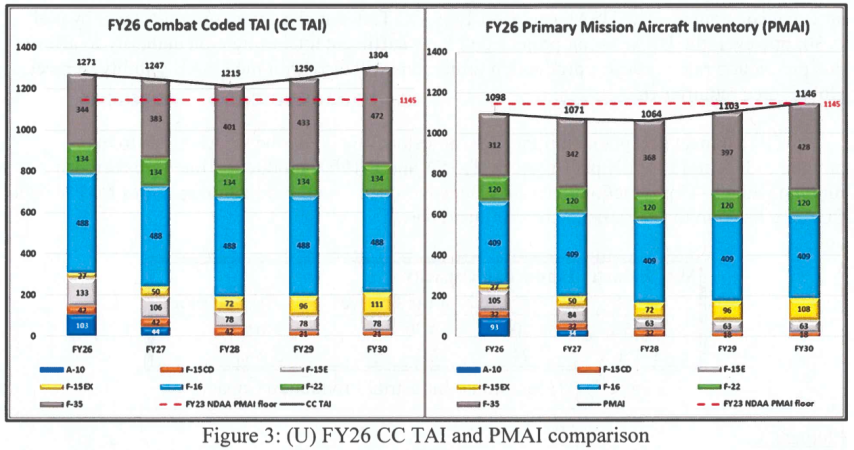
In the Fighter Force Structure report to Congress this summer, Air Force officials sought a new reprieve, this time asking for a change to the way it counts aircraft. It sought to count total combat-coded aircraft instead of primary mission aircraft, a method that would include backup aircraft and attrition reserves.
Primary Mission Aircraft Inventory (PMAI) “does not fully capture the combat capacity of the USAF and excludes 15% (on average) of the aircraft required to generate combat power, including Backup Aircraft Inventory and Attrition Reserve,” the report argued.
A graph in the report showed the impact of changing counting methodologies, noting that without the change, the USAF fighter force would fall below legal mandates until at least 2030, assuming planned future procurement and divestments were approved.
With Congress mum on the matter in the pending NDAA, however, it is unclear what impact if any will come from the apparent shortfall. The legislation now heads to the Senate, where it cleared its first procedural vote Dec. 15.
Primary mission aircraft inventory is defined as “aircraft assigned to meet the primary aircraft authorization to a unit for the performance of its wartime mission.” According to a USAF spokesperson, the Air Force’s legislative proposal submitted earlier in 2025 asked Congress to adopt CCTAI in place of PMAI in setting the minimum size of the fighter fleet. The NDAA, which typically comprises such requests, took no action.
The Air Force’s 2026 budget request proposed retiring 258 older fighter and attack aircraft while projecting deliveries of around 55 new jets, a net loss of 203. While the service did not specify how many of those jets were primary mission aircraft, it did project its PMAI at 1,098 fighters.
But the NDAA does not support the Air Force’s divestment plan, blocking 124 of the planned 258-jet cut. How many of those would qualify as primary mission aircraft is not clear, but an appendix to the fighter force report noted that exactly half of the F-15E fleet is coded as PMAI. So, assuming that 124 aircraft remain in the total inventory, and that half are primary mission aircraft, that would add 62 fighters to the PMAI. In that case, those 62 aircraft combined with the original 1,098 projected PMAI would be just enough to clear the legal threshold of 1,145.
It is unclear if further action from Congress is warranted; it is also unclear whether the Air Force will get the necessary funding to keep those aircraft crewed and operable.
While Congress could theoretically consider the legislative proposal separately, or fold it into the NDAA at the last minute, neither seems likely.
Matt Donovan, who was a professional staff member for the Senate Armed Services Committee when the floor was passed, told Air & Space Forces Magazine earlier this month that Congress established the minimum fighter inventory with the “unspoken rationale … to get the Air Force increased support for larger procurement funding, and to give them a built-in reason for it: i.e., ‘It’s the law!’”
Donovan, who went on to become Undersecretary of the Air Force and Acting Secretary during the first Trump administration, derided the Air Force’s proposed change as “putting lipstick on a pig” by trying to make the shortfall look acceptable. “No matter how much lipstick you put on a pig,” Donovan said, “it’s still a pig.”
Retired Lt. Gen. David Deptula, dean of AFA’s Mitchell Institute for Aerospace Studies, said the implications for changing the definition are broader than the Air Force let on, and argued that falling short of Congressional direction was a mistake.
“Congress gave the Air Force explicit direction and set a minimum number of primary mission aircraft that the Air Force has to maintain and operate,” he said. “In its current state, the Air Force is going to fall short of that, and changing how you count doesn’t change the underlying facts.”
Because budgets are built based on PMAI, the counting change is more complicated than just changing numbers. “Aircrew and maintenance manning authorizations are predicated only on PMAI,” he said, noting that primary mission aircraft totals are the basis for a host of decisions, and have been for decades.