
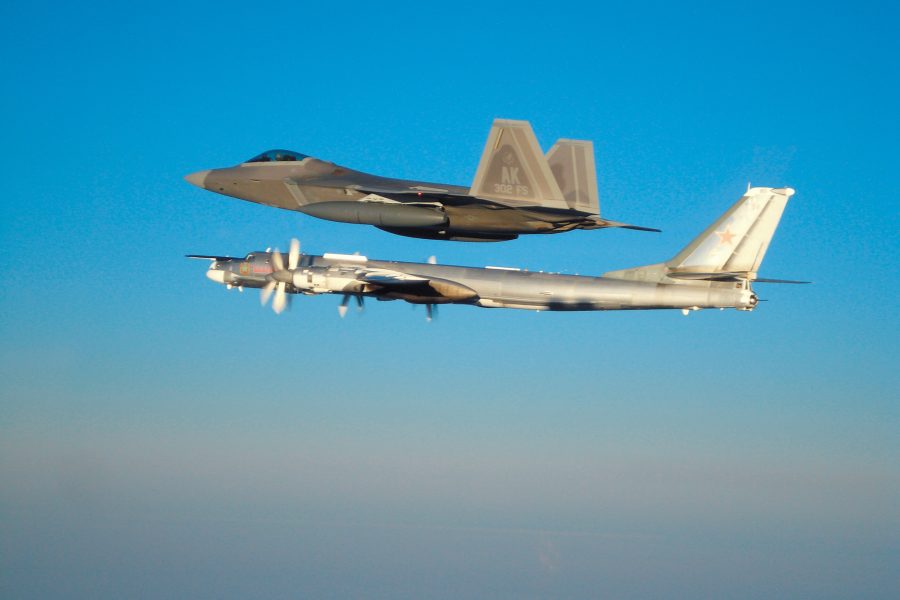
NORAD scrambled a half-dozen American and Canadian fighters, along with six support aircraft, to intercept two Russian military aircraft that entered the Air Defense Identification Zone off the coast of Alaska and Canada on March 4.
The response, which included fifth-generation F-35s and F-22s and Canadian CF-18s, is among the largest NORAD has mounted in the past decade and comes as hundreds of U.S. combat aircraft are massed in the Middle East for operations against Iran.
The Russian Tu-142s, used for maritime reconnaissance and anti-submarine warfare, entered the Alaskan and Canadian ADIZ—the international airspace just outside U.S. and Canadian sovereign airspace—but did not penetrate either nation’s airspace, NORAD said in a release.
In response, the command scrambled:
- 2 F-35As
- 2 F-22s
- 2 CF-18s
- 4 KC-135 tankers
- 1 CC-150 tanker
- 1 E-3 AWACS
Russian aircraft fly regularly off the coast of Alaska without entering U.S. airspace, and NORAD stressed in its statement that the activity was not viewed as a threat.
But the approach was the first since the U.S. launched Operation Epic Fury against Iran, and the 12-aircraft response to just two Russian ASW planes suggests NORAD wanted to send a message to the Russians. In contrast, when Russia sent two Tu-95 strategic bombers, two Su-35 fighters, and an A-50 airborne early warning and control aircraft into the Alaskan ADIZ on Feb. 19, NORAD scrambled just nine aircraft, including two F-16s, two F-35s, and five support aircraft.
This was the largest NORAD response since July 2024, when Russian and Chinese bombers flew a joint patrol off the coast of Alaska, the first such mission ever. American F-16s and F-35s and Canadian CF-18s intercepted the bombers in that instance. It was also the first time in recent years that F-35s and F-22s were scrambled together.
The Russian incursion came in the midst of Arctic Edge 26, a large-scale annual exercise that stretches from Alaska to Greenland, and involving both the U.S. and Canadian militaries.