
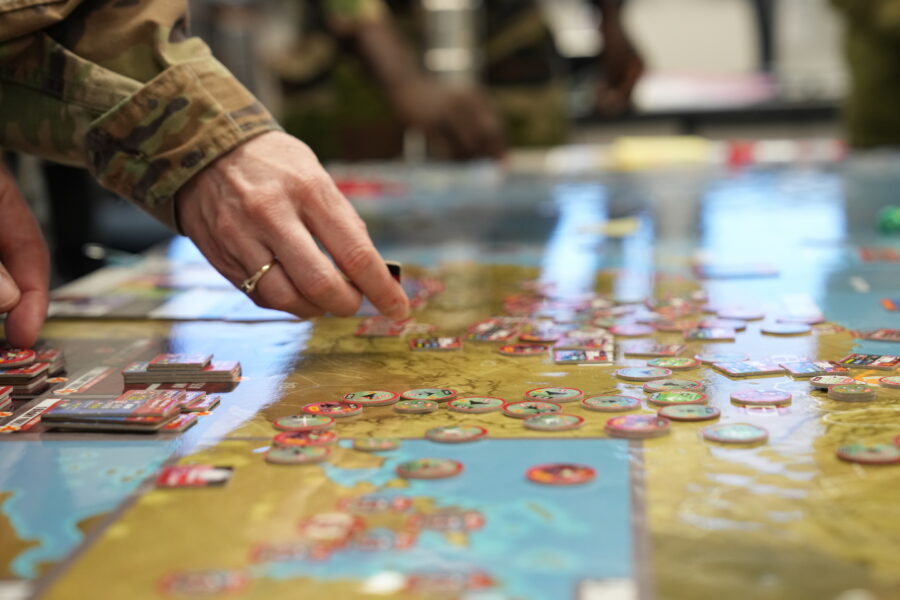
Based on its current modernization trajectory, the U.S. Air Force would not be able to repel a Chinese invasion of Taiwan in 2035 or launch strategic attacks in the ensuing conflict, according to analysis of a new unclassified wargame.
AFA’s Mitchell Institute for Aerospace Studies, which organized the wargame, released a report April 9 with insights from the game’s 60 or so participants, which included Airmen, industry officials, and allies.
The wargame’s “blue force” teams were divided into two and given different force mixes, explained retired Col. Mark Gunzinger, former deputy assistant secretary of defense for forces transformation and resources who acted as project leader for government-sponsored wargames during that time.
On one hand was “Team Doolittle,” meant to represent the Air Force in 10 years if its current plans hold. On the other was “Team Mitchell,” meant to represent a more aggressive modernization push. Notably, Team Mitchell had fewer total fighters, but more bombers, Collaborative Combat Aircraft drones, and E-7 battle management aircraft, plus the new sixth-generation F-47.
“The path the Air Force is currently on, it’s going to take you closer to the future force that Team Doolittle played in the wargame, not the more modernized Team Mitchell force,” said Gunzinger, now the director of future concepts and capability assessments at Mitchell and a coauthor of the report summarizing its findings. “It was crystal clear to the players which force they would rather take to fight, and that was absolutely unanimous across all players from all disciplines.”
Strategic Strikes
The wargame unfolded across three moves, tasking the blue teams with first deploying forces to deter and prepare to counter a Chinese invasion of Taiwan in 2035, then launching into operations to counter an invasion and launch strategic strikes on mainland China, followed by executing a protracted conflict in the event that China continues to fight even after its Taiwan invasion.
Immediately, Gunzinger said, both teams were ”on the horns of a dilemma”: If they deployed forces to U.S. bases in the first island chain to be closer to Taiwan, China’s long-range missile forces were able to inflict heavy losses, particularly on aircraft still on the ground.
“Attrition on the ground was the most significant driver of both teams discussions and operational choices. Now, our assessment of the game results indicated that both teams would have suffered more attrition for red’s missile attacks than they would have from air engagements,” Gunzinger said.
However, moving forces outside or near the end of the range of China’s missiles limited the teams’ ability to generate sorties. As a result, both blue force teams decided to send some of their forces forward while keeping others based further out. They then had to send their attacks in “pulses,” rather than applying continuous pressure.
The two teams differed, however, in their approaches once conflict broke out.
Team Doolittle’s force, more reliant on nonstealthy aircraft and standoff munitions, focused its efforts on defeating the Taiwan invasion force. Team Mitchell worked to repel the invasion force while also having “enough F-47s, B-21s, and other capabilities to attack deep into China,” Gunzinger said.
“Team Doolittle’s inability to generate enough long-range penetrating counter-air and strike stories, that was the most significant difference that affected their operational choices,” Gunzinger said.
In the end, wargame leaders determined that Team Doolittle’s approach wouldn’t work because China could continue to move forces within its borders to reinforce its invasion efforts. Team Mitchell, meanwhile, might have been able to prevent a successful Taiwan invasion in part because of its strategic strikes.
Neither force, however, was able to sustain itself in a protracted conflict—the rate of attrition was too high for the numbers of aircraft each were able to commit to the fight.
“That’s the direct legacy of downsizing the Air Force’s combat inventories year after year over the last 30 years,” argued Gunzinger.
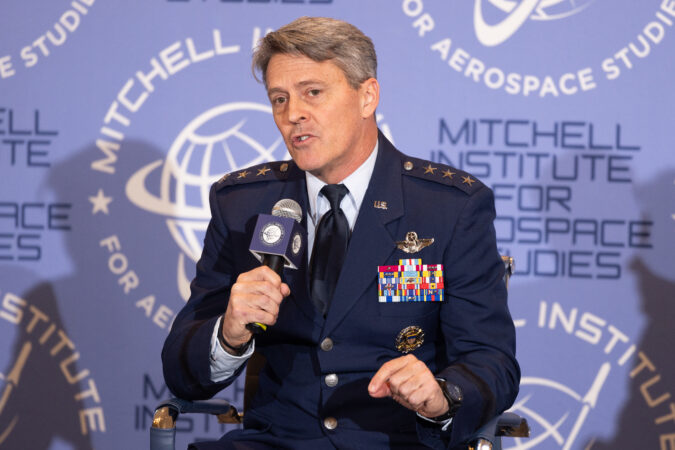
Photo by Jud McCrehin, Air & Space Forces Association
Organic Kill Chains
Lt. Gen. Jason Armagost, deputy commander at Air Force Global Strike Command, compared the wargame to a chess match—and noted that switching some of the pieces between the two blue forces fundamentally changed the entire game.
“It very clearly delineates how you can get off the constraints of the board and move and maneuver differently, to not essentially join the game on the conditions or on the requirements of the adversary chosen,” Armagost said.
That, he later added, is at the heart of strategic strike.
“What you’re trying to do through strategic attack is to compel an adversary to change their strategy, essentially to the defense, but then also to force their systems’ failure on their strategy,” he said. “And so that strategic attack approach is a really important part of the conversation, because it has to arrive from a place of resiliency and a place of optionality, and that doesn’t come from building single nodal attack blue forces that invites counter-strategic attack that could then subsequently collapse as well.”
To that end, Gunzinger said a key takeaway from the wargame participants was the need to rebalance the Air Force’s stand-in and standoff forces. A mix like Team Doolittle is over reliant on shorter-range, non-penetrating forces and long-range kill chains that are easier for adversaries to disrupt, while Team Mitchell’s B-21s and F-47s to create “organic kill chains” less reliant on external systems.
“During the … wargame, blue team players explored the potential for these next-generation combat aircraft to reduce the Air Force’s dependence on long-range kill chains and create innovative ways to defeat China’s counter-C3ISRT operations,” the Mitchell report states.
The report concluded with a dozen recommendations based on the wargame’s findings, all meant to “rebuild a balanced Air Force that has the capacity to win.” They ranged from procuring more B-21s and F-47s to improving air base defenses; balancing long-range and organic kill chains and fielding a mix of space-based and air-based intelligence, surveillance, and reconnaissance systems.
Overall, “the U.S. Congress and [Pentagon] should shift resources toward the Department of the Air Force and Department of the Navy by trading-off forces and capabilities—primarily from the U.S. Army—that will be less relevant in a conflict with China in the Western Pacific,” the report concluded. “These resources should include additional funding to allow the Air Force to defend its bases and operating locations in the Pacific’s first and second island chains.”
Or, as Armagost summed it up, citing legendary General of the Air Force Hap Arnold:
“If you want an air force that is second to none, it must do two things. It must have range and striking power, and those two things in combination can be tested in a wargaming environment, can be tested as we develop doctrines and strategies to confront the world as it is,” he said.
