
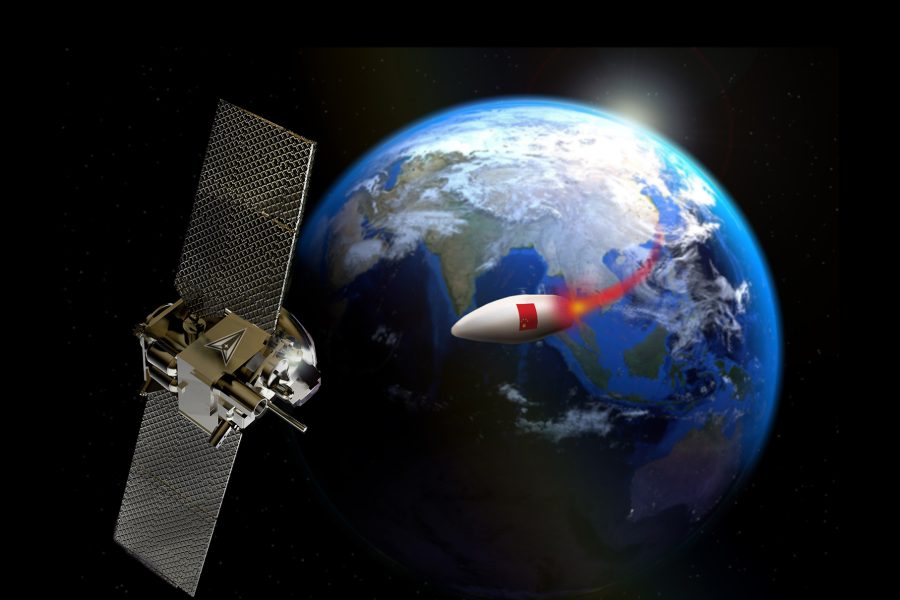
As the list of countries developing both kinetic and nonkinetic space weapons grows, more nations are investing in “bodyguard” capabilities designed to protect and respond to threats against their space assets, according to a new report.
In its annual report on the global counterspace threat landscape, the Secure World Foundation highlighted the trend toward developing new methods to shield spacecraft from adversaries. Japan, France, India, and Germany have all indicated they plan to pursue or are already building such satellites, the report notes.
“We are seeing an increase in the number of countries interested in developing ‘bodyguard’ satellites and spaceplanes, both of which have co-orbital capabilities,” the report states. Co-orbital capabilities are weapons that can maneuver and attack a target.
The concept of observing and protecting against orbital threats is not new; many spacefaring countries have satellite sensors and ground-based radars designed to monitor activity in orbit, especially as China and Russia display increasingly aggressive behavior in space. The Space Force’s Rapid Capabilities Office launched a project last year to field threat awareness sensors on satellites designed to alert operators to nearby hazards.
But bodyguard satellites or spaceplanes are distinct in that they not only observe potential threats, but they can shield and respond with counterattacks of their own. In 2019, France announced its vision to create laser-armed “patroller” satellites. Then in 2024, it joined in on a European Defence Fund project to develop an “Autonomous Space Situational Awareness Bodyguard Onboard Satellite.” The spacecraft—expected to take three years and $6.5 million to build—will not only provide elevated threat detection and monitoring, but is also designed to “counteract with a robot or laser,” according to an EDF fact sheet.
Since then, several other countries have revealed similar projects. Japan’s Defense Ministry said last year it would prototype and launch a bodyguard satellite by 2029. India is also developing a similar capability, and announced last month it will fly a prototype later this year. The Secure World Foundation report states that India’s pursuit of the capability was prompted by a 2024 incident in which one of its satellites “was approached by an unnamed neighboring country’s satellite” that reportedly came within one kilometer of its spacecraft.
Finally, there’s Germany, which was included in SWF’s report for the first time this year after releasing its first-ever space security strategy last November. In that document, the Ministry of Defence includes as one of its lines of action, “developing and using highly agile, low-signal surveillance and bodyguard satellites and reusable spaceplanes to inspect and effect an adversary’s systems.”
The U.S. Space Force hasn’t discussed whether it plans to develop a bodyguard-like space vehicle or whether it already has such a capability in orbit. The SWF report notes that China and Russia have speculated that the service’s largely classified X-37B spaceplane, operated by its orbital warfare-focused Mission Delta 9, could carry destructive weapons to target other satellites. The vehicle’s mission is largely classified, but SWF writes that based on known information about its size, shape, and orbit, the vehicle’s ability to host weapons is likely “limited.”
“Its limited gliding capability and maneuverability makes it not militarily useful as a orbital bomber,” the report states. “Based on tracking data from hobbyists, the X-37B historically has orbited between 300 and 400km and at inclinations between 38 and 54 degrees with a ground track that repeats every few days. This strongly indicates a likely remote sensing mission, perhaps by flight testing new payloads.”
However, the report notes that even if the spaceplane doesn’t fit the profile of an “orbital bomber,” its potential use as a test platform for other offensive space capabilities can’t be ruled out.
“The failure to catalog the deployed satellites—something that has been done even for classified U.S. military and intelligence satellites—calls into question the trustworthiness of the public [space situational awareness] data provided by the U.S. military,” SWF states.
A separate report, published April 6 by the Center for Strategic and International Studies, illuminates one of the possible drivers of increased investment in satellite protection and counterspace capabilities. The report highlights a pattern of “unusual behavior” by Chinese satellites observed in geosynchronous orbit between 2016 and 2025.
While a large portion, around 86 percent, of China’s 109 GEO-based satellites didn’t perform any substantive maneuvers, the report identified 75 maneuvers that are consistent with potential military or intelligence operations, including signals intelligence, refueling, communications, and reconnaissance. The report also highlights eight satellites as the “unusual movers.”
“To an observer on the ground, most satellites in GEO appear to be stationary,” the report states. “But the stationary use of this orbit is changing. Some satellites stalk the GEO belt, slipping between certain inhabitants and creeping up toward others. The U.S. Space Force has criticized Chinese GEO satellite operators for making ‘norm-shattering’ movements in orbit.”
