
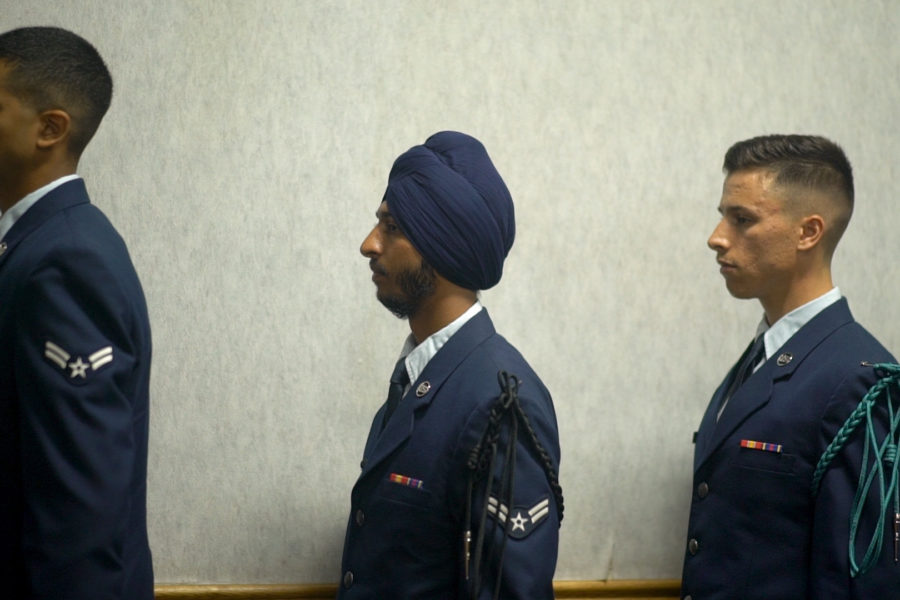
The Pentagon recently put out new guidance for evaluating requests for religious accommodations to grooming standards—a lengthy new process that could make it more difficult for some Airmen and Guardians to keep their beards.
Defense Secretary Pete Hegseth’s latest step to crack down on facial hair requires service members currently granted religious accommodations to wear beards to submit a new request for review by June 11 that includes a “sworn written statement affirming that the requester’s belief is sincerely held and religious in nature,” according to a March 11 memo posted on Reddit. A Pentagon official confirmed the memo’s authenticity to Air & Space Forces Magazine.
In a speech to high-ranking generals and senior non-commissioned officers last September, Hegseth made clear that he wants to cut down on the number of service members with facial hair.
“No more beardos,” he said. “The era of rampant and ridiculous shaving profiles is done.”
Sikhs, Muslims, and other religious groups have been permitted to wear beards in uniform under religious accommodations since 2010. But Hegseth argued that those accommodations have spiraled out of control.
“We don’t have a military full of Nordic pagans, but unfortunately, we have had leaders who either refuse to call BS and enforce standards, or leaders who felt like they were not allowed to enforce standards,” he said.
In a memo released the same day as his speech, Hegseth wrote that the religious accommodation standards were reverting back to pre-2010 status and that “documentation demonstrating the sincerity of the religious or sincerely held belief will be a central factor in evaluating accommodation requests and must be sufficient to support a good faith determination by the approving authority.”
The new guidance issued March 11 implements that memo by laying out in detail the new process for religious exemptions.
Airmen and Guardians, as well as new recruits, requesting religious accommodations to wear beards must submit requests that provide the following:
- A sworn written attestation affirming that the requestor’s belief is sincerely held and religious in nature.
- A statement describing the specific religious belief that is the basis of the request for a religious exemption.
- An explanation of how the requirement to be clean shaven substantially burdens the requestor’s exercise of religion.
- Supporting information or evidence that demonstrates the applicant’s religious belief is sincerely held such as “personal testimony, participation in religious observances, or corroborating statements from religious leaders or community members.”
Service members that make “false statements may be subject to disciplinary action under Article 107 of the Uniform Code of Military Justice, or denial of accession, as appropriate,” the memo states, adding that “determining the sincerity of a religious belief and whether a military policy, practice, or duty substantially burdens a service member’s exercise of religion is a critical component of the review process.”
After reviewing the memo, retired military officials said they hoped that the strict new guidelines will not discourage individuals who are devout in their religion from serving in the military.
“No American should be forced to choose between their faith and their desire to serve in the military,” said Alex Wagner, who served as Assistant Secretary of the Air Force for Manpower and Reserve Affairs in the Biden administration. “These new requirements seem purpose-built to make the process more burdensome for religious service members.”
Normally these types of policies are left up to the individual services, but former Chief Master Sergeant of the Space Force Roger A. Towberman said that this is likely the result of individuals finding ways to “game the system” to acquire religious exemptions.
“If your religious doctrine prescribes you to wear a beard, and it can be done safely and without creating mission risk, then it should not prohibit your service,” Towberman told Air & Space Forces Magazine.
But Towberman stressed that top-down policies usually occur in the military when service members start pushing the system by “publishing how-to guides” to get around requirements of a policy.
“Anybody that’s going to pretend that the system wasn’t being gamed is lying,” he said.
Towberman is not the first to say this. Retired Maj. Gen. Randall E. Kitchens, former Air Force Chief of Chaplains, said in October that some applicants figured out ways to game the system by using “the correct wording to get religious accommodations approved.”
Towberman said he saw similar policies created to govern tattoos in the military. “When I came into the military in 1990, the tattoo policy was fairly simple, and people were expected to use good judgment,” he said. “But over time, people were showing up to work with staples in their face.”
“When you push an institution, when you force it to say what you can and can’t do, it’s never going to end well for you,” Towberman added. “Policy is really, really hard to write and it’s going to be too restrictive and you’re not going like it. It just happens, especially with dress and appearance stuff.”
Under the new guidelines, commanders must provide input on specific information concerning whether a requestor is will be “expected use of protective equipment (e.g., helmets, masks, and firefighting respirators) and scheduled deployments, exercises, or assignments.”
Hegseth’s Sept. 30 memo on “Grooming Standards for Facial Hair Implementation” stated that beards, goatees, and other facial hair could interfere with a proper seal on a chemical protective mask or firefighter respirator. Beard waivers for religious accommodations “will be limited to non-deployable roles with low risk of chemical attack or firefighting requirements,” the memo states.
The March 11 memo doesn’t mention about service members failing to comply with Pentagon’s new beard policy being flagged as non-deployable, a status that makes Airmen and other service members vulnerable to administration separation if they go 12 consecutive months without deploying.
Commanders are also required to provide any contextual information that could impact a the approval authority’s decision such as “contradictory or inconsistent statements and conduct, and any evidence suggesting that the request may be based on personal preference or convenience.”
Applications must also include input from the requestor’s first-line supervisor on “character of the individual and adherence to service values,” the memo states.
Each service has until April 11 to submit implementation plans to the Undersecretary of War for Personnel and Readiness.
Currently, the Air Force does not track how many Airmen and Guardians have shaving waivers under religious accommodations because those decisions have previously been approved or denied at the installation commander level, an Air Force official said.
“We are currently in the planning phase to create an implementation plan to ensure Airmen and Guardians with current waivers are in compliance with the new guidance,” the Air Force official said.
The new guidelines direct that the approval authority for religious accommodation requests can be no lower than each service’s chief of personnel, who “must maintain accountability of the disposition of requests for religious accommodations permitting facial hair and implement measures to ensure they are notified of changes in circumstances, including anticipated operational requirements, that merit reevaluation of approved requests,” the March 11 memo states.
Overall, Towberman said he doesn’t “see the new policy as fundamentally different from old policies—a deeply held religious belief is supposed to be validated and documented. I see this as a necessary pathway to accommodation, not an impossible hurdle.”