
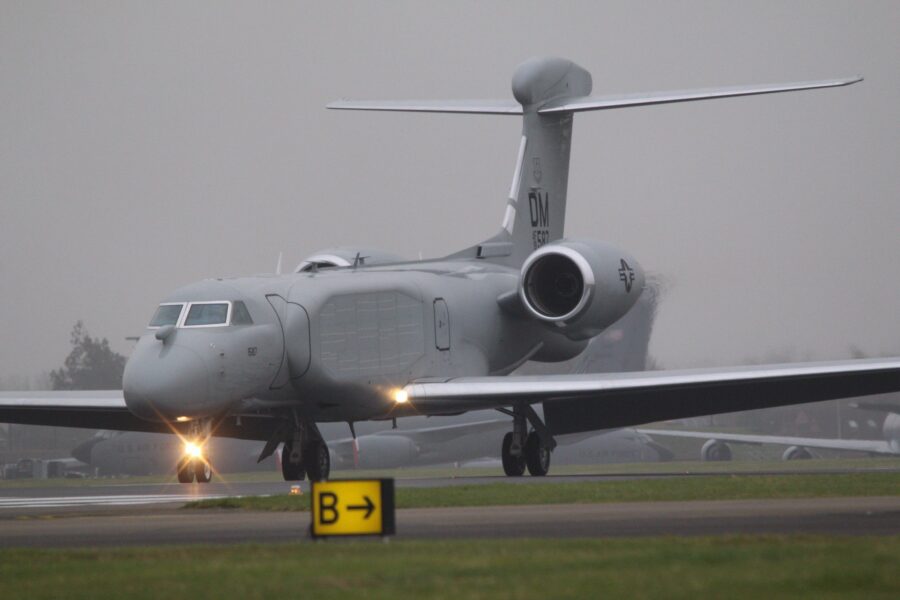
A pair of the U.S. Air Force’s EA-37B Compass Calls have been spotted at RAF Mildenhall in the United Kingdom, sparking speculation that the new electronic attack jets are headed to engage in operations against Iran.
Online flight trackers this week noted that two EA-37Bs—which are heavily modified Gulfstream G550 aircraft, loaded with electronic warfare equipment—departed Davis-Monthan Air Force Base in Arizona on March 30 and later landed at Mildenhall, using the call signs AXIS 41 and AXIS 43.
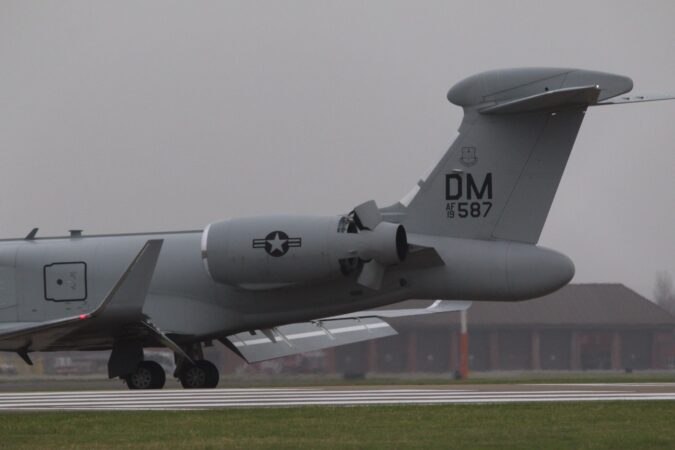
Photographs of an EA-37 at Mildenhall surfaced on social media March 31. The photographed plane bore markings on its tail indicating it was assigned to Davis-Monthan and showed the extensive fuselage modifications to accommodate electronic warfare equipment typical of an EA-37.
The Air Force now has five EA-37s, out of a planned fleet of 10. The planes will conduct multiple electronic warfare missions, including jamming enemy communications, radar, navigation, and other signals, and suppress enemy air defenses by blocking the ability of weapon systems and command-and-control networks to share data.
The EA-37 can fly nearly 770 miles per hour at up to 45,000 feet, with a range of 4,400 nautical miles, according to Air Combat Command.
The EA-37 is replacing the Air Force’s aging and dwindling fleet of EC-130H Compass Calls, which were created from C-130 airframes that date back to the Vietnam War era and have become increasingly hard to maintain. Over the last decade, the Air Force’s EC-130 fleet has dwindled from 15 down to four, even as the Compass Call played critical roles in operations like the war against the Islamic State and the withdrawal from Afghanistan.
EC-130s have been flying electronic warfare missions against Iran as part of Operation Epic Fury over the last month.
U.S. Central Command declined to comment on EA-37B movements, citing operational security reasons.
The 355th Wing at Davis-Monthan confirmed to Air & Space Forces Magazine that it has three EA-37B aircraft assigned to it, but declined to comment on their potential movements. Since May 2025, Airmen have been conducting training sorties there on the new Compass Call, which has not previously flown any operational deployments. The Air Force’s two other EA-37s are test aircraft.
Heather Penney, a former F-16 pilot who is director of studies and research at the Mitchell Institute for Aerospace Studies, said the Air Force has a track record of sending nascent aircraft into operations when there is a pressing need. She cited the 1991 deployment of two developmental E-8 Joint Surveillance Target Attack Radar System planes to take part in Desert Storm, and the use of an early version of the MQ-1 Predator in 1995 as examples of capabilities that were deployed sooner than expected and performed admirably.
Those early deployments “were not only operationally advantageous, but they fundamentally shaped and changed the way we did combat,” Penney said.
If the Air Force sends the EA-37 into operations, Penney said, it would be a noteworthy moment and demonstrate it can be successfully used in an operational environment.
“We need more of these” aircraft, Penney said. “Being able to control the electromagnetic spectrum is so crucial to modern and future warfare, and I think it has been under appreciated, because we’ve seen an under investment in these kinds of capabilities. There is this perception that you cross the red line on the threat map and you vaporize, and it’s just not how this works.”
And, Penney said, there would be no reason to fly two training EA-37s to the U.K. other than to send them into operations.
“The training assets are going to be just as capable as fielded assets,” Penney said. “It would be completely rational to deploy those assets if there was an urgent need. … If you’re just doing training operations, especially during wartime, you’re not going to get the kind of [temporary duty] funding it takes to go to Mildenhall and drink beer. That’s not what that trip’s going to be about.”
Pentagon Editor Chris Gordon contributed to this article.