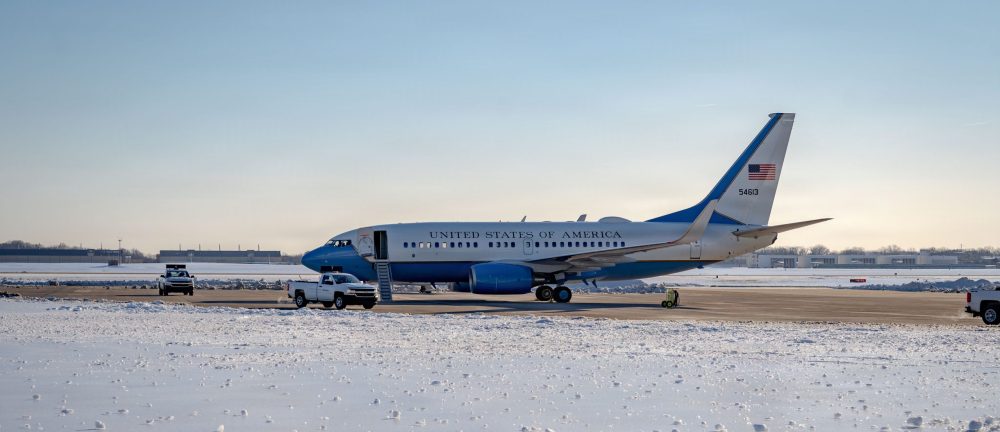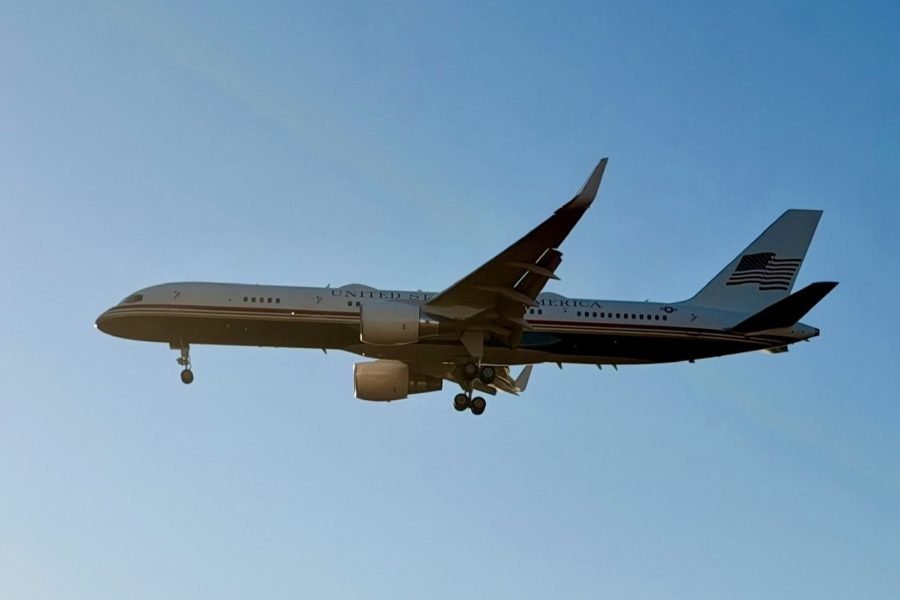
The next “Air Force One” presidential aircraft and other planes in the Air Force’s VIP transport fleet will soon have a new paint scheme—one preferred by President Trump and similar to the one painted on the president’s personal 757 aircraft.
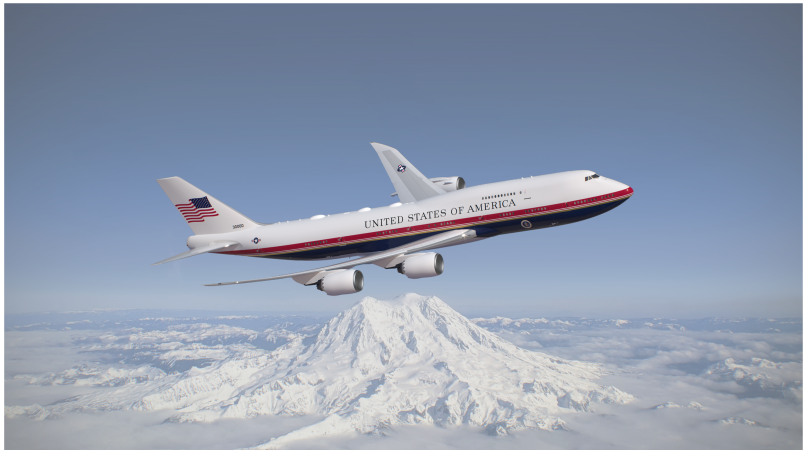
The Air Force officially unveiled the livery Feb. 18, releasing an artist’s rendering of a future VC-25B “Air Force One” in the new colors, which it identified as the “official paint scheme for Executive Airlift.”
The move confirms the service will be ditching the iconic light blue-and-white livery it has used on Air Force One and other VIP aircraft since the Kennedy administration, which First Lady Jacqueline Kennedy helped shape. Instead, the aircraft will be primarily white, red, and dark blue.
A C-32A, a modified Boeing 757 jetliner outfitted with secure communications equipment, is the first Air Force aircraft with the new livery. It was painted in the colors when it was in for scheduled maintenance, service officials said. The aircraft was photographed in its new paint scheme by an aircraft spotter who goes by @tt_33_operator on Instagram, who shared the photos with Air & Space Forces Magazine.
Also set to get the new paint job: the 747-8i gifted to the U.S. from Qatar last year, as well as the two future VC-25B aircraft being modified by Boeing to replace current VC-25A “Air Force One” aircraft that have been in service since the early 1990s, an Air Force spokesperson said.
The previously Qatari-owned 747-8i is being converted into a “bridge VC-25” and is expected to fly this summer, service officials have said. The jet is being modified by defense firm L3Harris, which works on other specialized Air Force aircraft, people familiar with matter said. The VC-25B is expected to be delivered in mid-2028, according to the Air Force’s latest timetable.
Four C-32s, known as “Air Force Two” when they carry the Vice President and which are also used by other cabinet officials, typically the Secretary of State and Secretary of Defense, are also being repainted, the Air Force spokesperson said.
The announcement of a new paint scheme is the first official reversal of course on the appearance of the Air Force’s VIP planes from the Biden administration’s plans. In 2023, the Air Force announced that the new VC-25B would feature a scheme very similar to the current Air Force One aircraft, reversing course from the design of the aircraft depicted when Trump agreed to a deal with Boeing for the new aircraft in 2019.
“The Air Force is implementing a new paint scheme requirement,” for its executive aircraft, the spokesperson said. The scheme was described as “red, white, gold, and dark blue” by the Air Force: white on top, with red and gold lines down the middle and a dark blue underside, quite similar to the design Trump originally favored in 2019.
In addition to the color change, the new scheme depicts the American flag waving rather than a large, static American flag, as seen on the light blue-and-white livery currently painted on the “Air Force One” VC-25As and other aircraft.
At least on the freshly painted C-32A and VC-25B, the aircraft will also prominently feature the “Stars and Bars” roundel, which is carried on most U.S. military aircraft, toward the rear of the planes. The VC-25B scheme also carries the presidential seal, as does the current VC-25A.
The Air Force spokesperson did not say who ordered the new paint scheme requirement.
“A change in paint requirements is not expected to result in additional delays or costs to the program,” the spokesperson said.
The C-32A with the new livery, tail 99-0003, has been operating from Majors Airport in Greenville, Texas, where L3Harris has facilities that support specialized aircraft, since December, according to flight tracking data. It was spotted flying last year in its traditional light blue-and-white color scheme. It was later seen airborne stripped of paint and in green primer earlier this month, before being painted in the new scheme. It carries no visible tail number, in line with a policy implemented by Air Mobility Command during the Biden administration, which U.S. officials say is for operational security.
“The C-32s will be painted during regularly scheduled maintenance,” the Air Force spokesperson said. “The first C-32 has been painted and is expected to be delivered to the Air Force in the next few months.”
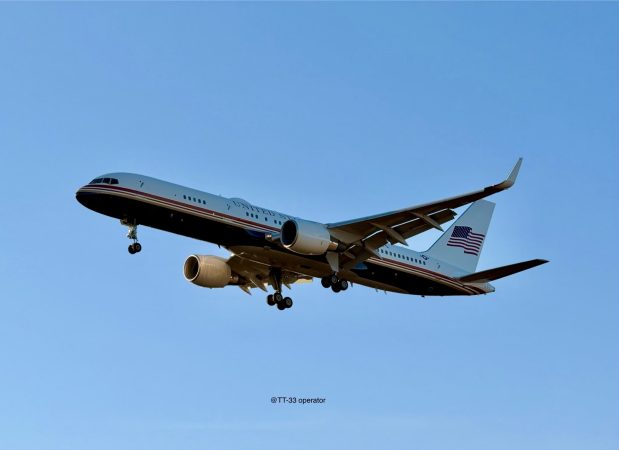
When the Biden administration changed the paint scheme in 2023, the Air Force said that the dark blue belly of Trump’s design “would require additional Federal Aviation Administration qualification testing for several commercial components due to the added heat in certain environments,” per a press release at the time.
The newly painted C-32A appears to be white or light grey on the belly, an area that carries communications antennas and other specialized equipment, indicating that the undersection of the plane is not entirely painted the previously troublesome dark blue. It is unclear if the underside of the future VC-25Bs will be entirely dark blue or carry a lighter color part on the belly of the aircraft.
There have been signs that Trump’s preferred scheme would be used for a variety of VIP government aircraft. For months, Trump has had a model of a VC-25B in his preferred colors on a table in the Oval Office. Last month, a modified Gulfstream G700 flown by the Coast Guard, known as the Long Range Command and Control Aircraft, was spotted carrying the new scheme last month, with the addition of the seal of the Department of Homeland Security, to which the Coast Guard belongs, painted behind the jet’s first passenger door. In addition, a Boeing Business Jet 737 airliner with a civilian registration that appears to be tied to the U.S. government has been sporting the livery in recent months.
The Air Force’s executive airlift fleet is flown by a highly selective, specially trained team of Airmen from the 89th Airlift Wing. The Air Force’s VC-25As and C-32As, along with C-40s and C-37s are assigned to the unit. C-40s and many C-37s carry the old executive airlift scheme, and it is unclear if and when those aircraft will be repainted.