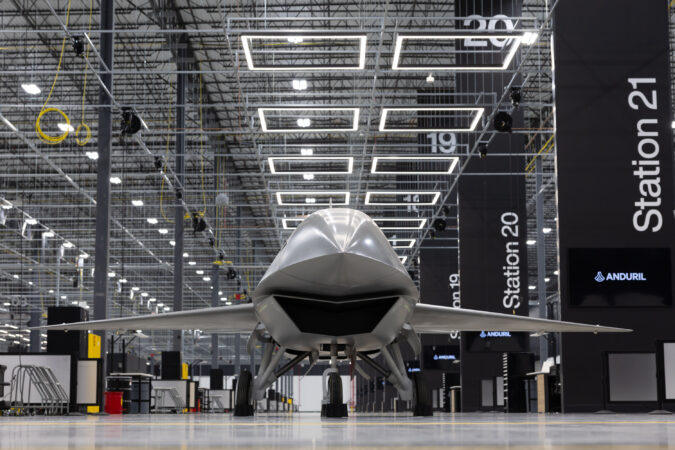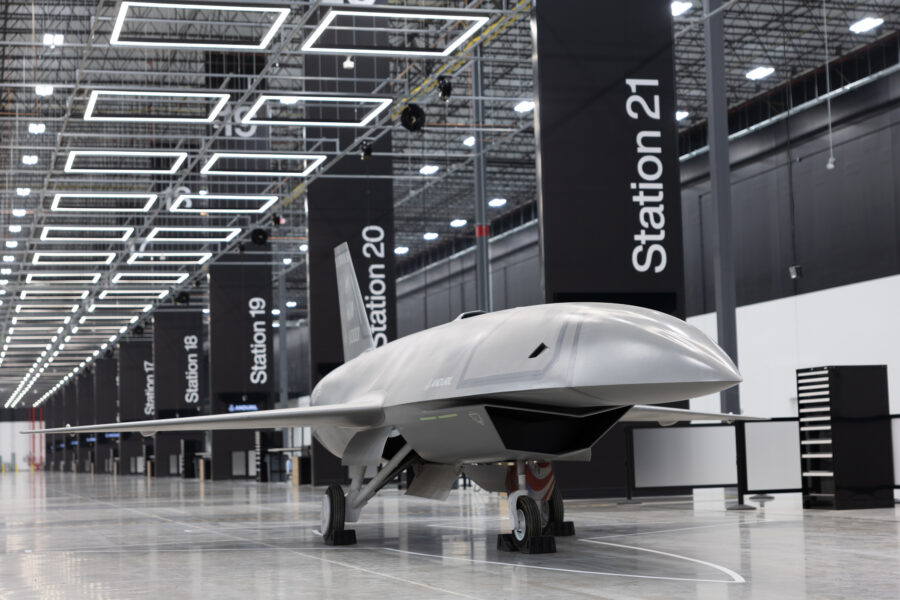
PICKAWAY COUNTY, Ohio—Anduril Industries has begun production of its YFQ-44A “Fury” Collaborative Combat Aircraft drone at its Arsenal-1 plant here, the company said March 23.
Along with General Atomics’ YFQ-42A, Anduril is competing for the first increment of the Air Force’s CCA program. The Air Force has not yet said how many Collaborative Combat Aircraft it plans to buy, but Anduril officials were bullish as they showed reporters around the sparse factory floor late last week.
Keith Flynn, Anduril’s senior vice president of production, told reporters the apparently barebones look of the facility is “explicitly the intent. We need to deploy capacity as fast as we possibly can.”
For a company that has made its name building weapons that can operate autonomously, the Arsenal-1 factory is decidedly hands-on.
“You’re not going to see complex equipment. You’re not going to see a bunch of robotics.” Flynn said of the plant. “How do we go about doing this in a way that is actually going to allow us to ramp as fast as possible? And then once we’re ramped, we can all look for all sorts of opportunities.”
The company says its initial goal is to produce some 50 aircraft per year. Its longer-term hope is to expand capacity to 150 aircraft with additional shifts as the company hires more workers, though it has yet to receive orders for that many aircraft. Anduril executives said they expect the first aircraft to roll off the production line this summer.
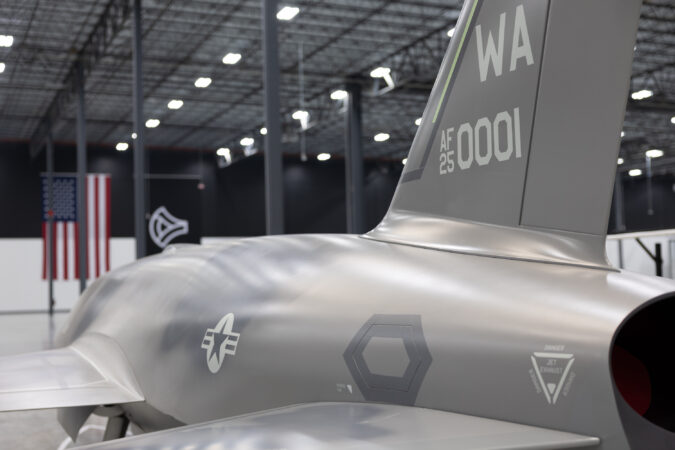
The company declined to say how many Fury jets are currently under contract under a development contract with the Air Force, nor how many have been produced so far. Company officials say they believe Arsenal-1 can meet the Air Force’s needs if Anduril is awarded the production contract for the YFQ-44A, and that the production aircraft would be similar to those built so far.
Located amid farmland and fields some 20 miles outside Columbus, the Arsenal-1’s exterior was a hive of activity as the company builds out additional factory space, with heavy machinery surrounding the site. That work continued as the company led a tour of the facility just before production of the company’s CCA began.
The factory is located near Rickenbacker International Airport, where the company says it is building a hangar for ground testing at the site. The firm expects to employ 250 people at the Arsenal-1 facility by the end of the year, with 4,000 people hired over the next decade.
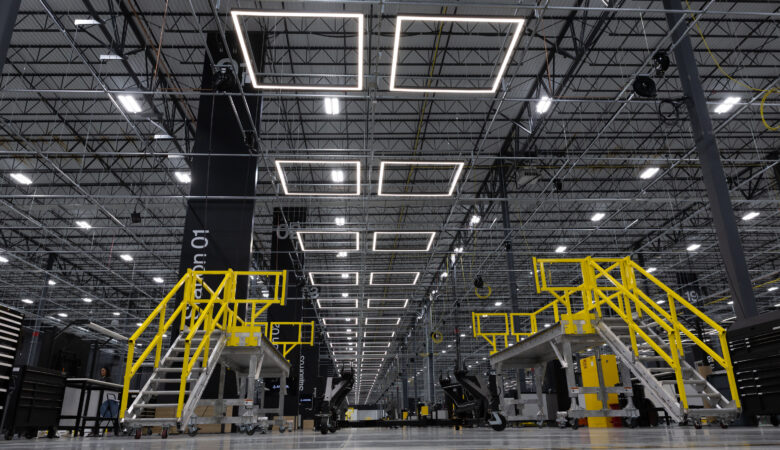
Arsenal-1 consists of a large hangar-like building with some 22 workstations for Fury production. As reporters toured the site, it was largely empty save for the workstations and a few cubicles in the center of the facility.
The first four stations for the Fury at Arsenal-1 focus on the aircraft’s structure. The following stations assemble the aircraft’s complex inner workings, including hydraulic systems, fuel lines, and avionics. Once the aircraft is halfway through the stations, the landing gear is installed, followed by the wings and the engine. The final few stations focus on testing, during which the aircraft is supported by its own landing gear. Around 30 workers are building the first batches of the YFQ-44A to be produced in Ohio and were trained at the company’s facilities in California.
“The aircraft is pretty simple, therefore the process is simple,” said John Malone, the head of production for autonomous airpower at Anduril. “We are definitely automation-free to start here.”
The company says 94 percent of the components for the YFQ-44A are commercially available and that prototypes are not expected to differ much from production aircraft. The aircraft is powered by a commercial business jet engine. The company says the aircraft has some 5,000 “line item” parts.
Some YFQ-44As have already been produced at the company’s existing facilities, and the aircraft is undergoing testing by the Air Force.
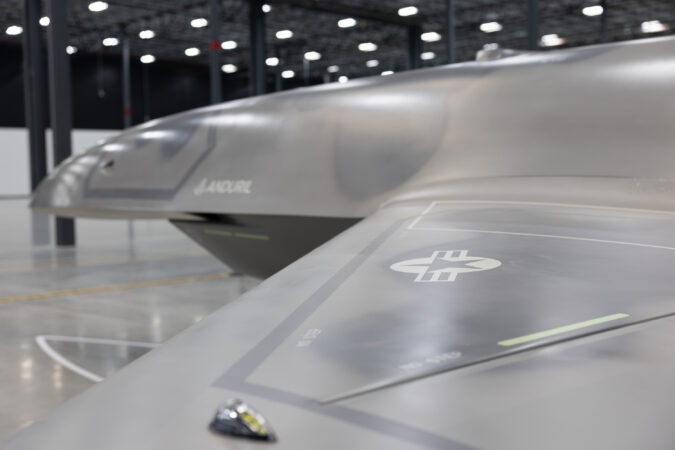
But the Fury won’t be the only system built here. The company’s Roadrunner vertical takeoff and landing drone, its Barracuda cruise missiles, and a classified program are all expected to be produced at the factory by the end of the year, Anduril officials said. And even as reporters toured the facilities, construction was ongoing on the other side of a wall for a separate weapons program.
“We’re specifically designing our factories to have as few monuments as possible and to be as flexible as possible—meaning that few big gantry cranes or big test rigs or big fixed-in-place-things that can’t move,” said Matt Grimm, the company’s co-founder and chief operating officer.
Indeed, there is very little fixed manufacturing infrastructure at the site, as is often seen at some aircraft plants. The company says it is intended to increase flexibility and change processes if required.
“If we had decided to make a massive robot that installs the wings, for example, it would be very hard for us to change it ever,” Malone said. “Instead, we have maximum flexibility with the absence of monuments in the space. Everything on the line is easily movable, and all the utilities necessary are on cord rails above the floor stations.”
Malone referred to the Arsenal-1’s design as part of Anduril’s philosophy of creating a “fungible space and fungible workforce, where you can shift and move capacity based on demand.”