
Coalition 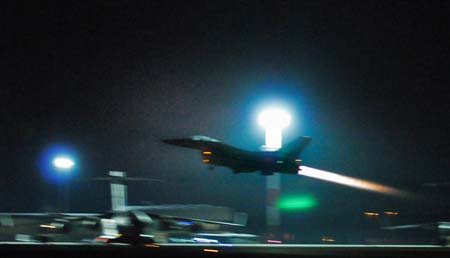 cruise missiles and strike aircraft have significantly impacted Libya’s air defenses just two days into Operation Odyssey Dawn, Vice Adm. Bill Gortney, Joint Staff director, told reporters Sunday. “We judge these strikes to have been very effective in degrading the regime’s air defense capability to include their ability to launch many of their SA-5s—their long range missiles—their SA-3s, and SA-2s,” said Gortney during a Pentagon briefing. UN-sanctioned Odyssey Dawn aims to protect Libyan civilians from bloodshed at the hands of forces loyal to Libyan strongman Muammar Gadhafi. Gortney said Gadhafi forces still possess mobile surface-to-air missiles and shoulder-fired anti-aircraft missiles that could threaten coalition aircraft establishing a no-fly zone. Despite that, Joint Chiefs Chairman Adm. Mike Mullen said Sunday on CNN’s “State of the Union” program that the NFZ already was “effectively in place” over Benghazi. The protective overhead coverage would start to expand west—closer to the Libyan capital of Tripoli, he said. (AFPS report by Jim Garamone) (CNN webpage with Mullen video) (Gortney transcript and briefing slides) (AFPS report by Army Sgt. 1st Class Michael J. Carden) (See also our earlier coverage)
An important U.S. Air Force E-3 Sentry AWACS command and control plane was among the aircraft damaged in a March 27 Iranian missile and drone attack on Prince Sultan Air Base, Saudi Arabia, people familiar with the matter told Air & Space Forces Magazine.