
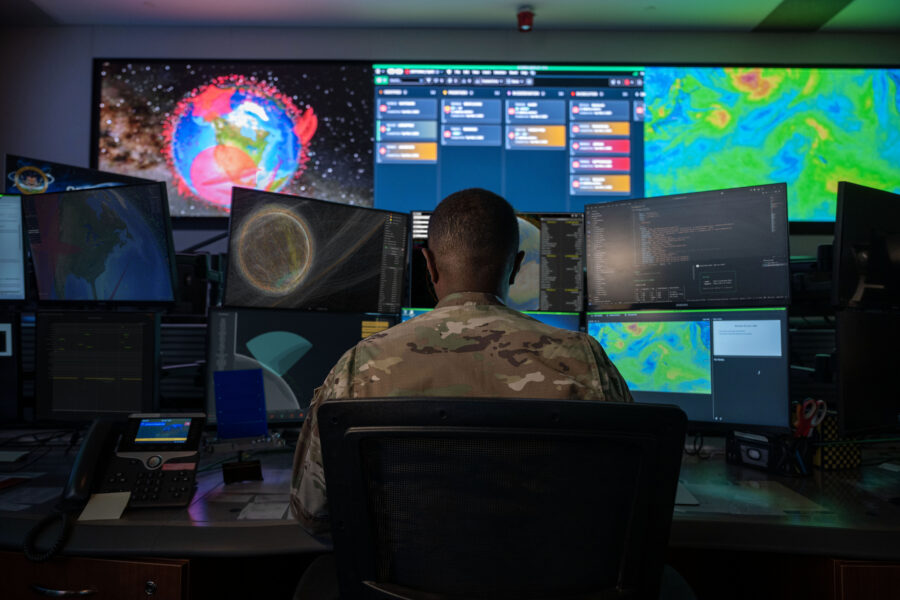
The Space Force is still not ready to decommission a 1980s-era command and control system, despite approving a next-generation upgrade for initial operations last year, according to a new report from the Pentagon’s top weapons tester.
The service signed off on the Advanced Tracking and Launch Analysis System last September, describing it as a “revolutionary leap forward for our warfighters.” But the program still does not meet the requirements necessary to decommission the decades-old system it was meant to replace, the Space Defense Operations Center, according to a March 16 report from the Director of Operational Test & Evaluation.
“ATLAS, as tested, did not contain the minimum viable capability necessary for SPADOC decommissioning,” the director’s office said in its report, which described a test event that occurred last year, prior to ATLAS acceptance. “Testing also revealed deficiencies consistent with system immaturity.”
A Space Force official told Air & Space Forces Magazine that Combat Forces Command, which validates that new systems meet requirements and are ready for operational use, is working with acquirers at Space Systems Command to execute a “deliberate plan” to decommission SPADOC this year. The official did not respond to questions about the program’s current deficiencies or spell out which decommissioning requirements ATLAS has not met.
ATLAS is the first part of a broader modernization effort called Space C2, which aims to improve the Space Force’s ability to analyze, process, and disseminate domain awareness data. While the program will feature other hardware and software upgrades, ATLAS will bring the foundational analysis and data processing capabilities needed to finally allow the service to move away from the outdated SPADOC system.
Space Systems Command is the lead integrator for ATLAS and L3Harris is its primary contractor. The service aimed to field the system in late 2022, but software integration challenges delayed the program by nearly three years. That setback earned the program a spot on former Space Force acquisition executive Frank Calvelli’s list of “troubled programs.”
Prior to ATLAS and the Space C2 program, the Air Force made several attempts to replace SPADOC. It successfully delivered some upgrades but struggled to keep a program on budget or on schedule. One of those attempts was through a program known as the Joint Space Operations Center Mission System, launched in 2009 to to incrementally take the place of SPADOC. By 2018, only one of three increments was fielded and the program was three years behind schedule and $139 million over budget. The service canceled the program that year.
The DOT&E report also sheds light on a Space Force decision last spring to restructure the broader Space C2 program. While the plan had been to deliver ATLAS and its processing capabilities before fielding additional upgrades, the service opted in May to create a separate but parallel program component called Kronos. The DOT&E report notes that while the Space Force and L3Harris work to deliver the remaining ATLAS capabilities, which will be largely focused on space domain awareness, Kronos will provide battlespace awareness tools like theater support and space defense.
The Space Force is using the Pentagon’s software acquisition pathway to field both ATLAS and Kronos, and both programs were approved to use the tool last May. The report doesn’t offer much additional insight into the testing status and delivery schedule for Kronos, but notes that the program is currently developing its test and evaluation strategy.
Air & Space Forces Magazine has previously reported on Kronos and the Space Force’s efforts to rapidly field new software to the system. The service issued a commercial solutions opening last November aimed at helping build a catalog of tools that Kronos can draw from as needs and threats emerge. Lt. Col. Collin Greiser, system program manager for advanced space battle management, said in February he’s also looking to funnel tools matured through the SDA Tools, Applications, and Processing Lab in Colorado Springs, Colo., into Kronos.
“We’re basically lining up the lab and the Kronos program to be able to have that catalog so that when an operator comes to me, because I talk to them all the time, and says, ‘I need an answer to this challenge,’ I can be like, ‘I’ve got one right here. Let’s work on getting that on contract,’” Greiser said.