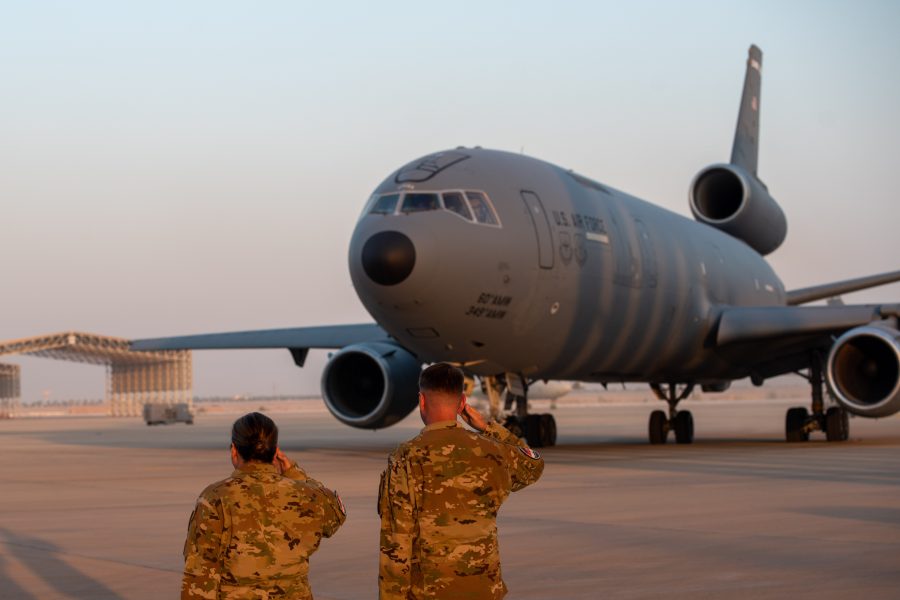
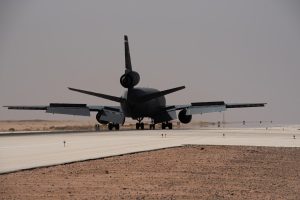
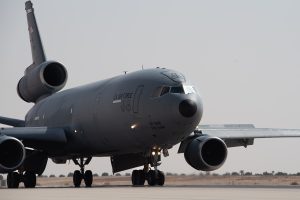
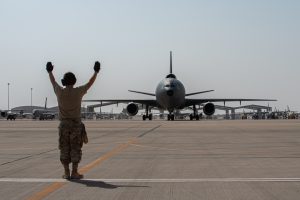
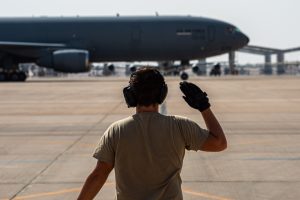
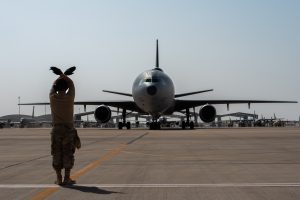
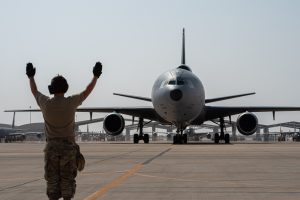
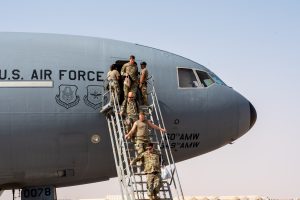
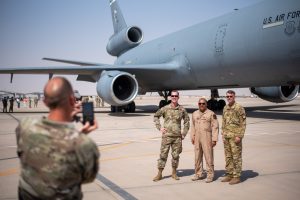
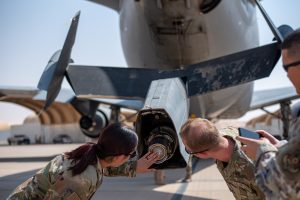
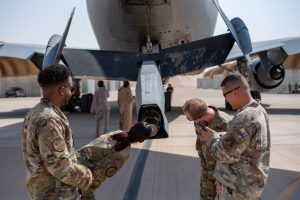
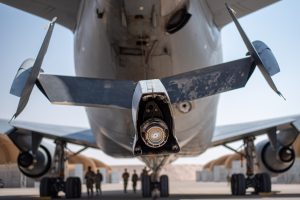
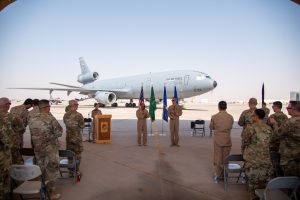
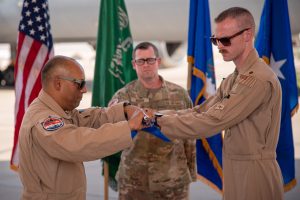
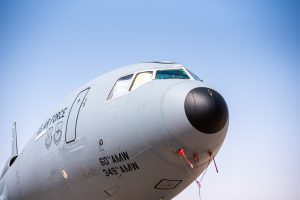
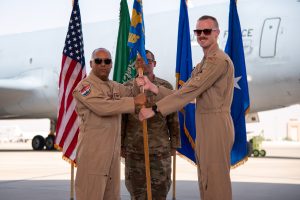
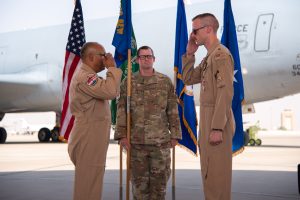
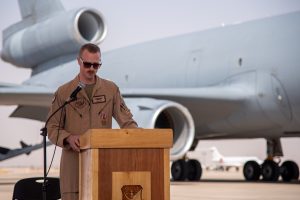
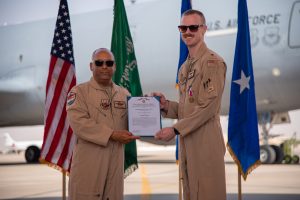
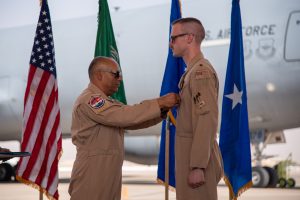
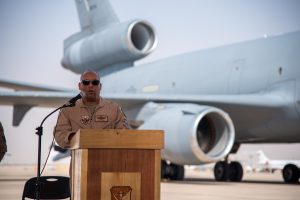
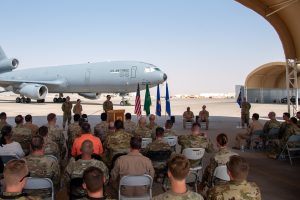
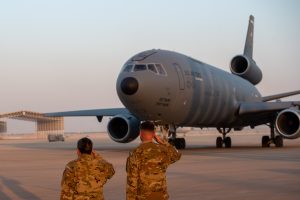
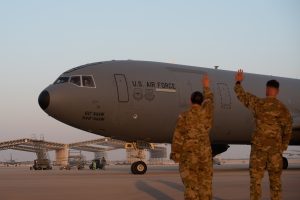
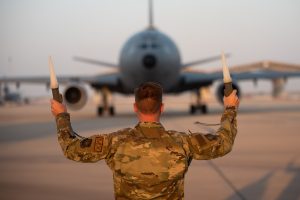
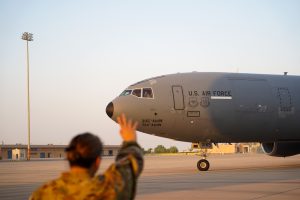
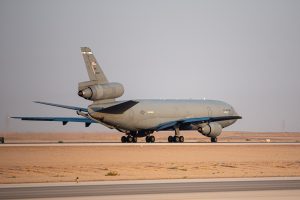
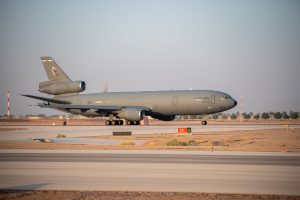
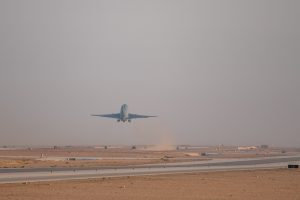
U.S. Airmen salute a KC-10 as it begins to depart after conducting the airframe's final combat deployment at Prince Sultan Air Base (PSAB), Kingdom of Saudi Arabia, Oct. 5, 2023. The departure of the KC-10 at PSAB marked the end of the airframe's over 30 years of service within the U.S. Air Forces Central (AFCENT) Area of Responsibility. By September 2024, the U.S. Air Force's fleet of KC-10s will be decommissioned and gradually replaced by the KC-46 aircraft. (U.S. Air Force photo by Tech. Sgt. Alexander Frank)
Audio of this article is brought to you by the Air & Space Forces Association, honoring and supporting our Airmen, Guardians, and their families. Find out more at afa.org
The KC-10 Extender took another step toward retirement last week, as the venerable tanker finished off its last ever deployment.
A KC-10 from Travis Air Force Base, Calif., conducted the aircraft’s final combat sortie from Prince Sultan Air Base, Saudi Arabia, on Oct. 3. The 908th Expeditionary Air Refueling Squadron, which has flown the KC-10 since 2003, then held a formal deactivation ceremony Oct. 4, and the last KC-10 departed the base Oct. 5.
A spokesperson from Air Mobility Command confirmed to Air & Space Forces Magazine that the KC-10 fleet has no more planned deployments before September 2024, when the last Extender will be retired. It may still be used for off-station training, contingency responses, or coronets—missions in which a group of fighters are assigned one or multiple tankers to fly with them over an ocean to ensure the smaller aircraft have enough fuel.
The KC-10 has been flying in the Middle East for Air Forces Central for more than 30 years, starting with Operation Desert Storm, though the aircraft has not always been permanently stationed there. The airframe moved to PSAB in March 2022, after previously operating from Al Dhafra Air Base, United Arab Emirates. Aircraft and Airmen from Joint Base McGuire-Dix-Lakehurst, N.J., and Travis Air Force Base, Calif., have regularly rotated through the base.
AFCENT still has the KC-135, which flies from Al Udeid Air Base, Qatar, as part of the 379th Expeditionary Air Wing. The AMC spokeswoman told Air & Space Forces Magazine that the command is “confident we can continue to meet Global Combatant Command requirements with our current tanker fleet. Our KC-135 fleet will provide tanker support from Al Udeid and Prince Sultan Air Base.”
Demand for aerial refueling in the region may increase in the coming weeks, as both the Air Force and Navy move additional fighters into the area in response to Hamas’ attack on Israel.
The Extender, referred to by many Airmen as “Big Sexy,” has been in the USAF fleet for 42 years. It can carry more than 356,000 pounds of fuel, almost twice the amount a KC-135 can haul, and nearly 170,000 pounds of cargo, almost matching the capacity of a C-17.
The Air Force is in the midst of modernizing its tanker fleet. In addition to the KC-46, the service has launched a KC-135 Tanker Recapitalization Program and started work on the Next Generation Air-refueling System, or NGAS.
Now comes the work of transitioning to the new KC-46 Pegasus.
“The KC-10 will continue to fly for the next year until all the tails have retired and crews have cross-trained into the KC-46,” said Maj. Joseph Rush, the last commander of the 908th EARS, in a statement. “It’s exciting for our community, as we get to take a lot of the best parts of the KC-10 culture we’ve built over the last 42 years and bring those best practices and experiences to a brand new weapons system.”
Audio of this article is brought to you by the Air & Space Forces Association, honoring and supporting our Airmen, Guardians, and their families. Find out more at afa.org
The Air Force Life Cycle Management Center is moving forward with a program to upgrade a quarter-century-old computing system for some F-16 fighter jets.
The U.S. Navy on Oct. 15 accepted a C-130J-30 Super Hercules plane that it will modify to become the first of its new nuclear command, control, and communications aircraft—a route the Air Force is considering for a similar NC3 mission under congressional direction.
More than 40 years after the original YF-117 operational prototype flew test runs from a Lockheed Martin Skunk Works facility, an F-117 returned for a $1 million refurbishment to look its best when it assumes its place in history alongside other iconic aircraft on permanent exhibit at the National Air…
A U.S. Air Force F-22 pilot controlled a YFQ-44A Fury Collaborative Combat Aircraft this month while both aircraft were in flight, according to an Oct. 16 release, another milestone in the service’s ambitious CCA efforts.
The Marine Corps recently conducted its first-ever “ripple” release of eight Small Diameter Bomb IIs from an F-35B, a key early step in proving out the capability for all F-35 variants.
The Air Force will field operational prototypes for an autonomous drone to replace its MQ-9 Reaper in 2028, Secretary of the Air Force Troy Meink said Oct. 14.
One of the Air Force’s critical B-2 Spirit stealth bombers has returned to Whiteman Air Force Base, Mo., after an extensive course of maintenance to restore its stealth coating and preserve its structural integrity.
BAE Systems has received a contract from Lockheed Martin to install an upgraded Block 4 electronic warfare system into new F-35 Joint Strike Fighters, as well as to retrofit some older jets.
The Air Force has figured out a way for maintainers to inspect what had been a “blind spot” in F-16 engines, after problems in that area led to the catastrophic crashes of two jets in recent years.
✓
Thank You!
Check your inbox to verify your email address and finish setting up your AFA account.
★
Welcome Back!
An account with this email already exists. Please log in to continue.
Subscribe to the Air & Space Forces Daily Report
The latest news from Air & Space Forces Magazine, as well as news from other leading publications, delivered right to your inbox every morning!
We’re sorry, there has been an error. Please review your input or try again later.