
Washington and its allies face a bottomless list of tasks, challenges, and uncertainties in every region of the globe. The geopolitical outlook has seldom been so unsettled.
The good news is that some answers, at least, already are clear. Nearly every day brings headlines further affirming the enduring importance of airpower. If everything else is changing or murky, that, at least, is neither.
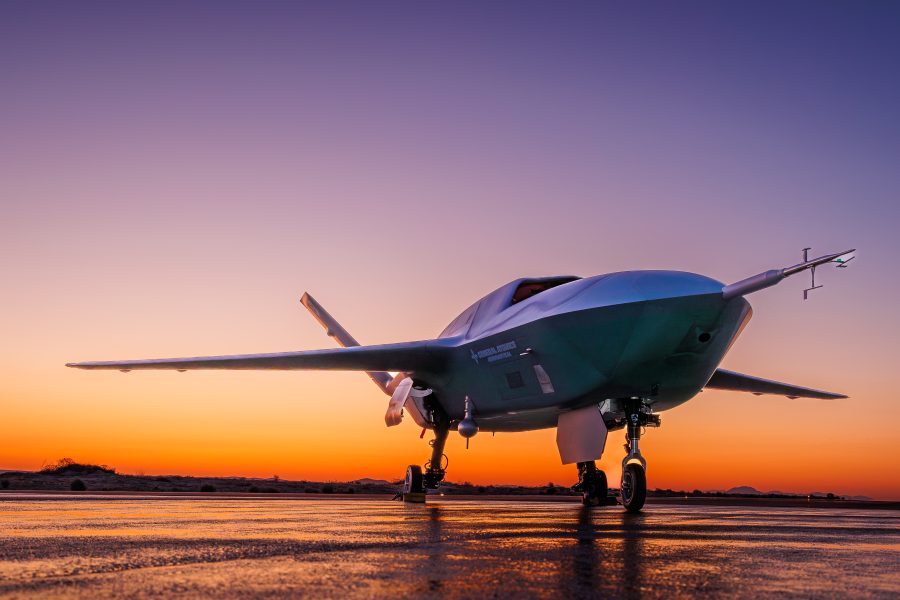
Also clear is the right answer about how to sustain and improve U.S. and allied strength in the air: with Collaborative Combat Aircraft (CCA).
These highly autonomous uncrewed aircraft fly alongside, or well ahead of, crewed combat aircraft to extend sensing, assume risk, and deepen the magazine available to air component commanders against the toughest and most sophisticated adversaries. And the right builder for CCA is just as clear — General Atomics Aeronautical Systems, Inc. (GA-ASI).
GA-ASI has the most powerful CCA platform available anywhere in the world. It is the most mature, best proven, most advanced, and easiest to scale overall for the U.S. Air Force and other users, both in the near and long term. Here’s a look at what brought that about and what it means down the road.
Legacy of Innovation
GA-ASI has been leading the development of uncrewed systems for more than 30 years, from the time of its iconic, world-changing Predator®, and into the future. The company’s fleet of aircraft has recorded more than 9 million flight hours in every area of the globe, much of that in combat, yielding a huge trove of experience that’s available nowhere else.
This matters because only seasoned designers, technicians, software engineers, and other specialists understand what is truly feasible with aircraft systems and autonomy, what isn’t, and what’s just wishful thinking. In an environment with many new entrants and a surplus of hype about what a given new platform can or can’t do, this operational grounding is invaluable.
That’s so not only in terms of getting an aircraft design from the drafting sheet into a flying prototype but also in designing a full-on program that can scale in the way the U.S. Air Force and its partners and allies need it to. No other aerospace and defense company has built as many large uncrewed aircraft as GA-ASI, supports ongoing production at the same levels, and is able to step as quickly and cost effectively into a high-volume CCA program.
The United States and its allies need large numbers of highly capable CCAs starting now, not five years from now. And no other company has the track record, present-day expertise, and future production margin — all working together — that sets up CCAs to succeed quickly, the first time. No one.
Cutting-Edge Aircraft
GA-ASI’s specific aircraft sets the company apart. That story, too, has been years in the making, starting with the first-of-its-class MQ-20 Avenger®, developed as an internal research and development project at the company’s expense. The Avenger is both a highly capable jet-powered uncrewed combat aircraft and an optimal flying testbed for operational autonomy that no one else has.
Avenger and other GA-ASI successes gave the U.S. Air Force Research Laboratory the confidence to commission the XQ-67A Off-Board Sensing Station (OBSS), a flying demonstrator that only needed months to go from design to the air. That, in turn, led to the operational demonstrator known as the YFQ-42A, now in serial production.
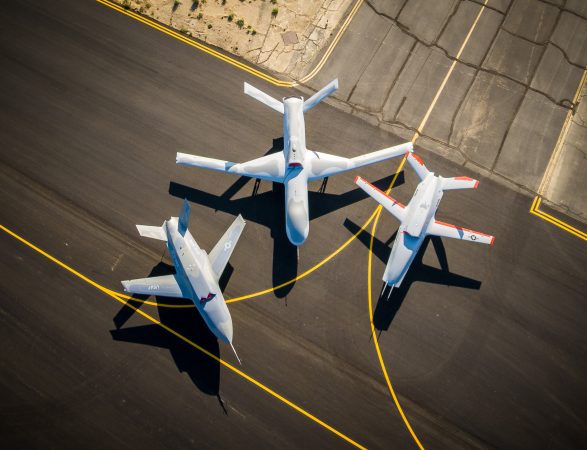
Numerous YFQ-42A aircraft are operational today with more under construction. They make regular flights, pushing the boundaries of what’s possible for semi-autonomous combat aircraft.
YFQ-42A is the Air Force variant of the platform that GA-ASI has codenamed Gambit — a series of highly common yet individually tailored uncrewed jets that deliver exactly what’s needed for the new era of air dominance.
Each Gambit Series aircraft has a common core, not unlike the main chassis used in automobile manufacturing. On the automotive line, for example, one frame that becomes an SUV to serve as a family car could take a turn in the factory and also become a luxury SUV or pickup truck.
So, too, with Gambit: a common central fuselage, avionics, engine, and other components let GA-ASI achieve high-rate serial production at a lower cost than rival platforms, which customers can then tailor to their needs.
Gambit 1 is an unarmed intelligence and surveillance platform; Gambit 2 carries air-to-air weapons; Gambit 3 is a high-fidelity aggressor trainer; Gambit 4 is a low-observable sensing platform; Gambit 5 serves naval users with its tailhook and other adaptations for shipboard operations; and Gambit 6 is optimized as an air-to-ground strike fighter.
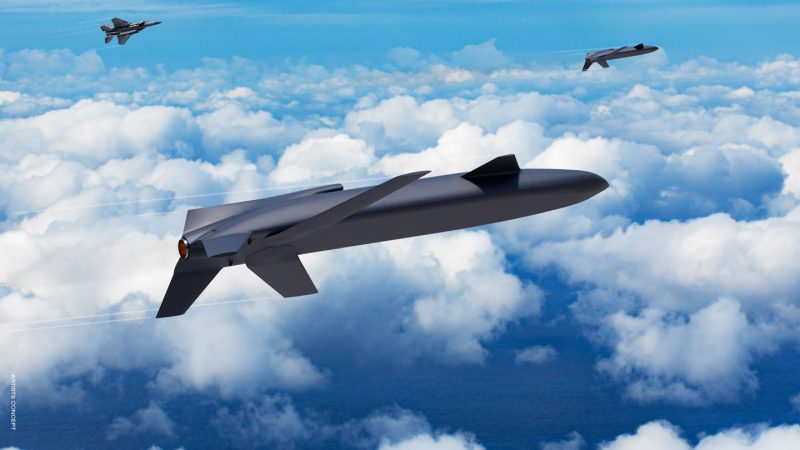
GA-ASI also has other platforms highly relevant to conversations about the current and future shape of CCA programs. Not all of them can be discussed publicly, but one that has been disclosed openly is LongShot, a smaller uncrewed system that carries air-to-air missiles and can be released from a legacy platform such as an F-15EX, a bomber, a cargo aircraft, or others.
LongShot is an effort of the Defense Advanced Research Projects Agency, and although precise details about it are restricted, the aircraft is well along as part of conversations for future increments of CCA.
So as U.S. and international airpower leaders prepare to convene in Denver for this winter’s Warfare Symposium of the Air & Space Forces Association, their agenda is full. The world is teeming with threats, risks, blind corners, and pitfalls. The choice about which company should build CCA, at least, is simple.