
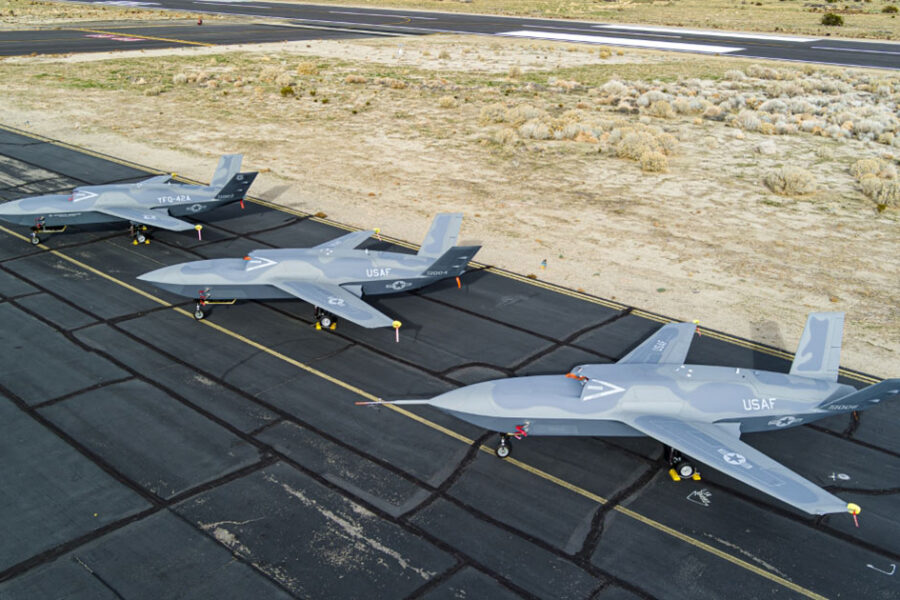
One of General Atomics Aeronautical Systems’ prototype Collaborative Combat Aircraft drones crashed shortly after takeoff April 6, and the company has paused its test flights while it investigates the incident.
The YFQ-42A drone took off from an airport in the California desert owned by General Atomics at about 1 p.m. Pacific time, the company said in a statement. It crashed shortly afterward.
General Atomics said it is evaluating the condition of the crashed CCA and investigating what caused the crash. The company said it is too soon to speculate about the possible root cause.
“Safety is our top priority, for our people and the public,” General Atomics spokesman C. Mark Brinkley said. “In this case, established procedures and safeguards worked as intended, and there were no injuries. We’re going to take a close look at what happened, gather all the data, and allow the investigation to guide us moving forward.”
General Atomics said several production-representative YFQ-42As are in low-rate initial production for the Air Force and fly regularly under the CCA’s operational test and evaluation program.
The company said those test flights will resume “when deemed appropriate.” Brinkley declined to estimate how long flight tests might be on hold.
The Air Force wants to create a fleet of lower-cost, semi-autonomous CCA drones to carry out strike, reconnaissance, electronic warfare, or other missions, sometimes alongside fighters such as the F-35 or F-47.
General Atomics’ YFQ-42A and Anduril Industries’ YFQ-44A are competing for what the Air Force is calling Increment 1 of the CCA program. The service has said it expects to make a production decision for Increment 1 by the end of fiscal 2026, on Sept. 30.
General Atomics achieved first flight with the YFQ-42A in August and started flying it with third-party “mission software” in February. Mission software is artificial intelligence-powered autonomy software that controls the aircraft in flight based on basic instructions from a human