
Lockheed 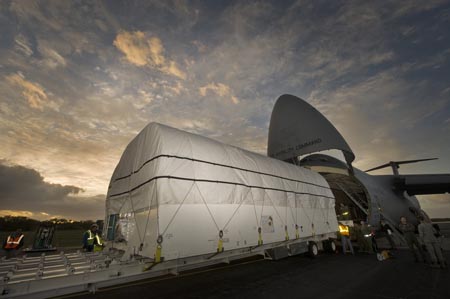 Martin announced Monday that GEO-1, the Air Force’s first Space Based Infrared System geosynchronous orbit satellite, has arrived at Cape Canaveral AFS, Fla., in preparation for its scheduled launch in early May. A United Launch Alliance Atlas V rocket will carry the sophisticated early warning satellite into space. “GEO-1 delivery to Cape Canaveral Air Force Station represents the program’s most significant milestone to date and I am proud of the entire SBIRS team dedicated to delivering this cutting-edge missile warning spacecraft,” said Jeff Smith, Lockheed’s SBIRS program director. “GEO-1 will play a vital role in our national security space architecture, and we look forward to getting this satellite on orbit,” added Col. Roger Teague, who heads the Air Force’s infrared space systems directorate. An Air Force C-5 transport flew the satellite from Sunnyvale, Calif., site of Lockheed’s SBIRS production facility, to Florida. (See also Los Angeles release)
The Air Force has embraced new technical approaches like open mission systems and rapid software updates for cutting-edge aircraft like the B-21 and Collaborative Combat Aircraft. Increasingly, though, the service is also working to apply these to its older, “legacy” aircraft, officials said this week.