
The Pentagon released its new National Defense Strategy late Jan. 23, emphasizing a new commitment to the Western Hemisphere. But while that focus garnered most of the headlines, the strategy’s subtle shifts on China raise questions about how the Trump administration aims to leverage U.S. military power in the Indo-Pacific.
The 2026 National Defense Strategy says the U.S. will practice “realistic diplomacy,” emphasizing “deconfliction and de-escalation” in its relations with China so that the two economic rivals and their trading partners in the Pacific can “enjoy a decent peace.”
“Our goal in doing so is not to dominate China; nor is it to strangle or humiliate them,” the strategy states. “Rather, our goal is simple: to prevent anyone, including China, from being able to dominate us or our allies.”
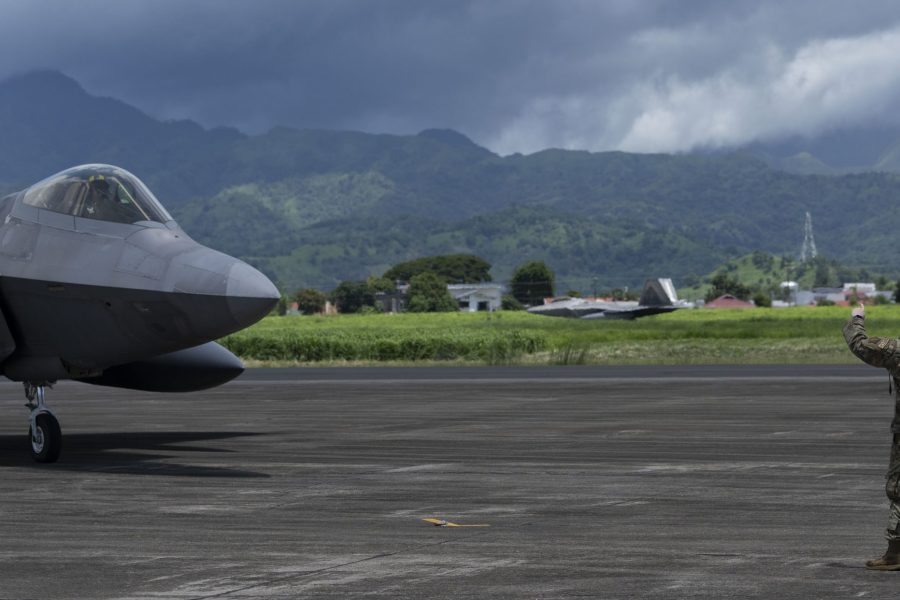
The United States will erect “a strong denial defense” along the First Island Chain, the strategy explains, referring to the Pacific islands that include Japan, Taiwan, portions of the Philippines and Indonesia. It will ensure the U.S. military can conduct “devastating strikes and operations against targets anywhere in the world, including directly from the U.S. homeland.”
But the unclassified version of the strategy released to the public leaves the term “denial defense” undefined.
“We will be strong but not unnecessarily confrontational,” the strategy concludes. “This is how we will help to turn President [Donald] Trump’s vision for peace through strength into reality in the vital Indo-Pacific.”
Pivoting East
Beginning in 2011, successive U.S. administrations have sought to reorient U.S. defense priorities from Europe and the Middle East to a greater focus on China and Asia. President Obama’s administration coined the term “pivot,” but with combat operations in Afghanistan, Iraq, and Syria, never fully made the shift. The first Trump administration’s 2018 NDS leaned further toward China, coining the term “long-term, strategic competition” in which the U.S. and other great powers, including China, were facing off economically, technologically, and militarily. When the Biden administration published its NDS in 2022, it dubbed China “the “overall pacing challenge for U.S. defense planning.”
The 2026 NDS still cites deterring China as a top priority, but defense analysts see a clear rhetorical shift in the new document.
It is an “acknowledgement that we’re probably not going to establish superiority vis-a-vis China,” said Michael O’Hanlon, who directs foreign policy research and the Center for 21st Century Security and Intelligence at Brookings. “We’re not looking to defeat China or change its regime. We’re not looking even to chase the elusive goal of military supremacy against China, because we think that’s not really attainable.”
By giving up the “pacing challenge” language from the 2022 document, a former Air Force official argued, the new document “will be read as a weaker position that the United States is taking in terms of deterrence and resolve.”
Retired Air Force Lt. Gen. David A. Deptula, dean of AFA’s Mitchell Institute for Aerospace Studies, disagreed. “I don’t see any surprises in [the new NDS],” he said. The focus on the Western Hemisphere does not reduce concerns about China, he added: “I think the way people interpret homeland defense is sometimes a miss.”
References to “denial defense” inside the first island chain are critical, Deptula said.
“The best way to achieve homeland defense is by deterring any adversary from shooting at our homeland, and the way you deter them is by ensuring that we have a very well-established power projection force that can crush them if they were to engage in any type of aggression against the United States,” Deptula said.
“If you want to deter China, you make sure they understand that they’re not going to be able to operate from a sanctuary, and that from the first instance of aggression on their part, their homeland is coming under attack,” Deptula added. “We’re not going to let their missiles freely launch against us. That is something that often times people overlook. They think, oh, homeland defense—we need to supply more catcher’s mitts so we can catch those missiles that they shoot at us.”
But defending the homeland has both defensive and offensive components, he said.
Elaine McCusker, a senior fellow at the American Enterprise Institute who was the Pentagon Comptroller during the first Trump administration, said it’s clear that investments in such weapons as the F-47 Next-Generation Air Dominance fighter, the B-21 Raider long-range bomber, and the Golden Dome missile defense shield are all intended to “deter China or compete with China or see China as a pacing challenge.”
Not spelling that out specifically could itself be strategic. How the U.S. develops its strong denial defense against China will be telling. Deptula said the denial defense should include equipping airbases in the first island chain with long-overdue passive defense capabilities like robust reinforced hangars and facilities that can endure an attack.
“You can expect Pacific airpower to be judged by whether it can survive the opening salvo attack,” Deptula said. Hardened aircraft shelters, the ability to disperse forces and use deception to make it more difficult for enemy forces to mount accurate attacks on U.S. bases will be key, he said.
A recent RAND Corp. study recommended that the Air Force invest in rapid runway repair capabilities, blast-resistant shelters, and other passive measures to ensure fighter sorties can launch despite repeated bombardment.
Historically, Deptula said, “These things have not been funded. You’ve got to be able to generate sorties. … We need to be able to sustain our attacks.”
The denial defense portion of the strategy will lean on the Air Force’s agile combat employment concept, pushing it from an “operational concept to an operating system,” Deptula said. ACE envisions small teams of Airmen setting up ad-hoc airfields in remote locations, dispersing air power and making it more difficult to target.
“If you’re going to disperse to a variety of airfields in the Pacific … it needs to be dozens, and those dozens of airfields need to be pre-positioned [with the] weapons, fuel, command and control required to allow them to contribute to a viable campaign,” Deptula said. “But [the Air Force] needs to be funded to do that.”
O’Hanlon said the details not laid out in the NDS will likely show up in budget requests, including “purchases of munitions” and “to increase submarine production” or B-21 bomber production. Former Air Force Global Strike Command boss Gen. Thomas A. Bussiere told the Senate Armed Services Committee in May that he supported expanding the requirement for B-21s from 100 to 145.
O’Hanlon said the real tell will be in classified documents and budgets. “I would look in the classified budgets for things like radiation hardened satellites, anticipating the possibility of nuclear detonations in space, by any great power that was losing a conventional war and wanted to find a place to go in between conventional war and all out nuclear war.”
How the U.S. views its allies in the Pacific is also telling in the new NDS, which suggests South Korea is capable of taking primary responsibility for deterring North Korea.
The Trump administration has “been fairly clear in telegraphing” it plans to adjust its forward posture in Europe and on the Korean peninsula. “That that leads to questions in terms of the U.S. ability to address threats to the homeland before they manifest here at home,” the former Air Force official said. “It’s worrisome in terms of the total deterrence posture and being able to leverage our alliance architecture in the Indo-Pacific.”
Deptula again disagreed, arguing that U.S. forces have been adjusting force posture in South Korea by moving Air Force units from Kunsan Air Base to Osan Air Base.
“Quite frankly, there’s already a transition occurring in the context of how U.S. force posture is on the Korean peninsula,” Deptula said. “The South Koreans themselves have become a very capable force. … I think what you’re going to see is that U.S. Air power is going to still remain a principal element when it comes to operations with the South Koreans, but it is going to need to be supplemented more with longer-range capabilities so that force presentation necessary for deterrence doesn’t dip or slack off.”
Still, the former Air Force official said the new strategy’s use of a “strong denial defense” of the First Island Chain “makes me worry that there are tradeoffs being made for other types of capabilities and concepts that are important for deterring Chinese aggression in theater.”
President Trump’s plan to increase the defense budget topline to $1.5 trillion in fiscal 2027—a potential boost of more than $500 billion above anticipated 2026 spending levels—deserves scrutiny in light of the NDS, the former Air Force official said. “Where is the $1.5 trillion going? How is the U.S. military preparing to demonstrate combat credibility for that deterrence, and how is that driving military modernization? Those questions are left unanswered, at least in the unclassified version of the strategy.”
At the same time, the former official questioned what a greater focus on the Western Hemisphere suggests. Strategically, it could mean focusing on keeping China and its Belt-and-Road initiative out of South and Central America, and reducing China’s influence in critical locations like the Panama Canal.
But it could also mean changing the mix and design of U.S. forces, the former Air Force official suggested. Might more operations in the Western Hemisphere require different capabilities?
“Does that then lead to the need for a high-low mix for the joint force overall?” the official wondered. “And are we back … in the post-911 era, where we know we need to be modernizing the military for contested environments and the demands of a China-like war fight, but the force is being used day-to-day in these low-intensity ways that require a different mix of capabilities?”
The Trump administration has said little about the strategy beyond releasing the document. But the President is gearing up for a State of the Union speech in February, and a budget that should follow no later than March. Those two releases should shed more light on how the administration intends to leverage the strategy to shape its future investments.