
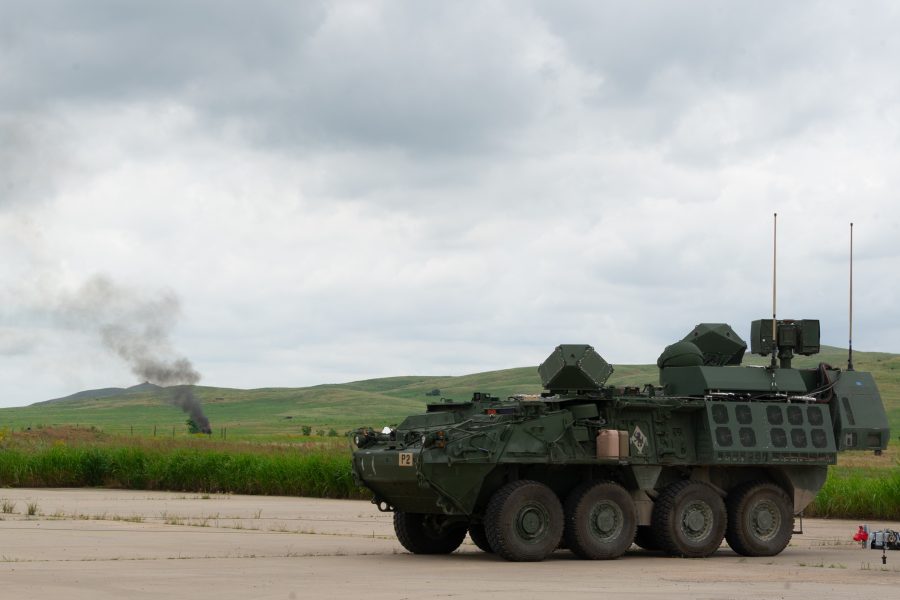
The use of a military counter-drone laser on the southwest border this week—which prompted the Federal Aviation Administration to abruptly close the airspace over El Paso, Texas—will be a “case study” on the complex web of authorities needed to employ such weapons near civilian areas and the consequences of agencies failing to coordinate properly, experts say.
The FAA ordered a 10-day shutdown of all flight traffic over El Paso after U.S. military units operating on the U.S.-Mexico border allowed U.S. Customs and Border Protection agents to use a military laser designed for counter-drone operations, according to a report by the Associated Press confirmed by Air & Space Forces Magazine.
The shutdown wound up lasting only a few hours before airspace was reopened, but the abrupt disruption to air traffic caused confusion and panic and quickly led to lawmakers and public officials demanding answers.
Sen. Jack Reed (R.I.), the senior Democrat on the Senate Armed Services Committee, has called for answers, questioning whether proper safety protocols were followed, and why public communications “appear to have been inconsistent” about what occurred over El Paso.
“The airspace closure over El Paso triggered immediate chaos and confusion and cannot be dismissed as a minor misunderstanding, Reed wrote in a Feb. 11 statement. “The conflicting accounts coming from different parts of the federal government only deepen public concern and raise serious questions about coordination and decision-making.”
U.S. officials have provided few official details about the incident except to say it involved Mexican drug cartels flying drones at the border. Department of Transportation Secretary Sean Duffy said the FAA and the Pentagon “acted swiftly to address a cartel drone incursion,” according to Feb. 11 post on X.
U.S. Northern Commander’s Air Force Gen. Gregory M. Guillot told lawmakers in March 2024 that roughly 1,000 incursions by unmanned aircraft systems occur daily along the U.S.-Mexico border.
The incident is the latest high-profile example of the threats drones—even small, cheap ones—present to the U.S. homeland. While this threat was at the border near the Army’s Fort Bliss, the Air Force has been dealing with the issue since December 2023, when unidentified drone swarms flew unchecked over Joint Base Langley-Eustis, Va., for several days. Other drone incursions followed over air bases in Ohio, Utah, and other locations, compelling the Air Force and its sister services to place a top priority on finding ways to detect, identify, track and, if necessary, bring down these small, inexpensive drones.
Last year, the Pentagon began scrambling to buy low-collateral counter-drone technology that’s safe to use near populated areas, and the Air Force and other services have been investing hundreds of millions on counter-drone weapons.
Experts that have followed the government’s counter-drone effort have warned that using such weapons will require coordination with the FAA and other agencies. Now, those same experts are cringing at the apparent lack of coordination between the Pentagon and FAA.
“In terms of interagency coordination, this is a pretty bad scenario. … There was a failure to communicate between the military, CBP—which was actually using the laser, I understand—and the FAA,” said Henry Ziemer, an associate fellow at the Center for Strategic and International Studies. “This is a case study in how not to do it.”
Zeimer, who has focused on criminal organizations in Latin America, recently wrote a CSIS commentary on the need for a “drone wall” to counter drone usage by drug cartels on the southwest border.
“Criminal organizations are nothing if not adaptable, and so when you see a crackdown in one area, like we’ve seen on sort of land crossings along the border, they adapt,” Zeimer said. “Drones have been super useful in that regard and allow cartels to survey large stretches of the border to try and identify where the border patrol presence is and reorient their routes and figure out where to go next.”
“Most of the incursions don’t cross into U.S. airspace, but they’re hovering right just outside, observing the border patrols … and figuring out where they are,” he added.
A key challenge of countering the drone threat over military installations has been ensuring military commanders have the proper authorities they need to bring down potentially hostile drones if necessary. While details are still emerging, the Feb. 11 incident occurred in the area of Fort Bliss, Texas, which now sits adjacent to a new “National Defense Area” that runs between Bliss and the Southwest border for the purpose of “denying illegal activity along the southern border,” according to a May 2025 NORTHCOM announcement.
The Pentagon’s Joint Inter-Agency Task Force 401, which focuses on finding counter-drone solutions, recently published updated guidance designed to empower “installation commanders to take decisive action to protect military facilities, assets, and personnel within the homeland.”
The new guidance is designed to streamline policies for counter-drone operations under authority of U.S. law governing the protection of certain facilities and assets from drones, by providing commanders with more options such as allowing drone-defense activities to go beyond an installation’s fenceline, according to the document.
Stacie Pettyjohn, director of the Defense Program at the Center for a New American Security, acknowledged the efforts the Pentagon has undertaken to counter drones over the U.S., but she said the incident in El Paso points to a lack of coordination and “shows how ill-prepared the U.S. Government writ large is for the small drone threat.”
“In trying to strip away some of the red tape, they’ve moved fast and haven’t necessarily ensured that the level of coordination that’s needed for some of these weapons to be employed,” Pettyjohn said, adding that she questions the decision to allow CBP members to employ counter-drone laser near a heavily traveled air corridor.
“Can you imagine if a laser hit a civilian airliner?” said Pettyjohn, who recently co-authored a CNAS report on protecting the joint force in the drone age. “It’s not just that the laser would damage an aircraft, it could blind the pilots and just cause an accident.”
It’s still unclear what laser technology was used in the El Paso drone incident. Reuters reported that the Army had deployed AeroVironment Inc’s LOCUST laser counter-drone weapon system near El Paso International Airport. AeroVironment delivered two Joint Light Tactical Vehicle equipped with 20 kilowatt laser systems to the Army in December as part of the second increment of the Army Multi-Purpose High Energy Laser prototyping effort. The Army has conducted numerous tests of its Directed Energy Maneuver-Short Range Air Defense, or DE M-SHORAD, that’s equipped with a 50-kilowatt laser for counter-drone operations.
Air & Space Forces Magazine reached out to the Pentagon and NORTHCOM for this story. NORTHCOM deferred to the Pentagon, which did not respond to the query by press time.
Pettyjohn questions the amount of training CBP members received before being cleared to use such as weapon. Military air defense units have “deep expertise” in the capabilities of counter-drone laser weapons, which has come through years of testing, she said.
“I think this does highlight the risks of transferring advanced weapons system to Customs and Border Pretection agents, who are not trained on it necessarily and might not be as aware of some of the potential risks of employing these,” Pettyjohn said.
Pettyjohn said she thinks it’s appropriate for Pentagon officials to accept risk in trying to change some of the restrictions on using counter-drone systems in the U.S., “but they’re accepting a lot of risk by transferring them to someone else to use.”
“I think this does highlight questions about the appropriate roles of missions between the Department of Homeland Security and the Pentagon for this … and I think there needs to be clear guardrails for employing different types of counter-drone defeat systems in the U.S.,” Pettyjohn said. “Is the laser the appropriate system to be using on the border or for a base? I think there are questions about that and so, and if they are going to employ it, they need to make sure that they do so safely and deconflict with commercial traffic.”