
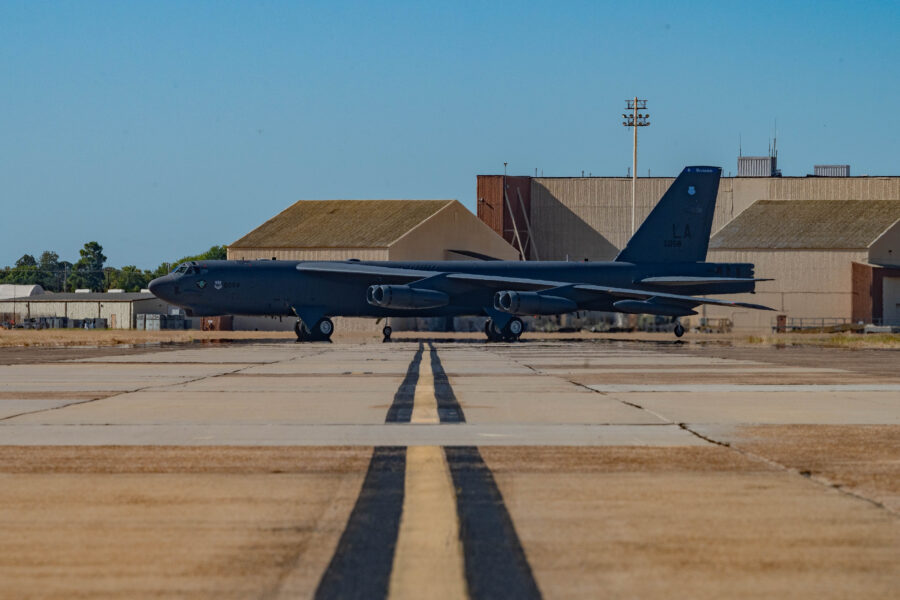
Unauthorized drones flew over Barksdale Air Force Base in Louisiana, home of a B-52 bomber wing, multiple times the week of March 9, Air & Space Forces Magazine has confirmed.
And at the start of U.S. operations against Iran on Feb. 28, small drones seen flying over a “strategic U.S. installation” were defeated, the head of U.S. Northern Command told lawmakers.
Barksdale announced March 9 it was implementing a “shelter-in-place” order after a drone incursion, and a 2nd Bomb Wing spokesperson confirmed March 20 that “multiple unauthorized incursions” have happened since. NORTHCOM boss Gen. Gregory M. Guillot, meanwhile, briefly mentioned a small drone incursion in written testimony to Congress on March 17 and 19.
“In the early hours of Operation Epic Fury last month, a deployed [flyaway kit of counter-UAS technologies] successfully detected and defeated sUAS operating over a strategic U.S. installation,” Guillot wrote, referring to a deployable new equipment package meant to rapidly respond to drone incursions over military bases in the U.S.
It is unclear if the incidents were part of a series of incursions or related in any way.
A NORTHCOM spokesperson declined to specify which base Guillot was referring to but did say there were multiple incursions and personnel used the flyaway kit’s “jamming protocol.”
The 2nd Bomb Wing declined to say if it employed any kinetic or nonkinetic weapons against the drones. Air Force Global Strike Command, which oversees the Air Force’s main strategic installations with bombers and intercontinental ballistic missiles, declined to comment.
In each case, officials cited operational security as the reason for not releasing more details.
Still, the revelations highlight the persistent, vexing threat that small drones present to military installations, more than two years after mysterious drones swarmed Joint Base Langley-Eustis, Va., in December 2023 and brought the issue to the attention of leaders.
Since then, U.S. Air Force bases from Ohio and Utah to the United Kingdom and Germany have reported drone incursions, sometimes forcing officials to pause flightline operations.
The Barksdale incident is the first publicly reported instance of such incursions over a U.S. bomber base, though there was a similar incident at a British base hosting U.S. bombers in 2024. ABC News reported March 20 that officials there noted “waves of 12-15 drones operating over sensitive areas of the installation, including the flight line.” The drones had features and behaved in way suggesting they were not operated by hobbyists, the network reported, including “non-commercial signal characteristics, long-range control links, and resistance to jamming.”
The 2nd Bomb Wing declined to comment on the number of drones or whether they are believed to be flown by hobbyists, saying an investigation is ongoing.
In spoken testimony before two congressional committees, Guillot did not address the specific incident referenced in his written statement. But in response to a question from Sen. Eric Schmitt (R-Mo.) about Whiteman Air Force Base, home to USAF’s B-2 bombers, Guillot said incursions at installations with strategic assets is critical.
“I pay particular attention to Whiteman and other strategic bases—whether submarine, silos, or aircraft,” he said. Guillot said he “works very closely with [Adm. Rich Correll] at Strategic Command to make sure that either through the services or through our own capabilities at NORTHCOM, we are protecting those vital locations from UAS.”
The “flyaway kit” that downed at least some unmanned systems, according to Guillot’s written testimony, is a new capability NORTHCOM started pursuing last spring. The kit, which can be deoloyed to any installation in need within 24 hours, includes a drone detection system, countermeasures such as jammers, lasers, and kinetic systems, and control software. Officials have not specified the technologies included.
The secrecy—about where the kit is deployed and what specific capabilities it includes—is necessary to ensure its effectiveness, the NORTHCOM spokesperson said.
“Connecting the Flyway Kit to a specific base can potentially illuminate that base’s vulnerabilities to an adversary,” the spokesperson said. “Additionally, by confirming a specific Counter-small Unmanned Aircraft System (C-sUAS) platform, we would potentially give an adversary an advantage in circumventing our C-sUAS capabilities at that location.”
NORTHCOM has just one of the kits, right now, with delivery of two more expected in April, Guillot told lawmakers.
Stopping drones is a growing challenge, and most escape before they can be defeated. “About a quarter of the ones that we detect, we’re able to defeat,” Guillot said. That represents an improvement since last year, when “almost every one that was detected was not defeated.”
In addition to NORTHCOM’s Flyaway Kits, the Air Force is working on improvements to its own counter-drone defenses at a new Point Defense Battle Lab at Grand Forks Air Force Base, N.D. The lab will develop tactics, techniques, and procedures to use with commercially desigend counter-drone technologies.