
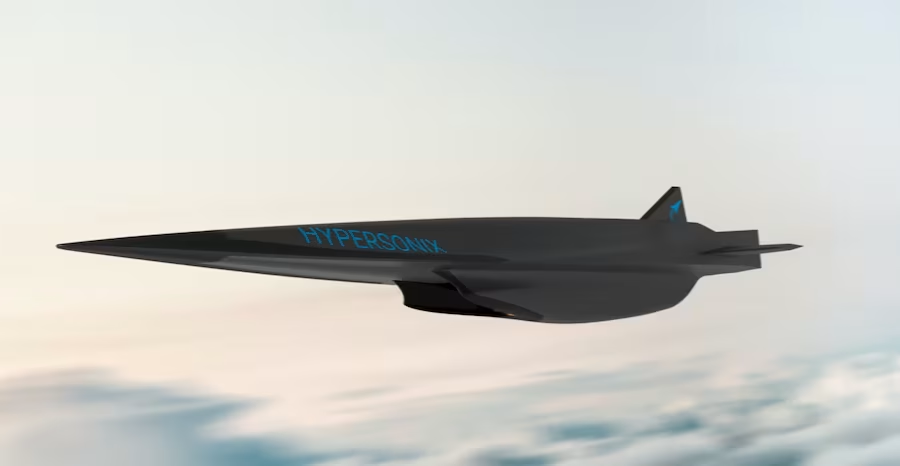
The Defense Innovation Unit is gearing up for the first flight of its commercially developed hypersonic testbed as soon as the end of February—part of a larger project to quickly increase the cadence of the Pentagon’s hypersonic flight testing and field advanced, high-speed systems and components at scale.
As part of DIU’s Hypersonic and High-Cadence Airborne Testing Capabilities program, or HyCAT, the mission will pair Rocket Lab’s HASTE launcher with a high-speed testbed called DART AE, built by Australian firm Hypersonix. The scramjet-powered DART will deploy in a suborbital hypersonic environment with the goal of collecting key propulsion, aerothermal, and vehicle control data to support future Defense Department testing. The mission will lift off from Wallops Island in Virginia “no earlier than late February,” Rocket Lab announced earlier this month.
The flight will be HyCAT’s second since DIU launched the program in 2022. The first took place last November in partnership with the Missile Defense Agency. During that flight, Rocket Lab’s HASTE flew multiple unnamed payloads, including one developed by Johns Hopkins University’s Applied Physics Laboratory.
HyCAT was established amid a broader push within DOD to actually field the hypersonic weapons capabilities the military services have spent years developing, like the Air Force’s Air-Launched Rapid Response Weapon and the Army’s Long-Range Hypersonic Weapon. Because the cost, availability, and fidelity of testing infrastructure is often a limiting factor in getting a complex capability over the finish line, the department has in recent years homed in on creating more hypersonic flight test opportunities and eventually increasing its flight test cadence to one test per week. Programs like HyCAT and the Test Resource Management Center’s Multi-Service Advanced Hypersonics Testbed are making some progress, but the Pentagon has yet to reach that goal.
Under the Trump administration, DOD has maintained its focus on hypersonic development and testing. Pentagon Chief Technology Officer Emil Michael recently identified “scaled hypersonics” as one of the department’s six critical technology imperatives. HyCAT’s work to foster and demonstrate the utility of commercial technology for complex DOD challenges like hypersonics is in line with direction from Pentagon leaders like Defense Secretary Pete Hegseth, who has called for the acquisition community to prioritize speed and scale and leverage private sector expertise—and capital—where possible.
Lt. Col. Nicholas Estep, director of DIU’s emerging technology portfolio, told Air & Space Forces Magazine the second HyCAT mission is unique in that it features a nontraditional commercial aerospace firm, Hypersonix, demonstrating air-breathing hypersonic propulsion—a complex engineering challenge that doesn’t currently have a commercial market.
Estep declined to discuss the flight’s performance objectives due to sensitivities, and wouldn’t say whether DART is expected to reach hypersonic speeds, though he noted that the intent is for the data collected to “show relevance” to DOD’s hypersonic community.
“This is just a very novel situation,” he said. “We’re pairing commercial companies, we’re leveraging as much commercial infrastructure as possible, and using a commercial liquid booster for this type of payload is unique. There’s lots of new things we’re intending to be able to demonstrate with this.”
Rocket Lab’s HASTE is a suborbital version of its workhorse Electron rocket, which launches small satellites for national security and commercial customers. The company modified the vehicle to support high-speed test missions in 2022 in response to the Pentagon’s hypersonics push and HASTE flew its first mission for MACH-TB in June of 2023.
Meanwhile, the upcoming HyCAT mission will be the first flight for Hypersonix and its DART AE. DART is powered by the company’s SPARTAN scramjet engine and is envisioned to eventually serve as a reusable hypersonic vehicle.
“This flight reflects years of engineering work and the confidence of our partners at DIU, NASA, and Rocket Lab,” Hypersonix CEO Matt Hill said in a statement. “It brings us a meaningful step closer to operational hypersonic systems that are reusable, sustainable, and strategically relevant for Australia and for our allies.”
While HyCAT’s early missions have focused on launch systems and test vehicles, Estep said the project is also working with companies—which he declined to name—to prototype and test targets, subsystems, and advanced materials.
“We’re going to do the near-term rapid prototyping to instill utility of those things so that they can then process to these other areas—whehter they’re specific targets that are leveraged by the community or maybe they’ll be leveraged as a subset of some testbed infrastructure for future flight validation,” he said. “If it’s a subscale payload or a subsystem that we can validate through flight, that can then transition to more traditional programs of record. All of those pathways exist and we collaborate with all of them.”