
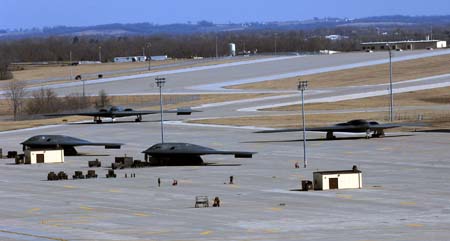
 With the US on the cusp of going down to about 1,500 deployed nuclear warheads and the nuclear-capable bomber force’s future in doubt, the nation is best served by shifting to a dyad of submarine-launched ballistic missiles and ICBMs, argue three senior members of the Northrop Grumman Analysis Center in a new Mitchell Paper issued Wednesday by AFA’s Mitchell Institute for Airpower Studies. “A dyad of modernized ICBMs and SLBMs will provide for strategic nuclear deterrence and stability in the years ahead, while allowing and encouraging needed investments in long-range conventional strike,” write Christopher Bowie, Dana Johnson, and Robert Haffa in Triad, Dyad, Monad? Shaping the US Nuclear Force for the Future. They recommend a policy that: maintains the ICBMs and SLBMs, keeps a niche nuclear capability with B-2 bombers, and phases out B-52 bombers from their nuclear role as ALCM cruise missiles are retired from service.
An important U.S. Air Force E-3 Sentry AWACS command and control plane was among the aircraft damaged in a March 27 Iranian missile and drone attack on Prince Sultan Air Base, Saudi Arabia, people familiar with the matter told Air & Space Forces Magazine.