
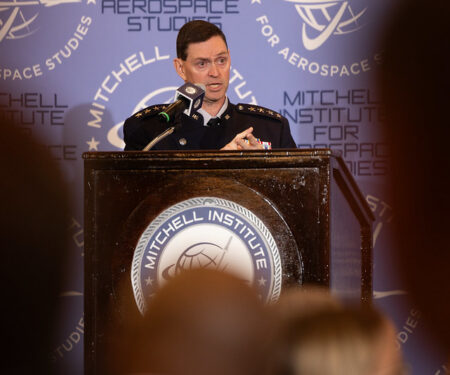
Saltzman: Space Force Guardians ‘Integrated Throughout’ Iran Ops
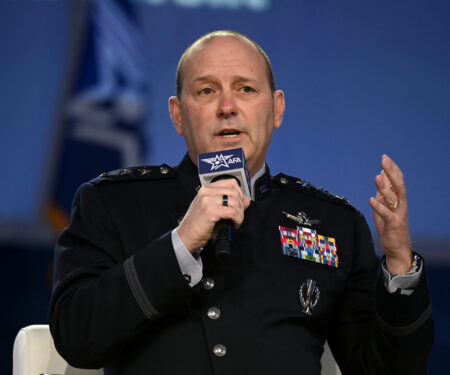
Space Force capabilities are deployed “inside the threat zone” and deeply integrated into joint operations against Iran, Chief of Space Operations Gen. Chance Saltzman said April 1.
President Donald Trump said U.S. forces will “finish the job” in Iran soon as “core strategic objectives are nearing completion,” offering a full-throated defense of the war April 1 in his first national address since the conflict began more than a month ago.
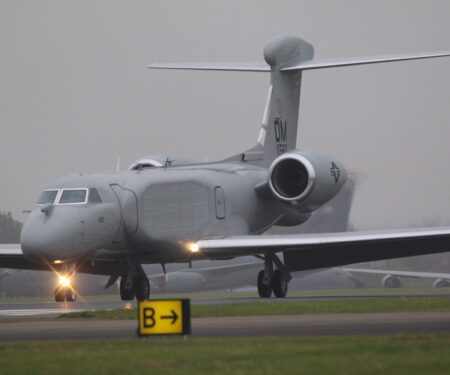
Since Feb. 28, Iran has struck radar systems, satellite communications and mission-critical aircraft at at least seven U.S. bases across Bahrain, Qatar, Kuwait, Saudi Arabia and the UAE. The attacks have focused on infrastructure that U.S. forces depend on to detect threats, refuel aircraft, and direct air operations in the region.
Before the Iran conflict, a looming threat of conflict with China had spurred Air Force officials in particular to adopt a new approach to disperse deployed forces, a strategy dubbed Agile Combat Employment in the service’s doctrine. Pentagon officials have emphasized the war in Ukraine has also provided valuable insight, such as the perils aircraft face on the ground following Ukraine’s successful “Spider Web” operation last year.
The Pentagon and Boeing have signed off on a framework agreement to triple seeker production for the PAC-3 interceptor over the next seven years, they announced April 1. The deal comes as the Defense Department pushes to replenish its munitions stockpiles and follows more than half a dozen other multiyear weapons agreements announced since the start of the year.
The powerful, low-cost attack drone the U.S. is using in its war with Iran doesn’t come from one of America’s more than 400 venture-backed drone startups. And it isn’t the product of Silicon Valley ingenuity.
The Pentagon is eager to incorporate AI “agents”—software that can autonomously execute complex tasks like customer service, scheduling, or code writing—into more of what soldiers and defense civilians do. But a growing body of research shows that agents built from well-known large language models exhibit unpredictable and dangerous behaviors even in benign settings. Edgerunner AI, a veteran-founded startup, built a different kind of agent tool for the military, one trained by former operators and experts on actual military tasks and in real combat settings.
The Army’s 101st Airborne Division incorporated Northrop Grumman’s new Lumberjack one-way attack drone into a recent training exercise, testing the platform’s autonomous target detection and strike capabilities.
The U.S. military has given the president a plan to seize nearly 1,000 pounds of highly enriched uranium in Iran that would involve flying in excavation equipment and building a runway for cargo planes to take the radioactive material out, according to two people familiar with the matter.
Troops deployed for Operation Epic Fury can receive combat pay of up to $225 each month, a number that varies on their location and proximity to direct hostile fire, defense officials confirmed to Task & Purpose.
The U.S. Air Force Materiel Command’s secretive NT-43A has been spotted in Florida, taking part in the preparations for the launch of NASA’s long-delayed Artemis II lunar space mission. This highly unique and notoriously shy plane, a converted militarized Boeing 737-200 variant (T-43) also commonly known by the callsign RAT55, has long been used as an airborne signature measurement platform to support work related to stealthy military aircraft. However, during a high-stakes space launch, its two huge radar arrays, modular electro-optical and infrared sensors, and other capabilities would likely be well-suited to gathering telemetry and other valuable data.